On this page
- How to use the Fence Calculator
- How the Fence Calculator calculates your result
- How many posts does a fence line need?
- How many rails should each fence section have?
- How many pickets or boards will cover the fence?
- How much concrete goes into each fence post hole?
- How does fence style change the material list?
- How much extra lumber and gate hardware should you plan for?
- What will the materials on your list cost to buy?
- What should you check on site before ordering fence materials?
- Frequently asked questions
How Many Posts, Rails, Pickets and Concrete Bags Does Your Fence Need?
A fence needs posts equal to its length divided by the post spacing plus one (100 ft at 8-ft spacing takes 14 posts), rails equal to rails per section times sections, pickets equal to the run in inches divided by picket width plus gap, and about 1.3 80-lb bags of concrete per line post.
Every post space is one section, usually 6 feet to 8 feet wide, or 2 meters to 5 meters on metric plans. The fence height sets the length of the posts, with about 1/3 buried in concrete. Rails per section times sections gives the total number of rails, and two rails is the most common setup for horizontal rails. Picket width plus the spacing between the pickets sets the total number of pickets. You can compare similar projects in our Fence Calculators & Cost Guides collection.
The decision often comes in summer as an outdoor DIY project. People want privacy from prying eyes on the street, protection and a safe area for children and pets away from stray animals, a windbreaker for a garden, some noise isolation from noise pollution, decoration, or simply tradition and the American Dream. Each motive points to a fence style, and the style drives the count.
How to use the Fence Calculator
The Fence Calculator turns your total fence run, post layout, style and post hole into a full material list with an order quantity for every item.
- Fence length: the full run, gates included.
- Spacing and height: on-center spacing and height.
- Style: privacy, shadowbox, picket, panel or rail, with board width and gap.
- Rails and gates: rails per section, gate count and width.
- Hole and waste: hole diameter, depth, gravel, post width, waste.
Walk gates are 3-4 feet wide for people and equipment; drive gates, often double-swing, run 10-16 feet wide so vehicles fit. Each gate gets two gate posts in 12-inch holes, plus hinges, latches and locks, so budget $30-100 of hardware per gate.
Hole defaults are a 10-inch hole, 24 inches deep, on a 4-inch gravel base, at 0.60 cu ft per 80-lb bag. For round posts, enter the post diameter as the width and add a bag; deepen the post depth on tall fences.
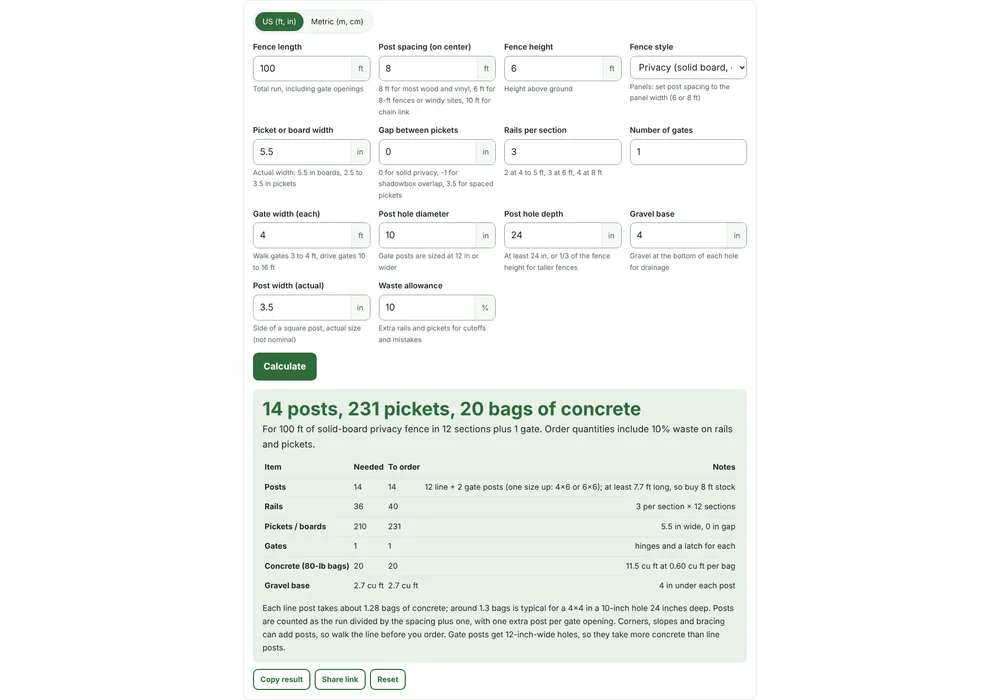
Worked example (defaults): 100 ft, 8 ft spacing, 6 ft high, 5.5 in boards with no gap, 3 rails, one 4 ft gate, 10 in holes 24 in deep on 4 in gravel, 3.5 in posts, 10% waste.
Result: 14 posts (2 of them gate posts), 12 sections, 40 rails and 231 boards to order, 20 bags of concrete and 8 ft posts. Your fence length and picket dimensions decide what to buy to build a fence, so use the tool as a fence estimator for fencing materials.
How the Fence Calculator calculates your result
The Fence Calculator applies the straight-run rule: the number of posts equals the run (fence length) over the post spacing, plus 1, rounded up, then derives rails, pickets and concrete with plain geometry.
| Output | Formula used by the tool |
|---|---|
| Posts | (run − gate openings) ÷ spacing, round up, + 1, + 1 per gate |
| Sections | posts − 1 − gates |
| Rails | rails per section × sections, plus waste |
| Pickets | run in inches ÷ (picket width + picket spacing), round up, plus waste |
| Concrete | per post: (π/4 × diameter² − post width²) × (depth − gravel); total ÷ 1,728 ÷ 0.60, bags rounded up |
The plus-one is the starting post; the last post closes the line. Counts never keep decimals. On metric, 8 meters at 2 meters gives five posts and four sections. Multiply rails by the number of sections for the number of rails; divide inches by width plus gap for the number of pickets.
The published rule is concrete volume = hole volume − buried post volume. It models a cuboid post in a rectangular hole three times its width and post thickness, or a cylindrical post with π at 3.1416. The tool keeps the subtraction with a round hole of your diameter, reported in cubic feet rather than cubic yards.
One reference sets post length at 1.5 times fence height; another buries 1/3 of the height. The tool adds height to concrete depth: 7.7 ft, sold as 8 ft. Posts, rails, pickets or panels are listed apart from gates, hardware and lumber, with one spacing throughout.
How many posts does a fence line need?
A fence line needs one post per spacing length plus one, so 100 ft at an 8 feet spacing gives 12.5 + 1, rounded up to 14 posts with 13 sections.
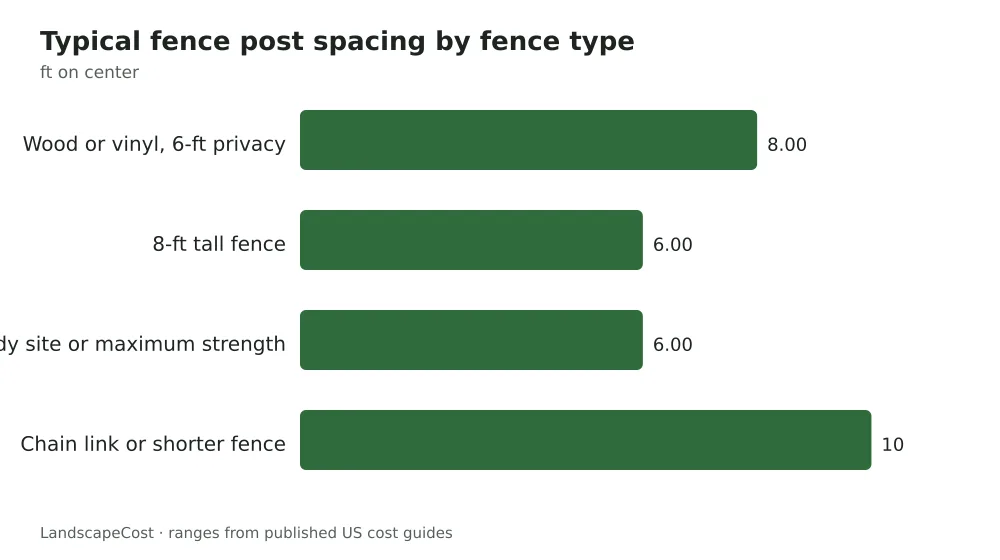
The standard spacing for wood and vinyl is 8 feet on center; metal and wire fences run between 8 and 25 feet. A 6-foot spacing gives maximum strength in windy areas, and chain link usually takes a 10-foot spacing (about 3 m). Metric guides put standard spacing at 2-3 meters. Tighter bays add stability; longer ones suit general purpose lines. Design and privacy needs usually settle spacing before price does.
To get the number of posts needed, divide the run by the post spacing, add one, then add one per gate. Those gate posts are additional posts that should be larger and stronger than line posts: a 4x6, not a 4×4.
A vinyl fence is panels and posts with no pickets; aluminum and wrought iron work the same. Match spacing to 6 ft panels or 8 ft panels, and take brackets and caps from the manufacturer's kit. On board fences the style sets rails: 13 sections × 3 = 39 total rails.
How many rails should each fence section have?
Each fence section needs at least two rails, plus one more as the fence gets taller: three for a 6-ft fence and four for an 8-ft fence.
The standard height is 6 feet for a privacy fence and 4 feet for decorative fences and pet fences; anything from 4 feet to 5 ft gets by on two rails. Privacy fences can reach 12′, and 8-foot tall fences need closer spacing of posts as well as extra rails. Height also sets post length, and walk gates reuse the rail count in their frames.
Run the textbook case. 100 feet ÷ 8 ft = 12.5; add one for 13.5; round up to 14 posts and 13 sections. Three rails each gives 39 rails. At 8 feet tall, four rails per section moves the same run to 52.
Rails are dimensional lumber: posts are 4×4, rails 2×4, and gate posts step up to 6×6. A rail fence such as split-rail has no vertical boards; three rails between posts are the whole fence, used for boundaries or livestock.
How many pickets or boards will cover the fence?
The picket count equals the fenced length in inches divided by picket width plus gap, rounded up, so a solid face of 5.5″ boards set edge to edge uses about 2.18 boards per foot.
Gap settings move the count fast. A solid board privacy fence uses a gap of 0 and at least 3 rails. A shadowbox or board-on-board face uses the same width at -1 inch, because boards sit on both sides of the rails, which takes more lumber. A stockade face packs 2.5″ pickets tight, and a spaced picket wood picket fence uses 3.5″ pickets with matching picket spacing on 2 rails.
Check a big case by hand. At 4 rails across 143 sections, a 1,000 ft run needs 572 rails. With 5-inch-wide pickets and 1 inch of spacing, the run is 12,000 inches, and 12,000 ÷ 6 = 2,000 pickets. Real runs rarely divide evenly, so the tool rounds up.
Then add a waste percentage for split boards and end cuts. Returning a few unused boards is easier than stopping work for a short supply.
How much concrete goes into each fence post hole?
A 4×4 line post in a 10-inch hole, 24 inches deep over gravel, takes about 1.3 80-lb bags of concrete, and gate posts in wider holes take more.
Depth comes first. Set at least 1/3 of the height of the fence below grade, in the ground: a 6′ high fence uses 8′ long posts with 2 feet buried. Sizing post length at 1.5 times height gives deeper post depth on taller fences. A 24 inches hole suits most 6-ft lines, with 4 inches of gravel base for drainage before the concrete goes in.
The same method scales up. A 1,000 feet run at 7 feet spacing and 10 feet tall gives 143.85, so 144 posts and 143 sections, each post 15 ft (180 inches) with 60 inches buried. For 5 × 4 in cuboid posts, eight × width × thickness × depth is 9,600 in³ per post; 144 posts need 1,382,400 in³, or 29.63 cubic yards.
That is a truck order. For a backyard line, the bag count matters more: the default 100-ft example needs 20 bags of 80-lb mix.
How does fence style change the material list?
Fence style decides which items appear on the list: board styles need posts, rails and pickets; panel styles need posts and panels; rail styles need posts and rails only.
| Style | What gets counted | Rails per section | Board width and gap |
|---|---|---|---|
| Solid board privacy | posts, rails, boards | 3 or more | 5.5 in, no gap |
| Shadowbox | posts, rails, boards | 3 or more | 5.5 in, 1 in overlap |
| Stockade (enter as Privacy, 2.5 in) | posts, rails, pickets | 2 or 3 | 2.5 in, no gap |
| Spaced picket | posts, rails, pickets | 2 | 3.5 in, 3.5 in gap |
| Rail fence | posts, rails | 3 | none |
The horizontal boards sit between the posts: rails per section × number of sections = total rails, at least two per board fence, three on most privacy fences. Fence boards or pickets hang on them.
For pickets or boards, width decides: a privacy fence uses flat 5.5″ boards; decorative fences use thinner 2.5″ to 3.5″ pickets, and a spaced 3.5-inch layout averages 1.71 pickets per foot. Wider gaps need fewer pieces, tighter gaps more, so measure the gaps first. Dog-ear tops and side-by-side boards count like flat ones; a split-rail fence looks rustic and has none.
How much extra lumber and gate hardware should you plan for?
Plan on 10% extra lumber and pickets, plus a full hardware set for every gate, and confirm gate swing and latch clearance before you order.
The 10% extra is the usual waste percentage, and the tool's default. A fencing calculator gives precise calculations, but boards still split. For a DIY project or a professional crew, a pre-calculated material list keeps waste and leftovers small. Measure twice and check dimensions first.
Price the list where you buy. A home center and a lumberyard quote differently, and local material costs shift with the market. Ask for 8-ft 4×4s, 2×4s, pickets by count, exterior screws and post-setting concrete, then add delivery for the total estimated cost.
Gates need their own check. Walk the gate swing so the leaf clears the ground, and leave latch clearance at the latch post. Each gate adds posts, rails, pickets, concrete and hardware, and gates hung on the wrong side are a common return trip. Ask a local yard whether delivery is included in the quote.
What will the materials on your list cost to buy?
Fence materials are priced locally, so the most reliable cost estimate comes from pricing your exact counts at a nearby yard, with wood the cheapest board option and vinyl or metal costing more.
Asking how much does a fence cost starts with material. Pressure-treated wood is the budget wood; cedar and redwood cost more but resist decay. Vinyl and metal cost more per foot, and chain-link is the low-cost wire option. Readymade panels save labor but fix one panel width, and a wood privacy fence sits mid-range.
For scale, a wood privacy fence runs $15-30 per linear foot installed. 100 feet means 14 posts and 13 sections before gates and corners, plus concrete and hardware. Professional installation adds $5-15 per foot of labor and takes about 1 day; a DIY build takes 2-4 days, so the material share is what you control.
For a full price breakdown, use the separate Fence Cost Calculator. This page stays on quantities, because two suppliers pricing the same 14 posts and 39 rails can be compared line by line.
What should you check on site before ordering fence materials?
Before ordering fence materials, measure every run on site, mark corners and gates, and confirm permit and code rules, because the yard changes the count more than the formula does.
A measuring wheel costs under $30 at most hardware stores and is more accurate than a tape. Measure the linear footage of all straight sections, note where the line changes direction, and count corners.
- Layout: mark gates apart and flag terrain changes; slopes and bracing add posts, more so with 3 or more corners.
- Rules: many municipalities require a permit over 6 feet or in front yards, and local building codes add height limits and setback requirements. An unpermitted fence risks fines.
- Neighbors: check property lines and HOA rules, and talk to neighbors early.
- Utilities: call 811 for free utility locating.
Purpose shapes the order too. A security fence wants height and few gaps, while decor fences may add stone pillars. Stage the lumber, nails or screws, and tools to mix and pour concrete before work starts.
Frequently asked questions
What are the main reasons to put a fence around a house?
The main reasons to put a fence around a house are privacy, protection and decoration, and the reason you pick sets the height and style you should count materials for.
Privacy calls for a 6-ft solid face, and protection means keeping kids in and stray animals out. Decoration points toward a lower picket line, and the classic white picket fence is still part of the American Dream for plenty of buyers.
Some reasons are practical. A tight board fence works as a windbreaker, and it gives some noise isolation from a busy road, though not as much as a masonry wall would. Others are pure tradition. Whichever reason leads, the count follows the style: a 4-ft picket fence needs two rails per section and spaced pickets, while a privacy fence needs three rails and solid boards.
Rank those reasons before measuring, because a fence that tries to do everything usually ends up overbuilt. A front-yard picket line and a rear privacy run can share posts at the corner and still be ordered as two separate lists, each with its own rail count and picket spacing.
How far apart should fence posts be?
Fence posts should be 8 feet apart on most wood and vinyl fences, 6 feet apart for tall or wind-exposed fences, and about 10 feet apart for chain link.
8 feet on center is the norm for wood and vinyl, and some materials stretch to 25 feet. A 6-foot spacing gives maximum strength and is required on 8-foot tall fences, while 6-foot privacy fences stay at 8 ft. Use the tighter spacing in windy areas, where wind exposure loads a solid face. A 10-foot spacing suits chain link and shorter fences.
Spacing that is too wide leads to sagging rails, especially with heavy materials like wet boards. A chain link fence has its own parts list: top rail pipe cut to 10.5 ft, fabric sold as 50 ft rolls, a bottom tension wire, and ties along every line post. Its terminal posts at ends, corners and gates are heavier than line posts.
On a slope, step the spacing down rather than up. Shorter bays follow the grade with less cutting, and the tool handles any spacing you enter.
How long should fence posts be?
Fence posts should be the fence height plus the buried depth, so a 6-ft fence with 2 ft in the ground uses 8-ft posts.
The post length rule is simple: a 6′ high fence takes 8′ long posts set 2′ in the ground. The tool works the same way and adds height to the concrete depth, then rounds up to a whole-foot stock length. Local frost depth can push embedment deeper, because a post that sits above the frost line can heave in winter.
Setting posts in concrete gives the most stability, and corner posts and gate posts benefit most. A line post typically takes 1.3 80-lb bags in a 10-inch hole. The gravel underneath is there for drainage: water pooling at the base of a post leads to rotting, so the gravel layer is worth the extra hour.
Water pooling at the base is what rots a post, so the gravel layer matters as much as the concrete. Taller fences need proportionally more depth, and the tool flags any hole shallower than 1/3 of the fence height.
What is the standard fence height?
The standard fence height is 6 feet for a privacy fence and 4 feet for decorative and pet fences, with privacy fences sometimes built up to 12 feet.
A fence 6 feet tall is the common privacy build, and most municipalities want a permit above that height. Some privacy fences go to 12′, so check the permit first. A shorter fence in the 4 to 5 ft range suits front yards, pets and decorative picket lines.
Height sets the rail count. One guide uses one rail for every 24″ of height with a minimum of two: 2 rails for a short fence, 3 rails for 6 ft, and 6 rails for a 12-ft fence. Another uses four rails at 8 feet. The tool lets you set any rail count from two to eight.
Height also changes the posts. A taller face catches more wind, so 8-ft fences pair with 6-ft post spacing and deeper holes. Pick the height first, then the rails, then the spacing, and the material list falls into place.
What is a linear foot of fence?
A linear foot of fence is one foot of fence length measured along the ground, regardless of how tall the fence is.
Linear feet describe total length only; the fence height is a separate number. A 100-ft fence run is 100 linear feet whether the boards stand 4 ft or 6 feet tall. Picket math converts that length to inches (multiply the feet by 12) so it can be divided by board width plus gap.
The difference matters when you switch to square footage. To find the area of the fence face, multiply the fence length in linear feet by the height in feet. A 100 feet run at 6 ft tall is 600 square feet of fence face. Stain and paint are sold by area, posts and rails by length, so the same fence needs both numbers.
Most suppliers and installers price and quote by the linear foot, which is why the calculator asks for length first. Height comes in later to set the post length, rail count and, through the face area, the finishing products.
How do you work out the square footage of a fence?
The square footage of a fence equals its total length in feet multiplied by its height in feet, so a 100-ft fence that stands 6 ft tall has 600 square feet of face.
Start with the linear foot count. Length is a horizontal measurement of the total length, measured in feet along the ground, and it is the same linear footage a crew uses when the fence is installed. Add up every run length, including all straight sections and gate openings, then multiply by the height.
The square-foot number is mainly for finishes. Board count comes from length and picket width, but stain, paint and sealer are sold by coverage, so the face area tells you how much to buy. Remember that a shadowbox fence has boards on both sides, so its stained area is roughly double.
For stepped fences on a slope, work out each bay on its own and add them. Each bay is one section length times its own height, and the sum is the area to finish.
How much fencing material should I buy?
Buy the counted amount of fencing material plus about 10% extra for cutoffs, mistakes and future repairs.
The 10% margin covers extra lumber for cutoffs and waste, a mistake or two, and boards set aside for future repairs. The picket math behind it is easy to check. A 5.5-in board plus a 2-in gap gives a combined width of 7.5″. 100 feet times 12 inches is 1200″, and 1,200 ÷ 7.5 = 160 pickets, so you would order 176.
Labor is the other half of the decision. DIY is cheaper and, for many people, satisfying and healthy work, though 100 ft takes 2-4 days with $200-500 in tool rentals. Professional installation adds a labor cost of $5-15 per linear foot but takes about 1 day. Either way, check permits and buy quality fasteners.
Finishes are a separate list. A paint calculator or deck stain calculator uses the face area of the fence, not the board count, so run that after the material order.
What goes into the price of a 100-foot privacy fence?
A 100-foot wood privacy fence costs about $1,500 to $3,000 installed at $15-30 per linear foot, and its material list is 14 posts, 39 rails, about 219 boards and 18 bags of concrete before gates.
Installed fences average $2,000 to $8,000, and the material, style and length move a job inside that band. Pressure-treated wood, cedar and redwood trade affordability against durability and aesthetics. Per linear foot installed, a wood privacy fence runs $15-30, wood picket $10-20, chain link $8-15, vinyl $20-35, aluminum $25-40 and wrought iron $35-60.
The count makes those rates checkable. At 8-ft spacing, 100 ft has 13 sections and 14 posts; 3 rails each gives 39 rails; 5.5-in boards edge to edge come to 219 before waste, and the posts take about 18 bags.
Ask anyone bidding to install the fence to list those quantities. If one bid shows far fewer posts or boards, ask why before signing, because a missing post tends to show up later as a sagging bay.
Do I need a permit to build a fence?
Many towns require a permit to build a fence, most often for fences over 6 feet tall or fences in front yards, so check local codes before you order materials.
A permit is the usual trigger for a fence 6 feet tall or more, or any fence in front yards. Local codes set height limits and setback requirements from property lines, and a fence built without approval can bring fines or a forced rebuild. HOA rules may add limits on style and color on top of the town's code.
Talk to neighbors before the first post goes in. A shared line fence can mean shared costs, and a neighbor who agrees in advance is less likely to dispute the line later. Some owners split the material list exactly by the count.
Before digging, call 811. The utility locating service is free, and marked lines change where posts can go, which can shift your spacing and your post count. Settle the permit, the property line and the utility marks first, then run the Fence Calculator with the final layout.