On this page
- How to use the Fence Cost Calculator
- How the Fence Cost Calculator calculates your result
- Why do per-foot fence prices vary so much?
- What raises the cost of a fence beyond the material?
- Which fence material gives you the most for your money?
- Why does the same fence cost more in one town than another?
- How should you request and compare fence quotes?
- What will a fence cost you over 20 years of ownership?
- Frequently asked questions
How Much Does a Fence Cost to Install?
A 150-foot backyard fence typically costs about $2,625 in chain link, $4,350 in cedar and $6,000 in vinyl when installed, and the Fence Cost Calculator above turns your own length, height, material and gates into a low-to-high range with a cost-per-linear-foot figure.
Those totals are national average midpoints, a sanity check rather than a budget. Material type, linear footage and fence height move together: a taller wood run needs longer posts, more boards and more crew hours, so height never adds cost in a straight line. You can compare similar projects in our Fence Calculators & Cost Guides collection.
The calculator covers nine material types, from chain link to redwood, and prices each one as a professional install or as a DIY order of materials. It does not guess your local market; it applies a published per-foot rate, so you can multiply your footage by a known rate and see where a contractor's material and labor lines should land. For related projects, see the fence calculator section.
How to use the Fence Cost Calculator
The fence cost calculator asks for length, material, height, gates, installer and ground, plus an optional box for old-fence tear-out, and it works the same on a phone or a desktop and is free to use.
- Length: type the total run length in linear feet (or meters), gates included, or a rectangle's full perimeter.
- Material and height: pick chain link, vinyl, aluminum, cedar or another of the nine, then 4, 6 or 8 ft.
- Gates: enter your gate count and type as walk gates and double drive gates.
- Installer and terrain: choose professional or DIY, and flag sloped ground, rocky soil or other hard terrain.
- Removal: tick the box when an old fence must come out and haul away.
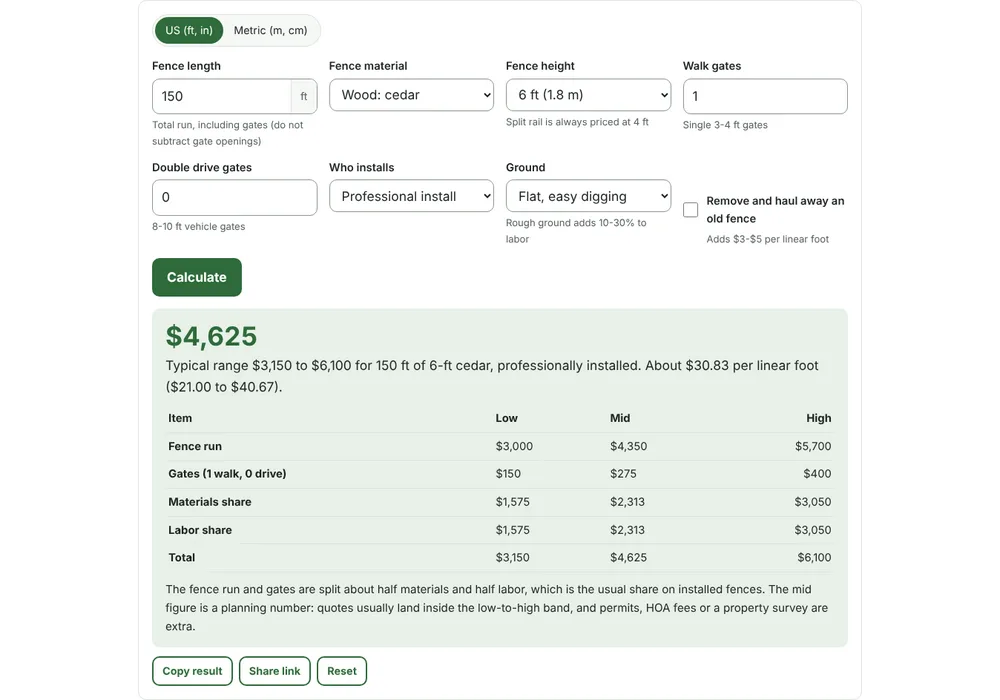
Worked example: 150 ft of 6-ft cedar, one walk gate, professional install, flat ground, no removal. The result is a $4,625 midpoint, a $3,150 to $6,100 range and about $30.83 per foot, split $2,312.50 materials and $2,312.50 labor. That 150 lf default suits a typical Residential yard.
Gate hardware (hinges, latches, drop rods, keyed locks) runs $40–$400 per opening and can push a gate past the tool's averages; one Texas installer quotes singles at $300–600 and doubles at $700–1,400. A large run of 500 ft or more is multiplied by 0.9.
How the Fence Cost Calculator calculates your result
The Fence Cost Calculator multiplies your length by an installed rate for the chosen material and height, adds gates and removal, then splits the subtotal into materials and labor.
In plain terms: fence run = L × R × H × D, where L is length in feet (2L + 2W for a full rectangle; meters divided by 0.3048), R is the installed rate below at the material's base height, H rescales R to your height and D is 0.9 for runs of 500 ft or more.
A 6-ft fence is 1.35 times a 4-ft one and 8 ft is 1.30 times 6 ft (midpoints of published premiums), so a 4-ft cedar rate is the table rate divided by 1.35. Gates add $275 per walk gate (3–4 ft) and $750 per double drive gate (8–10 ft) at mid, times the number of gates.
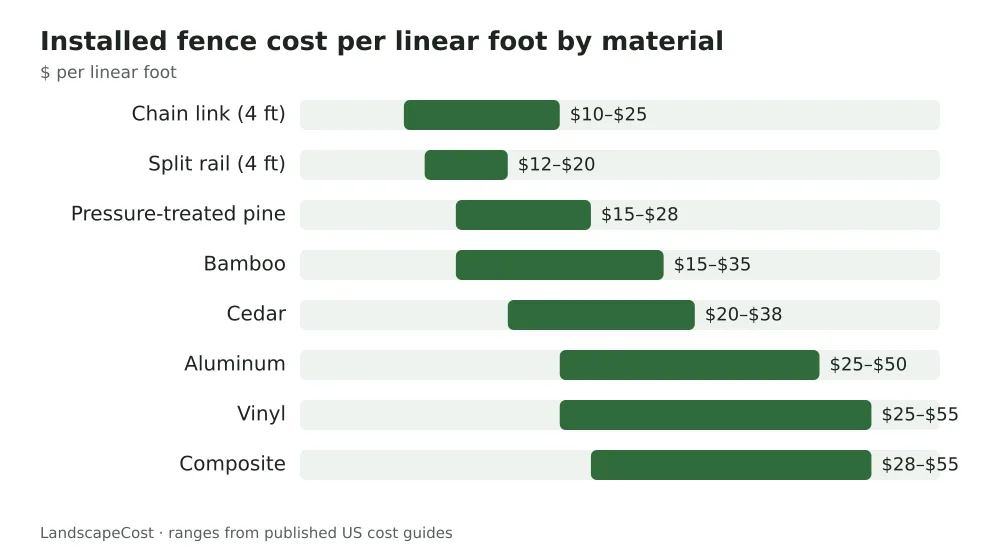
Half of fence plus gates is counted as labor. Rough ground applies a +10% to +30% premium, a labor multiplier of 1.10 to 1.30. Old fence removal adds $3–$5 per foot, or $450–$750 on 150 ft. DIY drops labor and adds one day of post hole digger tool rental at $75–$150. The default rates trace to RS Means 2026 and the National Construction Estimator 2026:
| Material | Installed $ per linear foot | Priced at |
|---|---|---|
| Chain Link | $10–$25 | 4 ft |
| Split Rail | $12–$20 | 4 ft only |
| Wood Pine PT | $15–$28 | 6 ft |
| Bamboo | $15–$35 | 6 ft |
| Wood Cedar | $20–$38 | 6 ft |
| Aluminum | $25–$50 | 6 ft |
| Vinyl | $25–$55 | 6 ft |
| Composite | $28–$55 | 6 ft |
| Wood Redwood | $28–$50 | 6 ft |
Why do per-foot fence prices vary so much?
Per-foot fence prices vary mostly because of labor, and a May 2026 national estimate for a fence begins at $33.48–$53.87 for each installed linear foot, inside a broader $20 to $60 band.
A 2-person crew bills roughly $10–$20 per foot nationally and sets 80–120 lf of wood privacy fence a day on level ground. Fence erectors earned a median $23.07 an hour ($47,980 a year) in 2025, and union wage premiums lift big Northeast metros higher.
Public contracts itemize the extras. One Georgia county contract bills a crew at $115.00 an hour, $15.00 per concrete post footing and a 50-cubic-yard disposal load at $400.00.
Because labor takes 45–55% of an installed price, a materials only order lands far lower: chain link mesh runs $5–$12 per foot, and DIY saves about $10–$18 per foot, or $1,500–$2,700 across 150 ft.
What raises the cost of a fence beyond the material?
Location is the biggest fence cost driver after material, because labor rates and frost depth shift by region.
The Northeast and West Coast run 20–30% above the national figure and the South 10–15% below it (NAHB Regional Cost Index 2026). A $3,200 fence climbs to about $4,000–$4,200 in Los Angeles or New York and $2,700–$2,900 in Texas. Urban work runs 40–60% above rural work (suburban Chicago and Detroit top Indiana and Iowa).
Posts must sit below the frost line, so deeper concrete footings mean longer posts and more concrete per hole:
| Region | Labor $ per linear foot | Typical frost line |
|---|---|---|
| Northeast (Boston, Philadelphia) | $18–$28 | 42–48 inches |
| West Coast | $20–$32 | 12–24 inches on the coast, deeper inland |
| Midwest | $10–$16 | 30–42 inches |
| South / Southeast | $9–$14 | 12–24 inches |
| Mountain West | $11–$17 | 18–24 in (Phoenix, Las Vegas); 36–48 inches (Denver, Salt Lake City, Boise) |
Which fence material gives you the most for your money?
The material that gives the most for your money is the one whose upfront price, upkeep and resale effect fit the job, and wood privacy panels at $20–$45 per foot sit in the middle of the range.
Wood stays the baseline for a privacy fence: pressure-treated wood and pine hold the low end, and cedar privacy boards cost more. On the West Coast, lumber freight from Oregon and Washington mills keeps wood prices steady.
Ornamental steel and aluminum copy a wrought-iron look; one county contract prices 42-inch aluminum at $32.50 per foot and a 3–5 ft PVC estate fence at $25.00. A 150-foot vinyl privacy run spans $3,750–$8,250.
Resale shifts the math slightly: a fence returns 30–70% of its cost, about 50% ROI on average, and rural sellers see 20–35% (Redfin 2026). Wood privacy may add $1,500–$4,000 to appraised value in urban or suburban markets.
Why does the same fence cost more in one town than another?
The same fence costs more in one town than another because soil, codes, permit rules and local crews change, even with identical length and material.
North Texas shows it. One installer serving Frisco, Prosper, Celina and McKinney lists 6-ft board-on-board cedar at $50–$60 per foot, while Gwinnett County, Georgia's contract BL076-21 pays $38.00 for 6-ft wood. Permit fees there run $50–$250 by city and average $150–250. North Texas clay may demand reinforced footings, and soils under 1,500 psf can need extended ones.
Some municipalities skip permits for fences under 6 feet that avoid corner lots, while others want one for anything visible from the street. Soil sets post depth; rocky soil may need a rock auger at $200–$400 a day plus a grade premium.
Coastal salt favors aluminum and rural acreage favors split rail. With no Region dropdown, adjust the national range by the percentages above.
How should you request and compare fence quotes?
Send every fence installer one identical written spec, then compare the itemized prices against the calculator's low-best-high style range.
- Layout: footage from a measuring wheel; trace each straight run and count corner posts.
- Material and grade: name the fence type and grade, such as knotty cedar 6 ft dog-ear versus clear cedar; knotty runs about half the per-foot cost.
- Fees: building permit ($50–$200), HOA review fee ($100–$300) for the architectural committee's check of height and setback, and any property-line survey.
- Site: tree roots, slope and disposal of the old fence.
Bids for one job often spread about ±20%, and prices follow your zip code. One installer's 150-ft cedar example came to $9,100, or $55.00 per foot. Short runs often hit a minimum charge. With a supervising general contractor, general contractor overhead adds 13% to 22%, and sales tax may sit outside the estimate.
What will a fence cost you over 20 years of ownership?
A fence's 20-year cost equals the install price plus upkeep, so the cheapest fence to build is not always the cheapest to own.
Wood needs the most care: a cedar run should be stained or sealed on a schedule, and professional staining is usually quoted separately once the fence is measured. Rolled bamboo culm panels reach a 10–20-year span only when sealed annually. Chain link, by contrast, lasts 25–40 years with little attention, and redwood carries the longest service life among the woods.
On a 150 lf yard, adding each material's yearly upkeep to its bid before comparing keeps a low wood quote from beating a vinyl quote with lower maintenance on paper, because lifetime cost is what you actually pay.
Urban and suburban sellers recoup 50–75% of fence cost under KW Appraisal Group 2026 guidelines, and careless installation can cost you the manufacturer warranties that protect that value.
Frequently asked questions
What does a fence cost per linear foot?
A fence costs about $10 to $60 per linear foot installed depending on material, with typical residential jobs at $20–$60 per foot and new fences totaling $1,800 to $6,500.
Per-foot pricing is the standard quoting unit because materials and labor grow with the run. To compare an installed rate fairly, give each bidder the exact linear footage, the fence material with grade and the height, and gather three quotes minimum (so at least three quotes to read side by side).
Treat any calculator's figure as an estimate only. The tool shows a low and high price built from planning rates, not market prices, and the final invoice follows your site. Even a high planning rate can miss commercial jobs, which price differently. Detailed planning estimates often rely on the Unit Cost Method, which prices each task by its unit, so a line-by-line quote is easy to check against the per-foot figure.
What is the cheapest fencing option?
Chain link is the cheapest fencing option, at about $1,500–$3,750 for 150 feet installed, roughly one-third of what wood or vinyl costs.
Galvanized chain link at 6-ft height costs $24.37–$26.37 per foot in one county contract, depending on wire gauge, and $35.75–$37.75 at 8 ft. Those are one county's contract rates, not the tool's planning ranges. The tradeoff is privacy: galvanized mesh hides nothing.
Split rail is the cheapest decorative choice. Locust or cedar rails drop into pre-routed post slots, which removes picket cutting and gives a rustic boundary on large lots.
Height is the other lever. A 6-foot fence runs 30–40% more per foot than a 4-ft fence, and 8 feet adds more again, so dropping one size cuts the per-foot rate. Mixing heights, such as 6-ft privacy beside a patio and 4-ft elsewhere, applies the same saving to part of the run.
What does a 6-foot privacy fence cost?
A 6-foot privacy fence usually costs $20–$38 per foot in cedar, or about $3,000–$5,700 for 150 feet installed.
Common styles are dog-ear privacy and board-on-board; the jump from a 4-ft fence comes from taller posts set deeper plus a third horizontal rail. One installer adds 15–20% per height step; national data puts 8 ft at 25–35% over 6 ft. A county contract pays $47.00 per foot for 8-ft wood, and that height can need a permit where 6 ft would not. The 4-ft height remains standard for chain link and split rail.
Board fences combine 4-by-4 pressure-treated posts, 1-by-6 boards and 2-by-4 rails, with No. 2 cedar priced on its own line. Each section needs a top, middle and bottom rail, and boards per section equal the section width divided by each picket's actual width plus any gap.
How do I work out what my fence will cost?
To calculate fence cost, measure your total length in feet, multiply it by the installed rate for your material and height, then add gates, removal and site extras.
Measure the property perimeter run by run: the front (50 ft), the back (50 ft), the left side (100 ft) and the right side (100 ft) total 300 linear feet. For a rectangle, use length and width. Do not subtract gate openings; each gate opening counts. Round to the nearest 5 ft with a tape; most homes need 100–300 lf.
Rocky and sloped terrain add labor. Tear-out is $3–$5 per foot here ($2–$6 in another planning tool). DIY tool rental totals $150–$300 for a whole job in one comparison; this calculator adds one rental day at $75–$150.
Treat the result as a planning estimate and send the same specification to every installer, so contractor bids match your planning rates and slope notes.
Is DIY fence installation cheaper than hiring a contractor?
Installing a fence yourself is cheaper in cash, because the materials-only rate runs 40–55% below the installed rate, but you trade that saving for your own labor.
On 150 feet of cedar, materials run about $1,200–$2,100 against $3,000–$5,700 installed. The installed price buys post-setting concrete, fasteners, labor and site cleanup. DIY suits a wood privacy fence in pressure-treated pine, while prefabricated vinyl panels are harder to set true, and a poor install can void manufacturer warranties.
If you hire, collect three contractor quotes and read the red flags. Itemized quotes should show line items for materials, labor and removal, since removal is the most omitted line item and often an additional fee. A deposit of 25–35% is the residential norm; walk away from any contractor who wants 50% upfront or more. Some towns issue the permit only to a holder of a state contractor license.
Does a fence increase home value?
A fence can increase home value, though it rarely returns its full cost, and materials that stay attractive with little work hold their value best.
Aluminum resists corrosion and gives a wrought iron look without the rust, which helps it age well. Vinyl offers a 30-plus-year service life and needs only a wash now and then, with no staining at all. Composite blends recycled wood fiber with polymer binders and lasts 25–30-year spans.
Vinyl and aluminum retain value better over time because of lower maintenance and a consistent appearance, and a 150-foot aluminum run costs $6,125–$6,625 over 20 years. Returns also depend on the market: rural sales recoup less than urban and suburban ones because privacy matters less on acreage lots, so check your local market before spending for resale alone.
How much does a fence permit cost?
A fence permit usually costs $50–$200 in most US municipalities, and homes in planned communities add an HOA review on top.
Permit requirements vary by town, so call the building department before buying permits or materials. A permit office may also want a property survey if pins are missing, and HOA requirements can dictate material, color and style.
Some places issue the permit only after checking a state license number with the contractor licensing board; in California that board is the CSLB, and Bay Area wage premiums push bids to the top. In Florida and coastal Georgia, hurricane-zone codes can call for deeper posts.
Before digging, call 811. The 811 locate is free, utility locate marks arrive within a few days, and hitting an unmarked line without calling leaves you liable. Confirm the property line before the first hole.
How much does old fence removal cost?
Removing an old fence costs $3–$5 per linear foot, which comes to $450–$750 on a typical 150-foot run, and the charge should appear as its own line item on every quote.
Price follows the post count. With 8-ft spacing, sections equal the run divided by section length, rounded up, and posts equal sections plus one; each corner post serves two runs. A 150-ft straight run therefore has 19 sections and 20 posts to pull, each set in concrete.
Removal gets harder when rock or roots grip the footings. Some calculators list old fence tear-out and haul at its own per-foot rate, which keeps the scope clear.
Good estimates list tear-out and disposal apart and add scope notes and photos of the old fence, so the crew and homeowner agree on what leaves the site.
Does chain link cost less than a wood fence?
Chain link fence is cheaper than wood fence, both to install and over 20 years, though it gives no privacy.
One Georgia annual fence contract spans $13.41 to $47.00 per foot across chain link and wood, with vinyl coated chain link in between. Chain link is priced as galvanized steel mesh plus line posts and terminal posts, and it suits pet-containment, security and pool-enclosure jobs at one-third the cost of wood.
Wood brings privacy but needs annual maintenance, with stain and seal work against rot; pressure-treated pine lasts 20–30 years with regular staining. The 20-year lifetime cost on 150 feet is $3,125–$4,125 for chain link, $8,350–$12,350 for cedar and $7,000–$8,000 for vinyl.
Removal differs too. Pulling cyclone fencing with concrete-set posts lands at the top of the range, since each post needs excavation, and the dump fee adds up.
What time of year is cheapest for fence installation?
The cheapest time to install a fence is fall, August–October, when contractors offer 5–15% discounts as summer construction demand fades.
Spring (March–May) costs +5% to +10% more, and tight contractor availability can mean a 4–8 week wait. Summer (Jun–Jul) is the baseline. Winter pricing runs -5% to -15% and works best in the South and Southwest, since weather delays are common in northern states. Permit approval can take from same-day to 4 weeks, so file early.
A seasonal discount works like any optional discount: apply the discount percentage to the quote and check the total after the discount against your plan.
DIY timing differs. A 150-ft DIY job runs $1,400–$2,600 over 2–3 weekends, against $2,850–$5,600 and 2–3 days for a crew, partly because crews buy bulk materials while you pay retail.