On this page
- How to use the Concrete Slab Cost Calculator
- How the Concrete Slab Cost Calculator calculates your result
- What is the cost of a concrete slab per square foot?
- How much does a concrete slab cost at common sizes?
- Which projects push slab cost higher: pads, garages or shops?
- How thick should a concrete slab be, and what does each inch cost?
- Where does the money in a concrete slab quote go?
- How much do site prep and grading add to a slab?
- What do finishes and add-ons add to a concrete slab?
- What does a real concrete slab estimate look like line by line?
- Should you pour a concrete slab yourself or hire a contractor?
- What should a concrete slab quote include?
- How do cure time and weather affect a concrete slab?
- What makes a concrete slab last longer?
- Frequently asked questions
How Much Does a Concrete Slab Cost?
In 2026 a concrete slab costs about $6 to $14 per square foot to install, so a plain 4-inch 20×20 slab runs roughly $2,400 to $5,600 and a 30×30 slab 4 inches thick lands near $5,400 to $12,600, with base work, steel, finish and region deciding where yours falls.
Published figures stretch from $4 to $16 per square foot because some quote materials only and others a full installation. A 4 inch slab on an easy site with light reinforcement sits at $6 to $9, while 6 inch slabs with thickened edges or a decorative finish reach $14 to $20. You can compare similar projects in our Hardscape, Driveway & Paving Calculators collection.
In one published cost-share table, labor is about half of a slab bill and concrete about a quarter, so the crew and the dirt work move totals more than the ready-mix delivery. The calculator above splits your estimate into concrete, prep, steel, labor and extras for that reason. For related projects, see the asphalt driveway cost calculator section.
How to use the Concrete Slab Cost Calculator
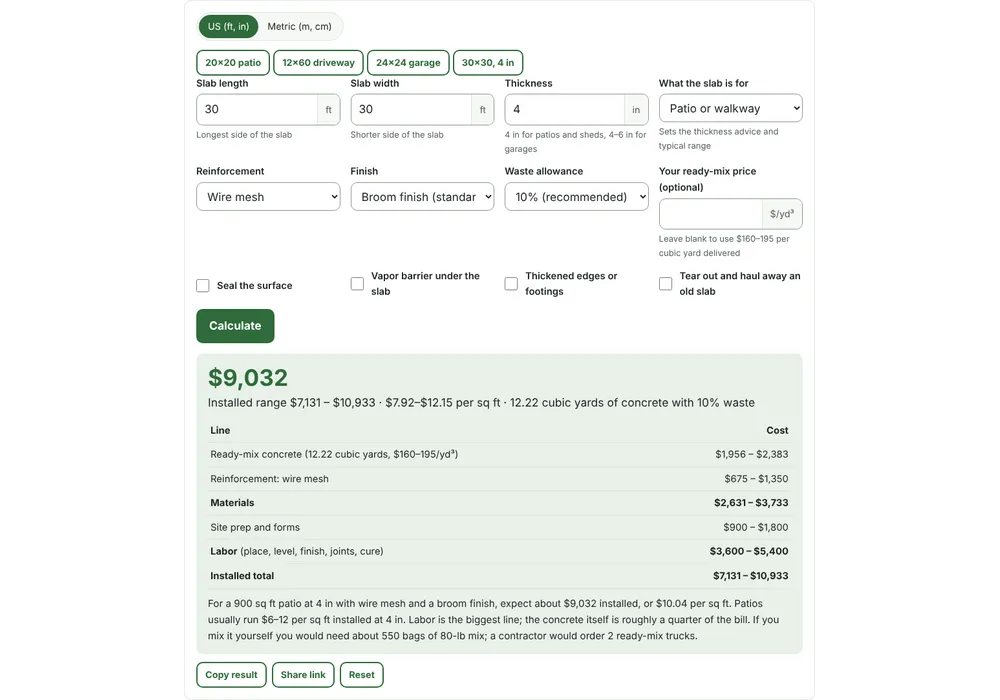
The Concrete Slab Cost Calculator needs only length, width and thickness, and the other boxes sharpen the cost breakdown for your concrete slab.
- Size: enter length and width in feet or meters; the tool multiplies length by width.
- Thickness: the thickness options run from 3 to 12 in. Use 4 in for walkways and light foot traffic, 5 in or 6 in for heavy pickups, RVs and trailers, and 6 in or more for heavy equipment (8 in is also selectable). A 3 in pour gets a warning, since IRC R506.1 sets 3.5 inches as the residential minimum.
- Use and steel: pick patio, driveway, garage or shed, then no steel, wire mesh, rebar or fiber.
- Finish and extras: a broom finish or steel trowel finish costs nothing extra; stamped concrete, colored concrete or exposed aggregate cost an extra $3-8/sq ft. Tick sealing ($0.50-1.50/sq ft), a vapor barrier (about 50 cents; heavy plastic against ground moisture), a turned-down edge, or tearing out an old slab ($3 to $8 for removal and hauling).
- Waste and price: set the waste factor to none, 5% (precise forms), 10% waste (default) or 15% (uneven ground), and add your own per-yard price if you have one.
Worked example: a 30 by 30 foot slab, 4 in thick, wire mesh, broom finish, 10% waste, no add-ons such as a pump truck or tear out. The result is 12.22 cubic yards and about $9,032 installed (range $7,131 to $10,933), or $10.04 per sq ft, with materials at $2,631 to $3,733 and labor at $3,600 to $5,400.
How the Concrete Slab Cost Calculator calculates your result
The Concrete Slab Cost Calculator turns length by width by thickness into cubic yards, prices that volume per cubic yard, and adds per-square-foot rates for prep, forms, steel, labor and extras.
Area times thickness in feet gives cubic feet; divide by 27 for cubic yards, then add waste. A 20x20 at 4 in holds 132 cubic feet, or 4.9 yards, so one yard covers about 81 square feet. Past 10 cubic yards, about one truck load by NRMCA sizing, the tool counts a second truck, and a pour that big needs construction joints.
| Line | Low to high rate | Share of a typical bill |
|---|---|---|
| Ready-mix concrete | $160 to $195 per cubic yard delivered | ~25% ($2-3/sq ft) |
| Prep, grading and forms | $1-2 per square foot | about 15% |
| Reinforcement, by type of reinforcement | mesh $0.75-1.5, rebar $1–2, fiber $0 | about 10% |
| Labor: placing, leveling, finishing, control joints, curing | $4-6 per sq ft | ~50% |
| Contractor minimum | $600 low, $900 high | small pads |
Rates come from 2026 contractor guides and a published cost-share table; one guide prices labor at $4 to $5, inside the span used, so concrete really is about a quarter of the bill. Because every line is per square foot, cost scales linearly: a 16×20 ft slab of 320 sq ft runs $1,920 to $3,840 at $6 to $12, and a 40×40 ft slab of 1600 sq ft reaches $19,200.
What is the cost of a concrete slab per square foot?
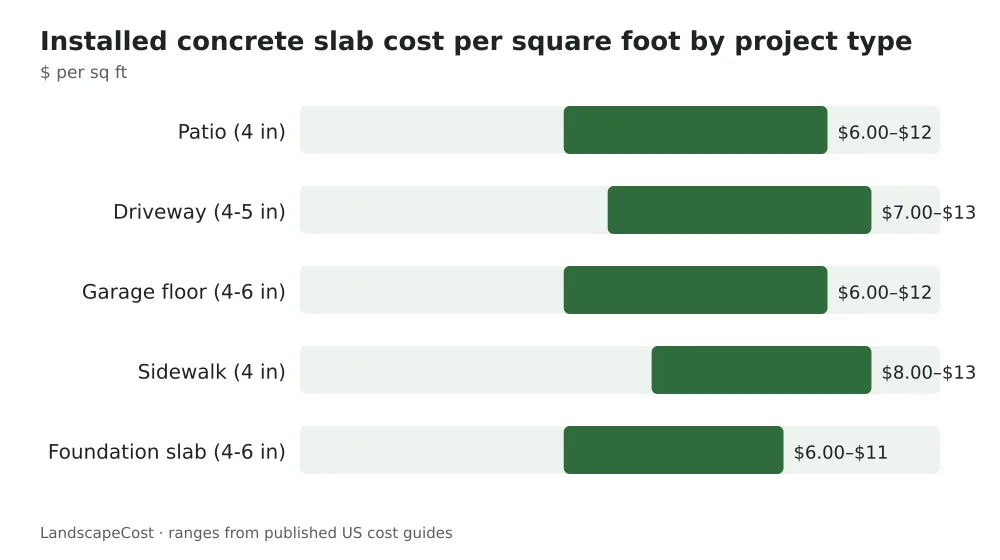
A basic poured concrete slab usually runs $6 to $12 per square foot, installed, while slabs built to last with a proper base and steel land between $10 and $14.
A May 2026 national average for a cement slab was $10.33 to $12.65 per square foot. Another contractor puts most installed slabs between $10 and $18, so check what each bid covers in your region.
| Project | Installed cost | Thickness | Typical size |
|---|---|---|---|
| Patio | $6–12 per sq ft | 4 in | 12×12 to 20×20 ft |
| Driveway | $7-13/sq ft | 4-5 in | 10×20 to 12×60 ft |
| Garage | $6–12 per sq ft | 4–6 in | 20×20 to 24×30 ft |
| Sidewalk | $8-13/sq ft | 4 in | 4×20 to 6×60 ft |
| Foundation slab | $6-11/sq ft | 4–6 in | full footprint |
Sidewalks run higher because they are narrower, with more edge work per linear foot.
How much does a concrete slab cost at common sizes?
A 20x20 concrete slab of 400 sq ft costs $4,000 to $5,600 installed at $10 to $14 per square foot, or near $2,400 in a cheaper market for a bare-bones pour.
At $6-12/sq ft, a 20×20 patio runs $2,400 to $4,800, a 12×60 driveway $4,320 to $8,640, and a 30 by 30 foot slab $5,400 to $10,800. A plain 4 inch slab at 20x20 takes 4.9 cubic yards.
Each additional inch adds $0.50-0.65 per square foot, or $100-130 per 100 sq ft from 4 to 6 in; installed, 50 cents to a dollar per inch. On a 24x24 garage, 4 to 6 in adds about 3.5 yards, or $600 to $700, toward a floor of up to $9,200.
Saving money means you pour everything at once and keep the shape simple; even a job under 1 cubic yard carries fixed delivery costs.
Which projects push slab cost higher: pads, garages or shops?
Slab cost climbs with the load a project carries, so standard residential patios and shed pads stay near the low end while shop floors, engineered lift bays and commercial slabs need 6 inches or more.
A concrete pad is a standalone pour of 50-200 sq ft for an HVAC condenser or shed; a true slab starts around 300+ sq ft. A 4×8 pad runs about $700 to $1,100, since contractor minimums sit near $600 to $900. Fixed costs and a higher edge-to-area ratio, with more form work per foot, explain it.
A 24×24 ft garage covers 576 sq ft, or $5,750 to $8,050 at $10 to $14. For cars, light SUVs and occasional truck traffic, one guide notes that going from 4 to 5 in brings roughly 50 percent more load capacity. A 1,000 square foot slab runs $10,000 to $14,000, and equipment loads push shops higher.
How thick should a concrete slab be, and what does each inch cost?
A concrete slab should be 4 inches thick for patios and sheds, 4 to 6 inches for a garage floor, and 5 to 6 inches for RV and trailer pads, since heavier loads need depth.
Most slabs run between 4 and 8 inches thick. Loads over 12,000 pounds need rebar, and a filled hot tub pad carries two or three tons. A lift maker wants 4.25 inches of 3000 psi concrete under 10,000 pound two-post lifts, so thicker pours suit a shop.
Wire mesh, a grid of steel wires, serves lighter slabs; rebar means steel bars for heavy-load foundations, both prevent cracking. Steel runs about 10% of installed cost, or $0.75-1.5 per square foot, and forms plus steel add $1.50 to $3.
A 30x40 shop at 4 in runs $12,000 to $16,800, and a 40x60 pole barn slab at 6 in runs $26,400 to $38,400.
Where does the money in a concrete slab quote go?
Labor is the largest line in a concrete slab quote at roughly half the total, with concrete near a quarter and site prep, forms and steel splitting the rest.
Site prep and forms take about 15% of the bill, or $1-2 per sq ft in one cost-share table. A stripped, leveled base compacted with 4 inches or more of gravel costs $2 to $3 per square foot in another guide, so site conditions and the type and condition of your soil swing the number. A stable base of 4-6 inches and careful leveling beat fixing cracks; ask each bidder for a complete quote.
One 120-square-foot estimate orders 129 SF of fibermesh 3500 PSI concrete and adds 7.5 h of labor, job supplies and an equipment allowance charged per job: $1,240 to $1,519. A supervising general contractor adds 13% to 22%, and sales tax and permit or inspection fees sit outside it.
How much do site prep and grading add to a slab?
Site preparation usually adds $2-3 per square foot to a concrete slab, and poor subgrade or an old surface can push that higher before any concrete arrives.
Bad ground needs subgrade work and sometimes soil stabilization; one guide adds $2-4/sq ft for that or for demolition of old concrete. Prep is priced by excavation to depth, the base material and how thick the compacted gravel base must be, so a flat lawn and a clay hillside carry very different lines.
The dirt work is the wrong place to economize. A complete quote names a 4 to 6 inch gravel base, so check that every bid lists the same depth before comparing prices.
One guide notes that a floating slab, not tied to footings, often costs less because it needs less excavation and less steel.
What do finishes and add-ons add to a concrete slab?
A broom or steel trowel finish is included in normal slab pricing, while stamped, colored or polished surfaces cost $3 to $8 more per square foot.
Stamped and colored finishes are the usual upgrades; price the premium finish as its own line. Custom work can reach $15 to $18 a square foot, and that premium buys finish quality. A vapor barrier is minor next to $3-8/sq ft of decorative work.
Precast slabs cure in a factory and are transported to your site, starting around $10 per square foot. A monolithic slab, foundation and floor in one pour, runs about $4 to $8, while some guides price a monolithic slab foundation at $6 to $12.
Higher-grade mixes among concrete grades cost more but last longer. One contractor notes that pro-installed pavers usually cost more than a plain slab because each piece is set by hand, and gravel is the cheapest surface of all.
What does a real concrete slab estimate look like line by line?
A real concrete slab estimate prices each task separately, so you see how base, steel, labor and finish build the total.
In one published small-job estimate, excavation with hand tools to a maximum depth 8 inches took 2.5 h, basic labor took 7.5 h, and the 120 SF labor figure assumed favorable site conditions. It left out excavation, compaction, the gravel base and hardscape demolition, and it required a uniform depth and a true final surface level.
A good estimate is a parts list: thickness and square footage, strength in psi and whether the mix is air-entrained, base depth, reinforcement type and spacing, control joints, the curing method, and extras like footings, anchor bolts or a pump.
One calculator adds $2-4 per square foot for decorative work in its tips but $3–8 in its table, so ask what a bare-bones pour omits before comparing concrete slab bids or labor costs.
Should you pour a concrete slab yourself or hire a contractor?
Pouring a concrete slab yourself pays off on small jobs because you save 50-60% on labor, but anything above 1 cubic yard usually belongs with a contractor.
DIY suits a shed pad or an air conditioner pad, with 3+ helpers and a surface where finish quality is not critical. Pro labor at $4 to $5 per square foot is the money you keep.
Size changes the math fast. A 20x20 slab takes about 225 bags hand-mixed, roughly 20,000 pounds of concrete, and with waste one calculator puts the same 400 sq ft job at 245 bags of 80 lb mix. Bagged concrete for it costs $1,348 to $1,960, against about $1,055 for 5.43 cubic yards of ready-mix plus delivery.
Professional installation of that slab adds installation labor of $1,200 to $3,200, or $3.00 to $8.00/sq ft. Check whether a permit applies before you dig.
What should a concrete slab quote include?
A concrete slab quote should include excavation, a compacted gravel base, forms, reinforcement, concrete materials and delivery, placement, finishing labor and cleanup, with every exclusion written down.
Ask whether excavation, a compacted gravel base of 4-6 inches, wire mesh or rebar, and demolition are in the price. Permits at $50-200, decorative finishes, sealing and soil stabilization are often extra. Get it in writing, and match the steel to ACI 332-20. For scale, one 120-square-foot estimate came to $10.34 to $12.66 per sq ft.
- Permits: rules change from town to town; for example, in Weld County, Colorado, ground level patios and driveways need no building permit, nor do sheds at 200 square feet or less.
- Delivery fees: one contractor lists charges from short loads, Saturday deliveries or a truck kept past its unloading window.
- Pumping: pump trucks run $800 to $1,800 when the truck cannot reach the forms.
How do cure time and weather affect a concrete slab?
Weather affects a concrete slab mainly through curing, so cold or wet pours need protection.
Winter pours between November and March need blankets for curing; plan for pour day if it rains or freezes. In one Colorado guide's local example, slabs freeze and thaw, the Front Range ground is largely clay that swells when wet, and state hazard planners rate about half the soil at high or very high potential, so shrinking and swelling is routine.
Builders there use air-entrained concrete at 4000 psi or better and control joints every 8 to 12 feet, cut a quarter of the way through. Footings go below frost depth, which varies by region (30 inches in Greeley), and 811 needs three business days of notice.
In freeze-thaw climates, freeze-thaw cycles set the grade; a higher grade extends slab life. The lowest bid unchecked, early salting and ground that slopes toward the slab are common mistakes.
What makes a concrete slab last longer?
A concrete slab lasts longest with a good base, the right mix and patient curing, and with that care it can give you 30 years or more.
Timing is the first test. A residential slab takes two to four days to install; you can walk on it within a day or two, light vehicles after about seven days, and it reaches full strength at 28 days, per American Cement Association figures one contractor cites. Ask the crew when you can drive on it or build on it, confirm they are licensed and insured, and read the warranty.
Care does the rest. Keep water draining away, seal outdoor slabs every few years, and use deicer sparingly.
Mix choice helps too. Standard concrete suits most jobs, ultra high-performance concrete and self-consolidating concrete add faster curing or flow, and permeable concrete helps drainage.
Frequently asked questions
What is the price of a 20x20 concrete slab?
A 20x20 concrete slab costs about $2,400 to $5,600 installed, depending on base, steel and location.
At one calculator's regional rates, the same slab runs $2,400 to $4,000 in the Southeast, $2,800 to $4,400 in the Midwest and Mountain West, $3,600 to $5,200 on the West Coast, and $3,600 to $5,600 in the Northeast. Labor costs more in coastal metros, so get 3+ bids there.
Concrete materials are fairly consistent nationally, about $2.50 to $3 per square foot, and moving from 3,000 to 4,000 psi adds only about $25 a yard. Labor, at 40 to 50 percent of the bill, drives the gap. National averages include thin pours with little base work, so a plain slab sits at the bottom of each range. The calculator's default 20x20 ($3,169 to $4,859) is narrower because it uses one set of per-line rates.
What is included in the cost of a slab installation?
A slab installation price normally includes excavation, a gravel base, forms, reinforcement, placement and finishing labor, concrete and delivery, and cleanup.
One cost guide lists excavation to depth, forms set and remove, concrete materials and delivery, placement, finishing labor and cleanup as standard, with rebar or wire mesh meeting ACI 332-20 for residential concrete construction.
Extras are usually not included: demolition at $2-4/sq ft, decorative finishes at $3-8/sq ft, soil stabilization where there is poor subgrade, sealing at $0.50-1.50/sq ft, and permits at $50-200. Stamped concrete alone can raise the total 20 to 50 percent, and polished surfaces cost extra too.
One guide adds that an ADU foundation needs engineered footings, plumbing under the floor, anchor bolts and inspections. Confirm any inspection fees in writing.
How much can you save by pouring a slab yourself?
Pouring a slab yourself saves the labor share, about $4 to $5 per square foot, which can be half the installed price.
A crew of 3-4 needs 4-6 hours on a 400 sq ft slab, which is 12-24 labor hours at $40-70/hour, and that is the work you take on. DIY makes sense under 1 cubic yard, which is roughly 45 bags of 80-lb mix, for a small patio with 3+ helpers. If you mix it yourself, everything must be finished before it sets.
Doing it yourself lowers the cost, but hire out for structural work: a driveway, garage floor, foundation or retaining wall, or when long-term performance matters or local code needs a permit. A 20x20 is about 5 yards, 225 bags or 20000 pounds from a truck, and the 50-60% on labor saving fits an air conditioner pad or shed base far better.
How much concrete do you need for a 20×20 slab?
A 20×20 slab at 4 inches needs about 4.9 cubic yards of concrete, or about 5.43 cubic yards once you add a 10% waste allowance.
The math: 400 sq ft times 0.33 ft is 132 cubic feet, and 132 divided by 27 is 4.9 yards, close to the 5 yards most crews order. Each yard covers about 81 square feet at 4 inches.
Pick the waste factor by site: 5% for precise forms, 10% waste as the standard, and 15% on uneven ground. With waste, 5.43 cubic yards equals about 245 bags of 80 lb mix, while the unpadded volume is around 225 bags. A shed pad of 100 to 200 square feet at 4 in needs 1.23 to 2.47 cubic yards, since every 100 sq ft takes 1.23.