On this page
- How to use the Paver Calculator
- How the Paver Calculator calculates your result
- What paver sizes can you choose from?
- How do you turn square footage into a paver count?
- What do real paver estimates look like from start to finish?
- Does the laying pattern change how many pavers you need?
- How deep should the gravel base and bedding sand be under pavers?
- What does a paver project cost once pavers and labor are added up?
- How much extra should you order to cover cuts and breakage?
- Why choose pavers for a patio instead of a poured slab?
- Which paver terms are worth knowing before you order?
- Frequently asked questions
How Many Pavers, Base Gravel and Sand Does Your Project Need?
To work out how many pavers you need, divide the area in square feet by the face area of one paver (length × width in inches ÷ 144), add 10% for cuts and breakage on a straight layout, and round up: a 10 × 10 ft patio in 4 × 8 inch pavers takes 450 pavers, or 495 once the 10% is added.
Every square foot of paving also rests on a paver base of compacted stone and a thin bed of sand, so the sand needed and the gravel tonnage come from the same measurements. The Paver Calculator returns the paver quantity, base and bedding volumes, edge length and a cost estimate from one set of inputs. You can compare similar projects in our Hardscape, Driveway & Paving Calculators collection.
Small mistakes grow fast on hardscape orders. Typing 8 instead of 4 for the paver width halves the count, and skipping the allowance for waste and cuts leaves the last row short. Published guidance for patios and walkways is to add 10% on straight work, and that overage is the tool's default.
Enter a price per paver or per square foot, and the tool carries it through so you can determine the material cost before asking for quotes. Planning more than one job? The retaining wall cost calculator works the same way.
How to use the Paver Calculator
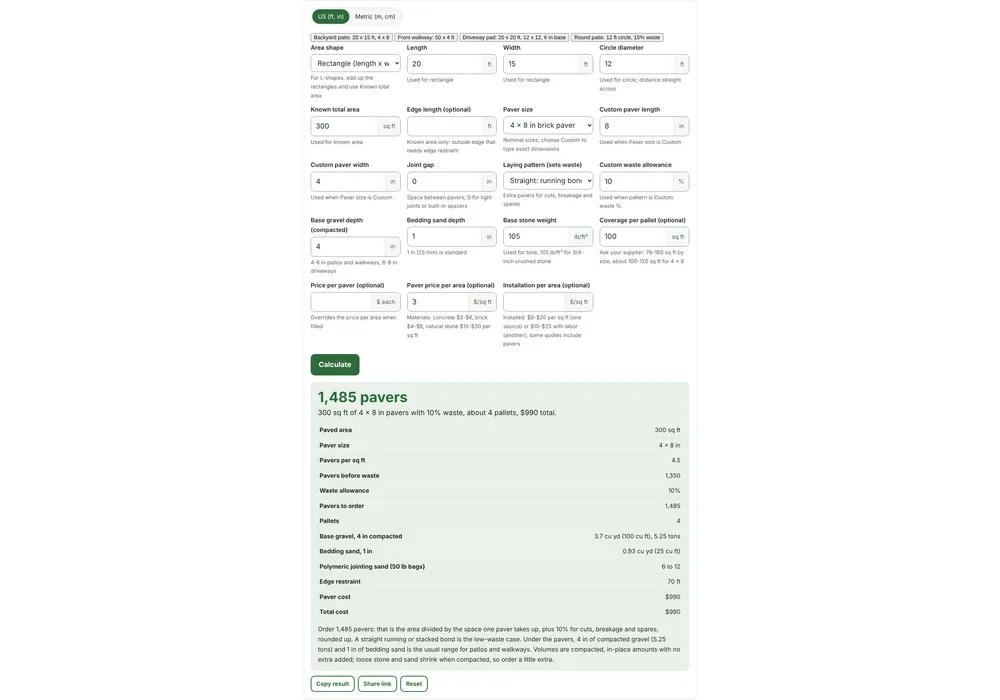
The Paver Calculator needs only the patio dimensions and a paver size; every other field starts with a working default, and the result updates instantly as you type. Fill the form from top to bottom:
- Units: US (ft, in) or Metric (m, cm). In metric mode, paver sizes and depths are typed in centimeters, and values already entered convert when you switch.
- Area: choose Rectangle and type the length and width of the installation area, choose Circle and type the diameter, or choose Known total area and type the sq ft you have already added up.
- Paver size: ten presets run from 4 × 8 through 14 × 14, 16 × 16 and 24 × 24 to a 4 × 4 cobblestone, and Custom accepts any length and width.
- Joint gap: the joint spacing between units; 0 suits pavers laid tight.
- Pattern: straight layouts such as running bond, stacked bond or basketweave at 10%; diagonal, herringbone, curved patterns or circles at 15%; complex shapes with many cuts at 20%; or a custom percentage.
- Base and sand: the compacted base of gravel (default 4 in; 4 to 6 inches for patios, 6 to 8 inches for driveways) and the bedding sand layer (default 1 inch, about 25 mm).
- Pallet and prices: coverage per pallet (default 100 sq ft), a price per paver or per square foot (concrete pavers run $3 to $6), and an optional installation rate.
Pallet coverage changes depending on size. Published figures run between 78 and 160 sq ft per pallet, and 100 to 120 sq ft for 4 × 8 units, so the 100 default leans cautious; replace it with your supplier's number.
Worked example: a 20 × 15 ft patio, 4 × 8 pavers, no joint gap, straight layout (10%), 4 in base, 1 in sand, 105 lb/ft³ stone, 100 sq ft per pallet and $3 per sq ft. Result: 300 sq ft; 1,350 pavers before waste and 1,485 to order; 4 pallets; 3.7 cu yd (100 cu ft, 5.25 tons) of base gravel; 0.93 cu yd (25 cu ft) of bedding sand; 6 to 12 bags of polymeric sand; 70 ft of edge restraint; total cost $990.
The four buttons at the top of the form load a backyard patio, a front walkway, a driveway pad and a round patio, each a straightforward starting point to edit. The interface needs no login and no project account, which keeps this patio paver calculator user-friendly on a phone in the yard. Treat any paver calculator result as an estimate to compare with a supplier or an installation service, not as the final order.
How the Paver Calculator calculates your result
The Paver Calculator divides the finished surface area by the space one paver occupies, joint included, then applies your waste allowance and rounds up, following the published joint-gap method: Count = A ÷ ((W + g) × (L + g) ÷ 144), then Final Count = Count × (1 + waste%), where W and L are the paver's sides in inches and g is the joint.
- Area (A): length × width in feet for a rectangle. For a circle, area = π × r², where the radius r is half the diameter and r² is the radius multiplied by itself. Values typed in meters are converted to feet first, so every dimensions field ends up in one system.
- Paver area: length × width in square inches ÷ 144 gives the paver sq ft. A single paver of 6 × 6 has 36 in², so 144 ÷ 36 = 4 pavers per square foot; a 4 × 8 gives 4.5 and a 4 × 4 gives 9.0. Custom length and custom width cover any single brick that is not a preset.
- Joint gap (g): the installation spacing, added to both sides of the paver before dividing, so (W + g) × (L + g) ÷ 144 replaces the bare face.
- Waste factor (w): the waste allowance as an extra percentage. The base count is A divided by the space per paver; multiply it by (1 + w), then round up to the nearest whole number for the final count, the total number to buy.
- Base and sand: A × depth (in) ÷ 12 gives cubic feet, ÷ 27 gives cubic yards, and base tons = cubic feet × 105 lb ÷ 2,000. The sand base depth (1 in by default) sets the sand volume the same way. Both are compacted, in-place volumes; loose stone and sand shrink as they are compacted, so order a little extra.
- Polymeric sand: one 50 lb bag fills the joints of 25-50 square feet, so bags run from A ÷ 50 to A ÷ 25, rounded up.
- Pallets: A × (1 + w) ÷ the coverage you enter; a standard pallet of 4 × 8 pavers often covers roughly 100 to 120 sq ft.
- Edge and cost: edge restraint equals the perimeter, 2 × (L + W) or π × diameter. Cost is the count × price per paver, or the ordered square foot coverage × price per square foot, plus installation × A.
Units cause most hand-calculation slips. A paver area quoted in in2 must be divided by 144 to reach ft2 before it meets a patio measured in feet; a 12 ft side is 144 inches, and a 16 in paver spans exactly 9 of them.
Every paver count and material estimate on screen comes from this one formula chain, so you can multiply and divide by hand to check it. The count and waste presets follow the joint-gap method and 10/15/20% figures published by dedicated US paver estimators, the depths follow the common 4 in base and 1 in sand build-up, and 105 lb per cubic foot is a published default weight for 3/4-inch crushed stone.
What paver sizes can you choose from?
Four standard US paver sizes cover most projects, 4 × 8 inches, 12 × 12, 6 × 6 inches and 16 × 16 inches, and across the United States the 4 × 8 is the most widely used of them on patios and paths.
The 4 × 8 is the most common paver brick size, shaped like a brick: one standard paver of that size covers 0.22 sq ft, so 4.5 pavers fill each square foot. A 12 × 12 inch square is the easy-math opposite, since 1 paver covers exactly 1 sq ft.
Clay brick units tend to stay near the brick module, concrete blocks come in nearly every size from 4 × 4 to 24 × 24, and natural stone ranges from sawn squares to irregular flags. A porous stone absorbs water, so porous units deserve a second look in cold regions.
Small units follow curves with little waste, while large squares lay quickly but leave bigger offcuts. The 4 × 8 is the widely used option for availability, not by rule, so enter the size you can actually buy.
How do you turn square footage into a paver count?
To turn square footage into a paver count, divide the area by the face area of one paver and round the result up, so 100 sq ft of 6 × 9 pavers comes to 267.
Begin with the project shape. A rectangle is length times width; an L-shaped patio or any different shape breaks into subareas, ideally identical rectangles you measure once. Add the pieces and enter the total, because rounding each piece separately ends in overbuying.
The table shows how many pavers a 100 sq ft area takes for each common size, before any waste or joint gap.
| Paver size (in) | Face area (sq ft) | Pavers for 100 sq ft |
|---|---|---|
| 4 × 8 | 0.22 | 450 |
| 6 × 6 | 0.25 | 400 |
| 6 × 9 | 0.38 | 267 |
| 8 × 8 | 0.44 | 225 |
| 12 × 12 | 1.00 | 100 |
| 14 × 14 | 1.36 | 74 |
| 12 × 18 | 1.50 | 67 |
Patterned layouts can be counted by the repeat rather than the single unit. Assemble one pattern repeat, add up its pieces, and divide the total project area by that figure to get the sets of the pattern. For illustration, a 3-piece pattern of two 4 × 8 bricks plus a single 8 x 8 paver covers 0.89 sq ft, so a 100 sq ft repeating layout needs 113 sets (226 bricks plus 113 squares).
What do real paver estimates look like from start to finish?
Real paver estimates follow three moves, area, count and allowance, and these common project examples show how far one rounded number moves the result.
A 12x12 ft patio in 16x16 in pavers is the tidiest case: 12 ft × 12 ft = 144 ft2, one 16 in × 16 in paver is 256 in2 (about 1.77 ft2), and 144 × 144 ÷ 256 gives exactly 81 pavers needed before any allowance.
A 600 sq ft patio in 4 × 8 pavers shows why rounding matters. One published example rounds the paver face to 0.23 sq ft and reaches a count of 2,609; the exact 0.222 sq ft gives 2,700, the figure this tool returns. The 91-paver gap is about 3%, enough to leave a row short.
The 20 × 15 ft backyard patio from the how-to section makes a fast planning baseline: 300 sq ft over a 4" stone base and a 1" sand base, the industry-standard build-up, with the 10% standard waste that many estimators bake in. Sum up the estimated expenses from that one run and the shopping list is done before the first quote arrives.
Does the laying pattern change how many pavers you need?
The laying pattern changes how many pavers you buy, not the area you cover: a 45-degree layout needs more pavers than the same amount of ground laid at 90-degree, because units along every border must be cut on the angle.
A straight pattern wastes little, since cuts happen only at the outline, and the usual advice is to order 10% more. Turn the field 45 degrees and every unit touching the edges becomes a triangle; you cut some pavers to fit along the whole perimeter.
Curved or patterned work often needs 12 to 15 percent or more. Mixed pattern sets, bundles of several sizes laid together, are easier to count by the set.
A soldier course is a border row laid in a different orientation from the field, and it frames a diagonal field so the angled cuts meet one straight line. Large units, as in a large-format slab look, make every cut costlier, so a diagonal layout of 24 × 24 slabs deserves the higher waste figure.
How deep should the gravel base and bedding sand be under pavers?
Pavers for patios and walkways sit on 4 to 6 inches of compacted gravel topped with 1 inch of sand, and driveways need 6 to 8 inches of base because vehicles load the surface far harder than feet do.
Walkways and patios carry foot traffic only, so 4 in is the tool's default. A driveway section must spread each tire load into the soil, so the driveway preset starts at 6 in.
Bedding sand is a setting bed, not fill. It gives each paver a flat, adjustable seat, and it is not meant to hide a lumpy base, because thick sand under a paver tends to shift.
Joints get their own material. Polymeric jointing sand locks pavers together and keeps weeds and plants from rooting between them. On many installations the joint sand is the rushed final step, yet it decides whether the field stays tight. If a contractor confirms an existing slab is sound enough to pave over, set the base depth to 0.
Before any digging, call 811 so buried utility lines are marked, check local permit and HOA rules, which matter most for driveways, and grade the base so water drains away from the house.
What does a paver project cost once pavers and labor are added up?
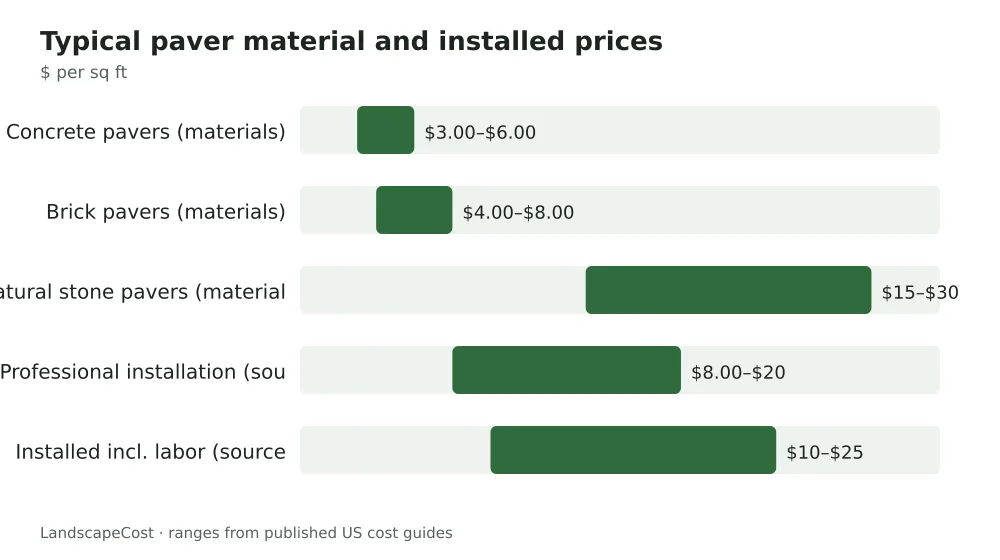
One published estimator puts professional paver installation at $8 to $20 per square foot and another quotes $10 to $25 installed with labor, with location moving the price within either range, while materials alone typically start at $3 to $6 per square foot for concrete pavers.
In one published example, 4,500 pavers at $0.50 each make a total pavers cost of $2,250, while the installation cost at $9 per square foot over 1,125 sq ft adds $10,125. That works out to $2 for pavers and $9 for labor, or $11 combined, so the cost per ft² of that patio is mostly the crew's time.
Pricing climbs fast with material. Concrete units at $3 to $6 sit far below natural stone at $15 to $30, so a 300 sq ft patio swings by thousands of dollars on that one choice before paver installation is counted.
Enter the pavers cost and an installation rate in the tool, or leave installation empty for a DIY total. Installed quotes sometimes already include the pavers, so check before adding both.
How much extra should you order to cover cuts and breakage?
Order 10% extra for straight layouts, 15% for diagonal, herringbone or curved work and 20% for complex shapes with many cuts; that allowance pays for cuts, breakage and a few spares for future replacements.
| Layout | Waste allowance | Reason |
|---|---|---|
| Straight (running or stacked bond) | 10% | Cuts only at the outline |
| Diagonal, herringbone or curved | 15% | Angled cuts along every edge |
| Circular layouts | 15% waste | Wedge cuts around the rim |
| Complex shapes | 20% | Many cuts at corners and inlets |
Sources disagree at the top end: one estimator puts diagonal work at 15% and another at 20%, and the popular 45-degree herringbone is where that gap matters. Add 15% as the planning figure and move toward 20% as complexity grows.
Flagstone is the exception. The stone is irregular, its coverage varies from one load to the next, and a fixed paver count means little, so flagstone is better bought by area with a margin.
Spares are invaluable later. A few leftover units from the same batch turn a cracked paver into a quick swap instead of a hunt for a matching color, which makes the waste line the cheapest insurance on the order.
Why choose pavers for a patio instead of a poured slab?
Pavers suit a patio because they are separate units: when one cracks, you lift and replace that unit, while a crack in a poured slab runs through the surface.
Pavers come in concrete, clay brick or natural stone, and a patio project can mix them for borders. A slab on its own is generally cheaper: poured concrete is the least costly surface overall, while stamped concrete ranks amongst the most expensive, which narrows the gap with pavers.
Climate cuts both ways. Porous stone and concrete pavers do not do well in freeze/thaw climates, where water inside a unit can freeze, expand and split it on the thaw, so cold climates call for dense units. Cracks in one paver mean a replacement of that unit only, and routine maintenance is mostly joints.
A solid base is the structural layer that keeps pavers from settling unevenly; a poured slab hides a weak base until it cracks, whereas pavers show it as a dip that can be lifted and relaid.
Which paver terms are worth knowing before you order?
A handful of terms decide most paver orders: unit thickness, base material, compaction lifts and the two kinds of sand used under and between the units.
Thickness is listed apart from size. Most pavers are 2 in (5 cm) thick, a 14 × 14 in (36 cm) unit is typically 3 in (7.6 cm), and a 12 × 18 in slab is typically 1.5 in (4 cm).
The compacted base is usually crushed stone or road base, spread and compacted in lifts rather than in one thick layer, and the finished result is compacted gravel that no longer moves underfoot. Paver sand is the bedding sand under the units, not the polymeric sand swept into the joints.
One habit saves more than any term: buy at least 10% more of everything. As with all construction works, paving invites slips, and every trip back and forth to the yard for a forgotten bag costs gasoline and an afternoon.
Frequently asked questions
What is the quickest way to calculate the pavers I need?
Calculate pavers by dividing the area in square feet by one paver's area in square feet, then add your waste allowance and round up to the nearest full paver.
Odd outlines split cleanly into simple pieces. A four-armed star built from five squares of 15 ft on a side has a patio area of 1,125 sq ft, and at 4 pavers per sq ft for 6 × 6 units that is 4,500 pavers before waste, or 4,950 at 10%. The answer must be a whole number, since nobody sells part of a paver.
Convert the count to pallets last. A pallet can hold between 78 and 160 sq ft, so divide the area plus waste by your supplier's coverage and round up. The Paver Calculator runs all three steps from the Known total area option.
How many 16x16 in pavers cover a 12x12 ft patio?
A 12 × 12 ft patio needs 81 pavers of 16 × 16 inches before waste, or 90 after a 10% straight-layout allowance.
The shortcut uses coverage per square foot. Each square foot takes 0.56 of a 16 × 16 paver (0.5625 exactly), so multiply the patio square footage by that figure: 144 × 0.5625 = 81. Dividing 144 sq ft by the rounded 1.77 sq ft face gives 81.4, which rounds up to 82, so use the exact 256 ÷ 144 when the count must be exact.
The common 10 × 10 ft version works the same way: 100 × 0.5625 = 56.25, so 57 pavers before waste and 62 with 10%. Large squares like these leave bigger offcuts, so a patio with a curved edge should move to 15%, which turns the 81 into 94 (81 × 1.15 = 93.15, rounded up).
Does a 45-degree pattern use more pavers than a 90-degree one?
Yes; a 45-degree pattern requires more pavers than a 90-degree pattern, because units along every straight edge must be cut on the angle and the offcuts rarely fit anywhere else.
Herringbone can be laid at 90° or 45°, and the 45° version is the one treated as diagonal. Published allowances put straight work at 10% and diagonal work at 15%, with one estimator calling for 20% more.
On a 300 sq ft patio of 4 × 8 pavers, moving from 10% to 15% adds 68 units, from 1,485 to 1,553. Angled cuts also produce more broken pavers, and running out mid-job means additional materials that may come from a different batch. Pick the Diagonal, herringbone, curved or circular option in the tool's pattern list and the 15% is applied automatically, or choose Custom to plan at 20%.
How many pavers are on a pallet?
Depending on size, one pallet covers between 78 and 160 sq ft, and a standard pallet of 4 × 8 pavers often covers roughly 100 to 120 sq ft, which is about 450 to 540 pieces.
Supplier ads and price lists usually quote pallets in square feet rather than pieces, so convert with the paver's coverage. A front walkway of 50 × 4 ft is 200 sq ft, or 220 sq ft with 10% waste, which means 3 pallets at 100 sq ft each or 2 at 120.
Large-format units fill a pallet with fewer pieces, so the piece count always depends on the size. Enter the supplier's figure in the coverage field and the Paver Calculator rounds pallets up.
What is the standard paver size?
The standard paver size in the US is 4 × 8 inches (10 cm × 20 cm), the brick-shaped unit sold for patios, walkways and driveways.
Brick sizes are often nominal. A standard brick at 3.75 × 7.75 inches is listed at about 4.8 per square foot, while a full 4 × 8 gives 4.5, so check which dimension a price list means before multiplying.
In a supplier glossary, a nominal size usually includes the joint and the actual size is the unit itself. When the two differ, choose Custom in the tool and enter the actual dimensions plus your joint gap, and the count follows the real layout. Check the spec sheet for 12 × 12 and 16 × 16 squares the same way, because each preset uses the stated size.
How do you work out pavers for a round patio?
For a circle, find the area with π × radius × radius, divide it by one paver's area and add 15% for the curved cuts.
Take a round patio with a 12 ft diameter: the radius is 6 ft, π × 36 = 113.1 sq ft, and 4 × 8 pavers at 4.5 per sq ft give 508.9, or 586 after 15%. The edge restraint for that circle is π × 12, about 37.7 ft.
Circles are built into the Paver Calculator, which takes the diameter and does the rest. Half-round and quarter-round shapes use the same area divided by 2 or 4, entered as Known total area. Small units such as 4 × 8 bricks follow a curve with smaller cuts than large squares, so a round patio in big slabs may need more than 15%.
How much do pavers cost per square foot?
Pavers cost about $3 to $6 per square foot for concrete pavers, $4 to $8 for brick pavers and $15 to $30 for natural stone pavers, before labor.
Of every type of paver, concrete is the least expensive; brick and stone cost more for the same area. One source puts installed prices with labor at $10 to $25 per square foot and another gives $8 to $20 for professional installation, with location and job complexity setting the point in either band.
For a 20 × 20 ft patio of 400 sq ft, materials alone run $1,200 to $2,400 in concrete, $1,600 to $3,200 in brick and $6,000 to $12,000 in natural stone, before the 10% waste allowance. Base gravel, bedding sand, joint sand and edge restraint sit on top of those figures, so enter a full per-square-foot price if your supplier quotes one.
Are pavers cheaper than concrete?
Pavers are not cheaper than plain poured concrete, which is generally the least expensive surface, but concrete pavers are the cheapest paver type and stamped concrete can cost as much or more.
A professional job is the fair comparison: one source gives an installed cost of $10 to $25 per square foot and another an average cost of $8 to $20, and either band can be held against a slab quote. If you install them yourself, the labor share disappears, but the job needs tools such as a plate compactor and a saw for cuts, rented or bought.
Price is only part of the comparison. Pavers are durable and can stay sound for many years, and paved patios avoid the way solid surfaces crack where temperatures swing, so a higher price can still be the better buy.
What are the disadvantages of pavers?
The main disadvantages of pavers are cracking in freeze/thaw climates, staining on concrete units, weeds in the joints and ongoing upkeep of the joint sand.
Where the temperature changes drastically between seasons, water in porous units freezes and cracks them, while dense pavers handle varying weather better. Concrete pavers can stain, and unsealed surfaces exposed to sun and weather may show fading over time.
A coat of sealer can protect the surface from stains, fading and weed growth, but it adds a recurring job. Joints also need occasional topping up, and a single sunken paver has to be lifted and reset by hand. None of these problems is hidden, though: each shows up unit by unit, so repairs stay small compared with replacing a cracked slab.
Do I need to seal my pavers?
Sealing pavers is optional but recommended for many installations, and the right time is 6 to 12 months after the pavers go down, when the surface has cured fully.
A paver sealer guards concrete units, which can be stained easily. Waiting also lets efflorescence show itself first: the white chalky residue that appears when salts travel to the surface with moisture, best cleaned off before any sealer goes on.
Reapply every 3 to 5 years, sooner where traffic and weather exposure are heavy; the 3 to 5 range assumes average use. Day-to-day care stays low maintenance, since cleaning is usually water with a little soap. Pavers can stay almost unchanged for years without a coat, so seal them for looks and stain protection rather than because a brand new patio needs it.