On this page
- How to use the Artificial Turf Cost Calculator
- How the Artificial Turf Cost Calculator calculates your result
- What is included in the artificial turf price per square foot?
- What drives artificial turf cost up or down?
- How does turf quality change the price?
- What does artificial turf cost to own over the years?
- Is artificial turf cheaper than natural grass in the long run?
- How does the type of project change artificial turf cost?
- How do you estimate artificial turf cost for your own yard?
- Is DIY artificial turf installation cheaper than hiring a pro?
- Does artificial turf pay for itself, and what does it add to a home?
- What water and environmental savings do turf sellers claim?
- Frequently asked questions
How much does artificial turf cost?
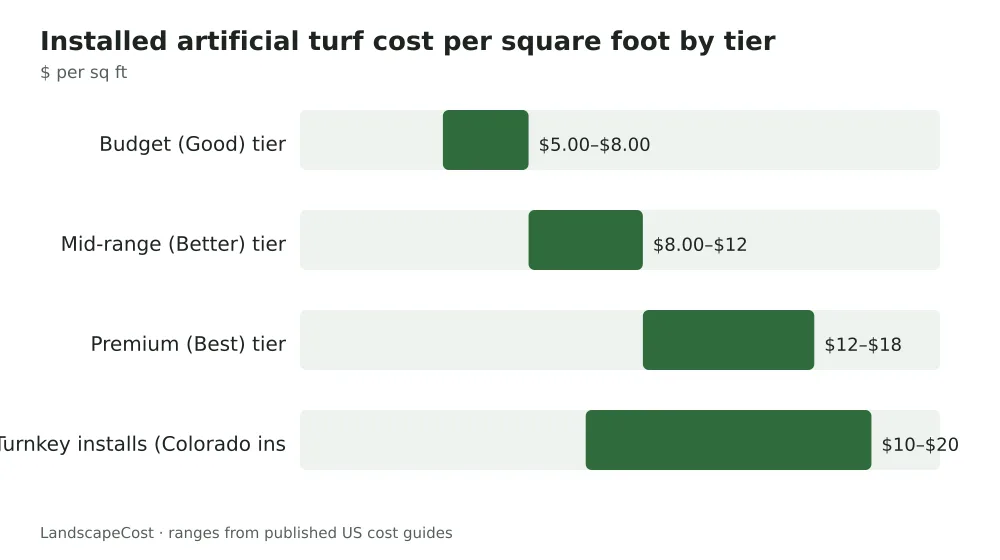
Artificial turf costs about $5 to $18 per square foot installed, materials and labor included: roughly $5–$8 for budget turf, $8–$12 for mid-range and $12–$18+ for premium, so a 1,000 sq ft lawn typically lands at $8,000–$15,000.
Those bands come from a national cost guide that prices turf by the finished square foot. Installation often takes half or more of the bill, so labor costs move a quote as much as the turf fibers do, and the low range buys turf at an affordable price. You can compare similar projects in our Lawn, Sod & Turf Calculators collection.
| Price tier | Installed cost per sq ft | Rate x 1,000 sq ft (simple math) |
|---|---|---|
| Budget (low) | $5–$8 | $5,000–$8,000 |
| Mid-range | $8–$12 | $8,000–$12,000 |
| Premium (high) | $12–$18+ | $12,000–$18,000+ |
The last column is plain rate x area; the guide's own 1,000 sq ft figure is the $8,000–$15,000 above. Small jobs follow their own math: the same guide prices a 200 sq ft lawn at $1,600–$3,000, because a crew and base work arrive no matter how small the patch is. For related projects, see the sod installation cost calculator section.
How to use the Artificial Turf Cost Calculator
The Artificial Turf Cost Calculator turns four key inputs, lawn size, turf material quality, who installs and site conditions, into a price range, a midpoint, a likely figure, the cost per square foot and the turf to order. Planning more than one job? The sod calculator works the same way.
- Measure the yard. Enter length and width so the calculator can plan roll strips, or type the square footage of an irregular shape.
- Pick a quality tier. Good is the budget band, Better adds enhanced durability and comfort, and Best covers the softest, longest-lasting products with a taller pile height.
- Choose who installs. Professional installation prices materials plus labor; DIY installation shows the materials share, which is how owners save money.
- Describe the site. Set ground conditions (Bare, Patchy, Sod), access (Easy, Medium, Hard) and shape.
- Read the result. Add infill and any cutting allowance, then read the range, the split and the base and infill quantities.
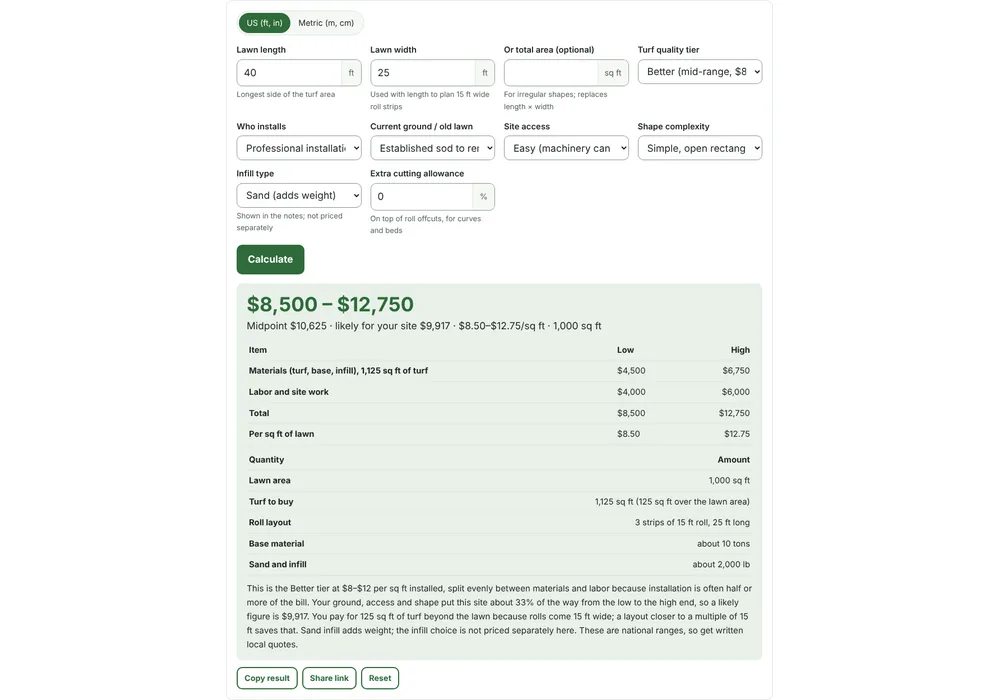
Worked example for a 1,000 square foot lawn: 40 x 25 ft (1,000 sq ft), Better tier, professional install, existing sod, easy access, simple shape, sand infill, no extra waste. Result: three 15-ft strips 25 ft long (1,125 sq ft of turf), $8,500 to $12,750, midpoint $10,625, about $9,917 likely for this site, $8.50 to $12.75 per sq ft, roughly 10 tons of base and 2,000 lb of sand and infill.
Treat that figure as a rough estimate: turf has a grain, so an installer may run strips another way to keep the blades leaning together.
How the Artificial Turf Cost Calculator calculates your result
The Artificial Turf Cost Calculator multiplies your lawn area and the turf you must order by published installed rates per square foot, then splits each rate evenly between materials and labor.
The calculator logic starts with the roll. Turf ships in 15-foot wide rolls up to 100 feet long and is sold by the linear foot, so a yard 17 feet wide needs two strips and, by one Colorado installer's account, has doubled the cost of turf for two extra feet. The tool tries both strip directions and keeps the smaller offcut.
- A (lawn area): length x width, or the typed area, in sq ft.
- T (turf ordered): strips x 15 ft x strip length, plus any cutting allowance.
- Rate: the three quality tiers follow the guide's national ranges of $5–$8 (Good), $8–$12 (Better, the mid range) and $12–$18+ (Best, the high range, capped at $18 in the tool).
- Split: the cost of materials is 50% of the rate x T; labor costs are 50% of the rate x A. A pro total adds both; DIY counts materials only.
- Site position: the ground condition options, accessibility options and shape (curves, tight spaces, terrain complexity) each score 0, 0.5 or 1; the average places the likely figure between low and high.
- Quantities: about 1 ton of base per 100 sqft and 2 pounds of infill and sand for each square foot, per the same installer.
The tier mapping, the 50/50 split and the 0, 0.5 or 1 site scoring are the tool's own planning assumptions for budgeting, not published methods, so the true cost of labor on a hard site can run higher.
What is included in the artificial turf price per square foot?
Artificial turf typically falls somewhere between $5 and $18 a square foot once installed, and that single rate already bundles materials, labor, site preparation and base preparation into one number.
Grass removal, grading, a compacted base, sand infill, edging and custom cuts all ride inside the per-foot quote, which is why the grass cost on a roll's price tag looks far lower. Installation complexity pushes a job from the low range toward the high range faster than extra durability does.
Size works in two directions. Larger lawns usually lower the turf cost per sq ft while raising the total: the guide's 1,000 sq ft example sits at $8,000 to $15,000. Smaller lawns carry fixed installation expenses and fixed labor costs, so a 200 sq ft strip still runs $1,600 to $3,000.
Before installing, check whether site prep is its own line; a quote without it can look cheaper while covering less.
What drives artificial turf cost up or down?
Artificial turf cost is driven mostly by lawn size, then by site preparation, the product chosen and how hard the space is to work in.
Size sets the scale. One Colorado installer's calculator sorts jobs into project size bands: starting under 750 square feet, then 751 to 1,000 square feet, next 1,001 to 1,500 square feet, then 1,501 to 2,000 square feet, after that 2,001 to 3,000 square feet, and finally 3,001+ square feet, with volume pricing for the bigger brackets, which typically favors one combined contract.
Grass removal and base preparation cost about the same on a small plot as on a big one, so site prep weighs heavier per foot on compact yards. Skipped steps become mistakes and future expenses.
Product and use finish the list. Polypropylene trades a shorter lifespan for a lower grass cost, while synthetic lawn systems built for dogs, playgrounds or rooftops must cope with odors, wear and weight, and that artificial turf costs more.
How does turf quality change the price?
Turf quality changes the price through the fiber, the backing, the infill and the extras, and each upgrade adds to the material cost per square foot.
A manufactured grass surface is only as good as its synthetic grass fibers and what holds them. High-traffic areas call for stronger backing. A Florida seller says its turf carries U.V. inhibitors against fading and a tuft bind for durability. Get any warranty in writing, since a label such as "15 year warranty" says nothing about what it covers.
Infills are a second lever: organic infill reduces heat and rubber infill adds resilience, while shock pads raise comfort and safety, each improving long-term performance at a price.
Backyards with dogs steer pet owners toward drainage-first products, traffic intensity and safety considerations rule play areas, and front lawns trade on curb appeal. Tight seams and clean edging keep any tier looking right with minimal maintenance.
What does artificial turf cost to own over the years?
Artificial turf costs little to own once it is in, because occasional brushing and minor fixes replace the mowing, feeding and watering a natural lawn needs.
The higher initial investment is the trade: turf front-loads spending, while sod and seed spread it across years of lawn care. Whether turf becomes the economical choice depends on its lifespan and durability: thin, low-density products flatten sooner, need more correction, and bring earlier replacement costs.
Reduced maintenance also means fewer machines and chemicals. A Florida turf seller says five percent of US air pollution comes from lawn and gardening equipment, and cites the Environmental Protection Agency for a claim that toxic fertilizers and pesticides totaling over 65 million pounds reach the local water supply each year as non-point source pollution.
For a low-maintenance yard in Colorado or elsewhere, the national guide says the initial investment returns long-term value as reduced upkeep and a consistent appearance compared with natural grass.
Is artificial turf cheaper than natural grass in the long run?
Artificial turf usually costs more on day one but less over a long ownership period, because natural grass keeps billing you every year for mowing, water, feeding and repairs.
Two turf companies priced a year of grass care, and their lists differ in scope:
| Natural-lawn line item | Colorado installer | Florida seller |
|---|---|---|
| Mowing | $1,440 per year (bi-weekly at $60 per visit) | $100 per month, $1,200 per year (with trimming) |
| Fertilizer and weed control | $450 | $8.50 per month ($102 per year) each |
| Water | $400 per year | $57 per month ($684 per year) |
| Aeration, overseeding, pest control | $150, $200, $235 | not listed |
| Irrigation repair | not listed | $15 per month ($180 per year) |
| Yearly total | $1,600 to $3,300 | $189 per month, $2,268 per year |
The turf side of the ledger is short: brushing, cleaning and small repairs, often done without professional lawn care. The break-even point arrives once yearly savings, water savings included, cover the price gap.
How does the type of project change artificial turf cost?
The type of project changes artificial turf cost because each use asks for a different fiber, base and drainage setup, and commercial installations sit above residential work in price.
A front yard is bought for aesthetic appeal and curb appeal, which suits polyethylene with its softness and realistic texture. Low maintenance appeal counts too, since an unmowed yard keeps its appearance.
Dog runs flip the priorities. Pet owners need fast drainage, sometimes enhanced drainage layers, plus a routine for pet waste. Yards in regions with heavy rainfall may also need french drains below the artificial lawn.
A school or business with high-traffic paths leans toward nylon, which holds shape under constant use but costs more. Those jobs often need deeper bases and extra base preparation, buying durability with a larger budget.
How do you estimate artificial turf cost for your own yard?
You estimate artificial turf cost by measuring the size of your yard, multiplying it by an installed rate for your material quality, then adjusting for ground, access and shape.
Installers quote on a per-square-foot basis, so sketch the lawn in rectangles and mark slopes, curves and beds. A bare yard that is already sloped for runoff needs less work than one covered in patchy grass or thick sod that calls for soil removal and fresh base preparation.
A Colorado installer's page, citing national survey data, puts a typical residential install between $2,000 and $8,000, says a 500-square-foot job averages around $6,250, and lists $2,500 - $9,000 in Colorado against $2,000 to $8,000 nationwide.
Recreational spaces at a school or business follow the same method with heavier products. For any artificial grass project, line the bids up, check that the installed scope matches item by item, and add expected annual maintenance before comparing totals.
Is DIY artificial turf installation cheaper than hiring a pro?
DIY artificial turf installation is cheaper in cash because it removes labor, which is half or more of a typical bill, but the base work is heavy and errors there are costly to undo.
Before any roll goes down, someone must clear rocks, roots near trees and old sprinkler systems, then handle the dirt work, the grading of uneven soil, compaction of crushed stone bases and a weed barrier. A full roll weighs about 1,000 pounds per roll, so machinery helps, and a narrow side gate means moving material by hand.
Accessibility and installation complexity are where a crew earns its fee, as are strict drainage requirements or a dog run that needs enhanced drainage. Before digging out the old lawn, call 811 so buried utility lines are marked, and check HOA and local rules on artificial turf.
DIY suits a small, flat, open lot. Measure square footage twice, price the materials share, and weigh it against the upfront cost of a pro. On a major investment, a failed base can turn DIY installation costs into the larger initial investment in the end.
Does artificial turf pay for itself, and what does it add to a home?
Artificial turf can pay for itself over time, but published payback periods run from about 2.5 to 7 years, and every one comes from a company that sells or installs turf.
A Florida seller claims a typical install can recuperate the owner's investment in 3-5 years, and models 1,200 square feet of lawn:
| Seller's 1,200 sq ft example | Synthetic grass | Natural grass |
|---|---|---|
| Installed price | $9.00 sq ft, $10,800 | $6.25 sq ft, $7,500 (incl. a $4,500 irrigation system) |
| Yearly upkeep | $300 per year | $2,268 per year |
| Total after 12 years | $14,400 | $34,716 |
The same page quotes a power brush service at $175 per year and an ROI in about 2.5 years, which does not match its own $300 yearly figure. A Colorado installer is more cautious: about 7 years to break even against a sod yard, on its stated assumptions of a $750 install and $850 a year in upkeep.
On resale, front yards in high-quality turf with a realistic texture offer long-term savings over a traditional lawn or fresh sod, though none of these sources measures a price premium.
What water and environmental savings do turf sellers claim?
Turf sellers claim that a synthetic lawn cuts water use, chemical use and mower emissions, but their figures are marketing numbers, not measured results for your yard.
The eco-friendly pitch rests on water first. Rising water bills push many owners toward turf, and water savings are the easiest benefit to verify: compare a summer bill before and after the switch.
Regional considerations decide how much this matters: a Colorado installer names water conservation as a concern in Colorado, where the maintenance savings carry more weight. Dropping fertilizer also ends the feeding schedule.
The softer benefits are real but hard to price. A Colorado installer frames turf as an upgrade to a home and to quality of life, and lists market perception among the things that shape its long-term value.
Frequently asked questions
What is the price range for artificial turf per square foot?
Artificial turf runs from about $5 to $18+ per square foot installed across the national cost guide's budget, mid-range and premium tiers. A Colorado installer puts most turnkey installs at $10-$20 per square foot, a little above those national averages. Taller blades, higher density and denser stitching use more fiber and push a product toward the top band. The calculator above applies the tier you pick to your own measurements.
What does 1,000 sq ft of artificial grass cost?
A 1,000 sq ft artificial grass lawn costs about $8,000–$15,000 installed, according to a national cost guide. The cost to install that area sits near the bottom when the ground is bare and access is easy, then climbs with material quality and site preparation.
Worked through the calculator, a 40 x 25 ft yard on the Better tier comes to $8,500 to $12,750, or $8.50 to $12.75 per square foot, because three 15-ft strips leave 125 sq ft of offcut that still has to be bought. Divide any quote's total by 1,000 to compare its installation cost per foot with these figures.
What does a small 200 sq ft turf lawn cost?
A 200 sq ft turf lawn costs about $1,600 to $3,000 installed, according to a national cost guide, because a crew's setup does not shrink with the lawn. Fixed labor costs tied to crew size and minimum labor hours stay put, and so do grading, crushed stone bases, weed barriers, infill and drainage work. Installation complexity matters more on tiny lawns wrapped around beds and paths, where much of the time goes into cutting. Ask whether a small-job minimum applies before comparing labor costs, and price the turf itself as a separate line.
What goes into the cost to install artificial turf?
The cost to install artificial turf covers the turf, the base underneath, the infill on top and the labor to put all three together, scaled by lawn size. Under the turf sits the base preparation: a compacted layer, often crushed granite, that smooths the ground and drains it. On top, silica sand weighs the turf down and helps the blades stand up.
The turf's backing materials matter too, since polyurethane backing usually costs more than latex but adds stability. Two budgeting tips follow: price base and infill as separate lines, and ask which backing each bid includes.
Is it cheaper to lay turf or install artificial grass?
Natural sod is cheaper to lay upfront, but artificial grass installed on a sound base often costs less over the long-term thanks to reduced maintenance and water savings. Owners who lay turf save on day one only. Natural grass is cheaper upfront because its initial cost skips the deep base and synthetic fiber. The gap closes through annual maintenance: once yearly savings repay the difference, the lawn passes its break-even point.
A Florida turf seller adds that over 50 percent of a typical water bill goes to watering grass and, citing the Southern Nevada Water Authority, that synthetic grass can conserve water by up to 55 gallons per square foot; check those seller figures against your own meter.