On this page
- How to use the Sod Calculator
- How the Sod Calculator calculates your result
- How do you measure a lawn for sod, one shape at a time?
- How much sod should you order for the square footage you measured?
- What does a complete sod order look like on a real yard layout?
- How much ground does a roll, a slab or a pallet of sod cover?
- What should a good online sod calculator tell you?
- How do you turn a sod quantity into a price estimate?
- How do delivery and pallet prices work when you order sod?
- What changes when you choose sod instead of grass seed?
- Frequently asked questions
How Much Sod Do I Need for My Lawn?
To work out how much sod you need, measure each part of the lawn in feet, multiply length by width (or use the triangle or circle formula), add the parts, subtract beds and paths, add 5-10% for waste, then divide by the coverage of one roll or one pallet (450 sq ft in most published guides) and round up: a 2,240 sq ft lawn plus 10% waste is 2,464 sq ft, which is 247 rolls of 10 sq ft or 6 pallets.
Most online sod calculators accept one rectangle, yet a sod lawn around a house rarely is one. A yard usually breaks into smaller, regularly shaped areas such as rectangles and squares, and irregularly shaped areas are where guesses go wrong. The tool above takes four shapes at once, so you measure each shape and it does the adding. You can compare similar projects in our Lawn, Sod & Turf Calculators collection.
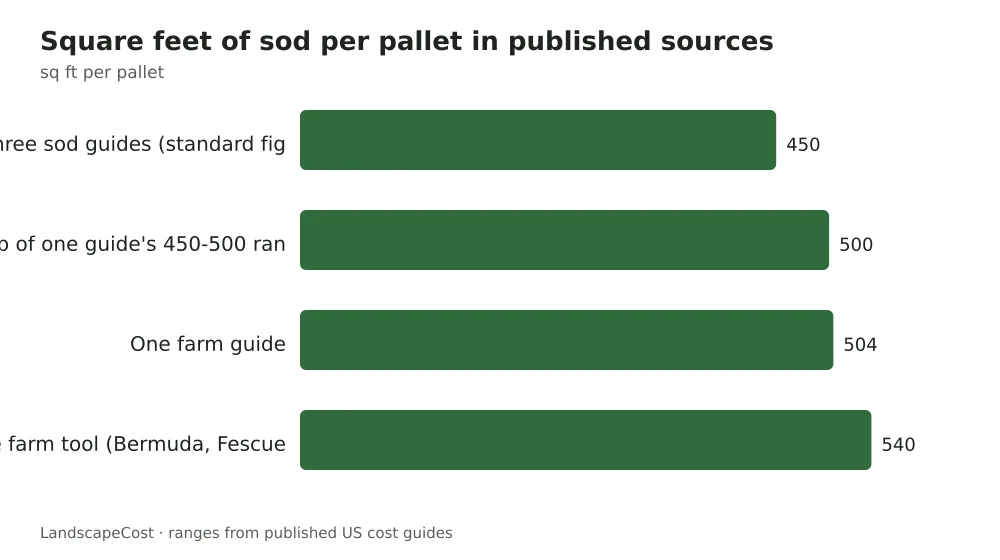
The second number is the unit you buy in: loose rolls, flat slabs or whole pallets, with the pallet count setting most delivery prices. Three published sod guides give 450 square feet per pallet, the tool's default. This guide shows how to measure your yard and read the result.
How to use the Sod Calculator
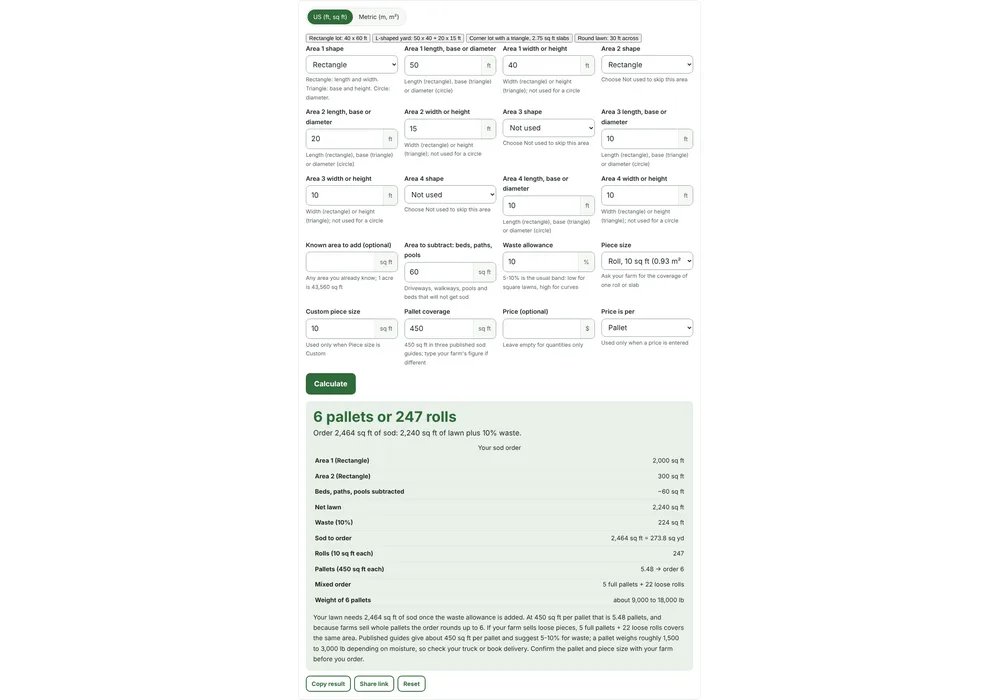
The Sod Calculator turns up to four measured areas, a waste allowance, a piece size and a pallet size into the square footage to order, the number of rolls or slabs and the exact number of pallets, updating as you type. Work through the form in these steps: Planning more than one job? The artificial turf cost calculator works the same way.
- Units: keep US (ft, sq ft) or switch to Metric (m, m²); values already typed convert when you switch.
- Areas 1 to 4: choose a shape for each row (rectangle, triangle, circle or Not used) and enter its dimensions. Rectangles take length and width, triangles take base and height, circles take the diameter.
- Add and subtract: an optional known area, plus the beds, paths and pools to take out.
- Waste: the percentage added on top of the net area, 10% by default.
- Piece and pallet: a 10 sq ft roll, a 2.75 sq ft slab or a custom piece, and the coverage of one pallet, 450 sq ft by default.
- Price (optional): one price, per pallet or per piece.
Each area row works separately, so you measure each one and the tool adds them. An L-shape is two rectangles: an L-shaped yard with a 50 × 40 ft block and a 20 × 15 ft strip fills Area 1 and Area 2. Any yard shape built from rectangles, triangles and circles fits the same way, and the quick buttons load common shapes, such as a 40 ft × 60 ft lot of 2,400 sq ft.
Worked example: Area 1 a rectangle 50 ft by 40 ft, Area 2 a rectangle 20 ft by 15 ft, 60 sq ft subtracted for a flower bed, 10% waste, 10 sq ft rolls and 450 sq ft pallets. The tool shows a net 2,240 sq ft and a total square footage to order of 2,464 sq ft (273.8 sq yd, or 228.9 m²).
The same run gives 247 rolls and 5.48 pallets; round up and the order is 6 pallets, or 5 full pallets plus 22 loose rolls. Six pallets weigh roughly 9,000 to 18,000 lbs.
The price box is optional. If you know the price of a specific type of sod, insert that price per pallet or per piece for a more accurate estimate of the material bill; leave it empty and the tool reports quantity and square footage alone. A copied link reopens the same order.
How the Sod Calculator calculates your result
The Sod Calculator finds the area of each shape, adds them, removes the parts that stay bare, adds the waste percentage and then divides by the coverage of one piece and of one pallet, rounding each count up to whole units. The geometry is standard plane-area math; the default sizes come from published sod guides.
| Step | Formula | Default and source |
|---|---|---|
| Rectangle area | length × width | Dimensions in feet, result in square feet |
| Triangle area | (base × height) ÷ 2 | Height measured square to the base |
| Circle area | 3.1416 × radius², radius = diameter ÷ 2 | Diameter in feet |
| Net lawn | Areas + known area − subtracted area | Beds, paths and pools removed |
| Order area | Net × (1 + waste ÷ 100) | 10%, inside the published 5-10% band |
| Pieces | Order ÷ piece size, rounded up | 10 sq ft roll (one tool guide) or 2.75 sq ft slab (one sod guide) |
| Pallets | Order ÷ pallet coverage, rounded up | 450 square feet (three sod guides) |
| Mixed order | Full pallets + leftover area ÷ piece size, rounded up | Same sizes |
| Weight | Pallets × 1,500 to 3,000 lbs | One guide's range, set by moisture |
| Square yards | Order ÷ 9 | 9 sq ft per sq yd |
| Cost (optional) | Pallets × price per pallet, or pieces × price per piece | Your own price |
For a rectangle, multiply length by width; triangles use base and height; for circles the tool halves the diameter to get the radius. A circle combination or odd shape still reduces to these formulas, entered as extra rows.
The tool will divide the total square footage by the pallet coverage, 450 sq ft unless changed, and round up. A 16" x 24" cut listed at 2.75 square feet means you divide by 2.75; strictly, 16 by 24 inches is 2.67 sq ft, so ask the farm.
One guide says a pallet weighs 1,500 lbs to 3,000 lbs by moisture; another puts a sod pallet at 2,800 to 3,000 lbs, so plan a truck for the top of the band. Every result rests on the square footage you enter.
How do you measure a lawn for sod, one shape at a time?
A lawn is measured for sod by breaking it into simple shapes, finding each shape's area in square feet, totaling the pieces and taking out everything that will stay bare. The sequence matters, because a skipped step is how most counts drift:
- Draw the yard from above and shade the areas that won't get sod: driveways, walkways, pools and beds.
- Split the grass into rectangles and triangles; a trapezoid or parallelogram becomes one rectangle plus triangles.
- Measure every piece in feet, to the nearest half foot.
- Calculate the area of each piece, length × width for every rectangle.
- Add them together, then subtract the non-lawn areas you shaded.
Around curved beds, take the widest rectangle that contains the curve and count roughly half of the unused corner area as lawn.
Guessing costs more than measuring: homeowners can easily misjudge a lot that looks like about a quarter acre (10,890 sq ft) by eye. Small sections also cap measuring error, since a one-foot slip on a 20 ft side shifts only that piece, by 5%.
How much sod should you order for the square footage you measured?
Order the net area you measured, add 5–10% for waste, and convert the result into whole pallets or loose pieces depending on the size of the job.
Every lawn loses turf at its edges, along curves and in the cuts around trees and steps, and a little extra sod covers the seam that refuses to close.
Sod is sold by the pallet for larger projects, and pallet sizing sets the step: an order 10 square feet past a 450 sq ft boundary forces one more pallet, so effective ordering means checking that remainder before ordering.
For tiny areas and small areas, buying by the roll, by the piece or as a half-pallet is the better option. Published guides suggest buying by the pallets once the job passes 400 square feet, just under one pallet, and that is where a sod order shifts to whole pallets.
What does a complete sod order look like on a real yard layout?
A corner lot with a 60 × 35 ft back lawn, a 30 × 20 ft triangular side strip and 200 sq ft of paths and beds needs 2,354 sq ft of sod at a 7% allowance, which is 856 slabs of 2.75 sq ft or 6 pallets. The layout breaks down like this:
| Piece of the layout | Measurement | Square feet |
|---|---|---|
| Back lawn (rectangle) | 60 ft × 35 ft | 2,100 |
| Side strip (triangle) | (30 ft × 20 ft) ÷ 2 | 300 |
| Walkway beside the driveway | 3 ft × 30 ft | −90 |
| Planting beds | Measured as small rectangles | −110 |
| Net lawn | 2,200 | |
| Order with 7% waste | 2,200 × 1.07 | 2,354 |
Corner lots often hide triangles where the lot line angles away. Subtract the walkways, the driveway edge and the beds before adding waste, or the allowance is figured on ground that never gets grass.
Dividing 2,354 by 450 gives a pallet count of 5.23. Partial pallets aren't sold by most farms, so the order moves to the next full pallet, 6, or to 5 pallets plus 38 loose slabs. Under one published quick method, 5 pallets cover a 2,000 sq ft yard, so the extra area here adds a whole pallet to the pallet count.
The net square footage is about 0.05 acres in acreage terms, and the total square footage stays the same for any grass type. Test the pH too: soil that is acidic or alkaline may need you to amend the soil, and 2" to 3" of compost over 2,200 sq ft is 13.6 to 20.4 cubic yards, which a soil calculator confirms.
How much ground does a roll, a slab or a pallet of sod cover?
In the published guides, one pallet of turf covers approximately 450 sq ft, while a single roll covers about 10 sq ft and a pre-cut 16 × 24 inch piece about 2.75 sq ft, so the piece size decides how many units make up a pallet.
| Unit | Typical size | Coverage | Where the figure comes from |
|---|---|---|---|
| Roll | 16" to 24" wide, 3 1/2' to 6' long | About 10 sq ft | One sod tool guide |
| Pre-cut piece | 16 × 24 in | 2.75 sq ft | One sod guide |
| Large slab | Up to 4' wide | Ask the farm | One sod tool guide |
| Pallet | 45 rolls of 10 sq ft in one example | 450 sq ft (450-500 in one guide) | Three sod guides |
Sod leaves the farm as pre-cut rectangles, stacked flat as slabs or rolled. The machine a grower uses to harvest the turf sets the piece size, so lengths vary between farms and square feet per roll matters more than the count of rolls.
One guide's example divides 567 rolls by 45 rolls/pallet to get 12.6 pallets, or 12 pallets plus 27 rolls; at 10 sq ft a roll, 45 rolls is exactly 450 sq ft.
Coverage holds regardless of variety: a Florida farm lists 450 sq ft for St. Augustine, Zoysia, Bermuda and Bahia, so grass type changes the price, not the count, while moisture content changes the weight.
What should a good online sod calculator tell you?
A good online sod calculator reports the order in square feet, pieces and whole pallets, shows the waste it added, and lets you change the pallet size to match your farm. Several free tools stop at total square feet plus a fixed 10%.
A calculator that quietly adds a fixed waste percentage hides a waste allowance you might trim for a square lot or raise for a curvy one. An estimate of pallets is only as good as its coverage figure, and the supplier knows the pallet size.
Some farm tools show an estimated supply cost for each type of sod and add delivery, and some farms deliver for a small fee. For how much sod costs with contractors and installation, use an installed-cost estimate; the cost line here is material only, just as a lawn mowing calculator handles upkeep.
How do you turn a sod quantity into a price estimate?
A sod quantity becomes a price estimate when you multiply the units you will buy by the price per unit: pallets times the price per pallet, or rolls times the price per roll. The hard part is a real figure for each variety.
In one published example, a 0.13 acres lawn of Kentucky Bluegrass converts to 0.13 × 43,560 sq ft = 5,662.8 sq ft, or 567 rolls of 10 sq ft; at $4 per roll the total sod cost is $2,268, an illustrative rate with no waste added.
Farms quote a price for each grass variety per pallet, and St. Augustine, Zoysia, Bermuda and Bahia can sit far apart. Enter your figure in the price box for an approximate cost of material.
The price for your new lawn as a finished job adds delivery, soil work and labor, so the material cost is one line of the total cost. Ask for an instant quote or a written complete price first.
How do delivery and pallet prices work when you order sod?
Sod delivery is either charged as its own fee or built into the pallet price, so check which one a farm uses before comparing offers. One Jacksonville, Florida farm's price list shows $300/pallet for St. Augustine, $350/pallet for Zoysia, $325/pallet for Bermuda and $200/pallet for Bahia, with delivery included, so there is no need to add delivery separately; those are one vendor's prices, not national averages.
Elsewhere delivery charges are a line of their own, and a quote that leaves them out is not a firm number.
Have the bed ready before the truck arrives: tilled soil worked 6" to 8" deep, leveled soil, and fresh topsoil where needed, screened of impurities and clumps. Laying sod on delivery day avoids a mid-project shortfall of fresh pieces.
What changes when you choose sod instead of grass seed?
Choosing sod instead of grass seed buys an instant lawn, and it swaps the wait for germination for a heavy delivery that must be laid quickly. Direct seeding is tied to the planting season, and seeding a bare lot can leave weeks of muddy soil and room for weeds.
A grass seed estimate needs a seeding rate for the chosen grass; a sod estimate needs only area and piece size, which is why the quantities on this page are pure geometry.
Transporting sod yourself is easy to underrate. With a pallet at 1,500 to 3,000 lbs, a truck or trailer must be rated for the weight and you need a way to load safely, so some buyers haul only a few rolls themselves.
Among the mistakes to avoid, two leave a lawn short most often: rounding the pallet count down and skipping the waste allowance.
Frequently asked questions
Which tools do I need to measure my yard for sod?
The main tool for measuring a yard for sod is a long tape measure: record the length and width of every grass area in feet, multiply each pair, and add the results. A pen, paper and a calculator are enough for most lots, and graph paper keeps a rough sketch close to scale.
A measuring wheel speeds up long runs along a fence or curb, and a smartphone app or digital measuring tool can double-check a distance you are unsure of. Mark the house footprint and the garden beds on the sketch before you start, so they can be subtracted later rather than measured as lawn by mistake.
Measure to the line where new turf will meet a hard edge, not to the property line, since sod stops at the patio or path.
How many square feet of lawn does one pallet of sod cover?
A standard pallet of sod covers about 450 square feet in the three published guides used here, and one of them gives a range of 450-500 square feet. The number of pieces on it depends on the size of the roll.
That same guide lists 60 rolls or 100 slabs per pallet, yet its own worked example uses 45 rolls of 10 sq ft. Sixty rolls on 450 sq ft would mean 7.5 sq ft rolls, and 100 slabs would mean 4.5 sq ft slabs, so those counts cannot all describe one pallet.
For that reason the Sod Calculator never assumes a fixed piece count; it divides the pallet coverage by the piece size you choose. Farms with non-standard sizes state their own coverage, so ask the supplier and type that figure into the pallet box.
How much extra sod should I add for waste?
Add 5–10% extra sod to the measured area for waste, using the low end for a square, open lawn and the top of the range for curved edges and many obstacles. The buffer pays for trimming and cutting at every bed and path, plus small measuring slips.
One published front-yard example applies +8% waste to a 2,580 sq ft subtotal to reach 2,786 sq ft; 2,786 ÷ 450 = 6.19, so the order is 7 pallets, since a partial pallet is rarely sold. Round up, never down: rounding down saves one pallet and risks a second delivery.
Padding has limits, because unused sod does not keep. If patches turn sparse or yellow after the turf starts to root, the usual fix is to overseed them with the same type of grass, then fertilize and water them with the rest of the lawn.
How should I measure an irregularly shaped yard for sod?
Measure an irregularly shaped yard by dividing it into rectangles and triangles, finding the area of each, then adding the pieces and taking out the beds and walkways. Corner lots and irregular property lines often need 4–6 sections rather than one shape.
A published front yard layout shows the pattern: a main lawn of 45 ft × 50 ft (2,250 sq ft) plus a side yard of 15 ft × 30 ft (450 sq ft), minus a curved bed cutout of −120 sq ft, gives a subtotal of 2,580 sq ft before waste. In the Sod Calculator, that is two rectangle rows and 120 in the subtract box.
For curved beds, the rectangle-and-half method slightly overestimates material, which errs on the safe side of the order. The same approach works for any yard: pieces you measure individually, then add or subtract, give a closer total than one rough outline.