On this page
- How to use the Sod Installation Cost Calculator
- How the Sod Installation Cost Calculator calculates your result
- What does sod installation cost per square foot?
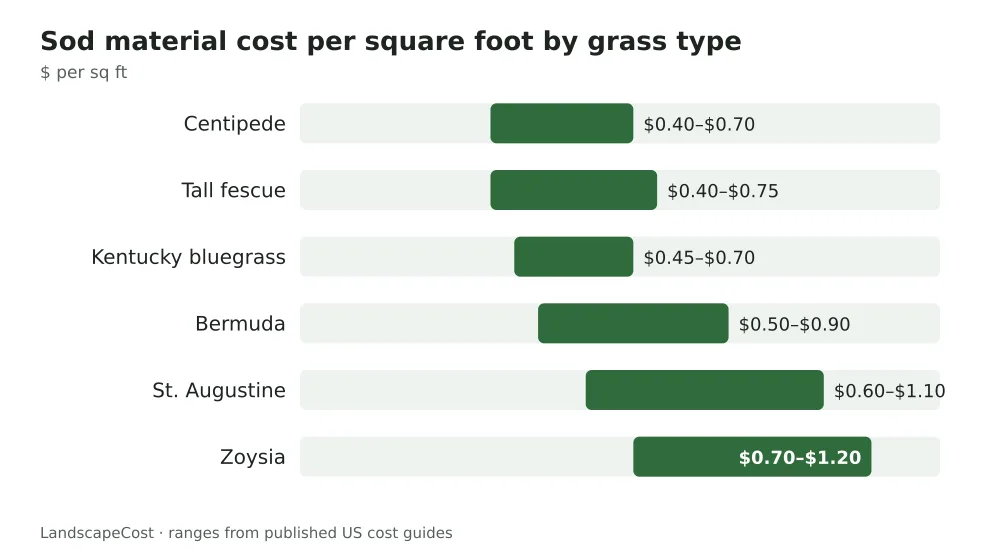
- How much does sod cost by grass type?
- What do installation labor and ground preparation add to the price?
- How much does it cost to sod a yard, by lawn size?
- Which extra costs show up on a sod installation quote?
- What do sod delivery, pallets and deposits cost?
- Is it cheaper to lay sod yourself or hire a crew?
- What makes one sod job cost more than another?
- How do you measure a yard before ordering sod?
- When should sod go down, and what does early care cost?
- Which mistakes raise the cost of a sod lawn, and where can you save?
- How do seeding and hydroseeding costs compare with sod?
- Frequently asked questions
How Much Does Sod Installation Cost?
Professional sod installation typically costs $1,300 to $2,850 for a 1,000 sq ft lawn, because sod material at $0.30 to $0.85 per square foot is added to installation labor at $1.00 to $2.00 per square foot, according to a sod grower's 2026 pricing guide. The calculator above runs the same arithmetic on your own yard, grass and prep choices.
That grower prices the crew as labor only, a charge billed on top of the turf itself. Two bids for one yard can therefore look far apart until both are split into lines. A 2026 new-lawn pricing guide frames every bid around three main costs: the sod, the ground preparation and the installation work. You can compare similar projects in our Lawn, Sod & Turf Calculators collection.
A turf supplier's planning guide reports a different snapshot. Its residential projects run $1,048 to $2,992, with most owners of an average-sized lawn spending about $2,010. Its all-in rate of $0.86 to $1.75 per square foot already folds sod, labor and materials together, and larger or complex jobs reach $7,238 or more. For related projects, see the sod calculator section.
None of these figures is wrong. Each source measures a different scope, so hold any quote against the source whose scope matches it. Planning more than one job? The artificial turf cost calculator works the same way.
How to use the Sod Installation Cost Calculator
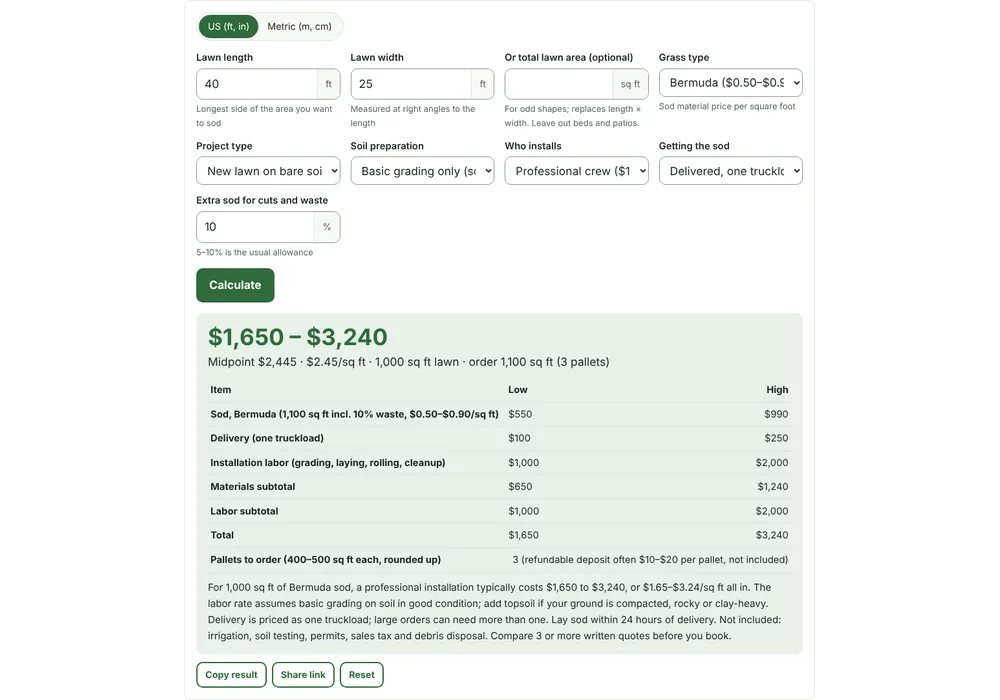
The Sod Installation Cost Calculator gives homeowners a low-to-high installed price, a midpoint, a cost per square foot and a materials-versus-labor split from six inputs:
- Size: measure length and width in feet, or type the total square footage in the area box for odd shapes.
- Grass type: pick your turf, from Bermuda at $0.50 to $0.90 per sq ft up to Zoysia.
- Project and prep: new lawn or remove-and-resod, with or without added topsoil.
- Who installs: a professional crew bills labor at $1.00 to $2.00 per sq ft; DIY swaps that for tool rentals.
- Getting the sod: delivery of one truckload adds $100 to $250; pickup at the farm skips the delivery fees.
- Waste: keep 10% or set any value in the usual 5–10% range, and the tool will order the extra.
Worked example: a 40 ft by 25 ft backyard is 1,000 sq ft. With Bermuda, a new lawn on bare soil, basic grading, a professional crew, delivery and 10% waste, the tool orders 1,000 × 1.10 = 1,100 sq ft of sod (3 pallets) and returns $1,650 to $3,240, a midpoint of $2,445, or $1.65 to $3.24 per square foot. Materials come to $650 to $1,240 and labor to $1,000 to $2,000.
Switched to DIY, the same yard drops to $740 to $1,420, and laying sod becomes a full weekend project instead of a crew's single day. Treat either result as a planning figure for a lush yard and green lawn, not a contract price.
How the Sod Installation Cost Calculator calculates your result
The Sod Installation Cost Calculator adds line items, Total = Sod + Topsoil + Delivery + Labor + Removal, with fertilizer and tool rentals replacing labor in DIY mode. Every default price comes from one sod grower's 2026 pricing guide, so figures from different sources are never mixed.
- A = net lawn area in sq ft. A national estimator asks for the finished surface area plus openings enclosed by it; this tool wants only ground that gets sod, so subtract beds.
- Order = A × (1 + waste %), the grower's waste rule of 5–10% extra.
- Sod = Order × the grass rate in the table below.
- Labor (crew) = A × $1.00 to $2.00, covering grading, laying, rolling and cleanup.
- Topsoil = A × $0.25 to $0.50 for 2–4 inches of topsoil or soil amendments.
- Removal (crew) = A × $0.50 to $1.00 for a remove-and-resod job.
- DIY extras = rototiller rental ($50 to $100), lawn roller rental ($20 to $40), starter fertilizer at $20 to $40 per 1,000 sq ft, plus a one-day sod cutter rental ($70 to $115) for removal.
Pallets = Order ÷ 500 square feet and ÷ 400, rounded up, since a standard pallet covers 400 to 500 sq ft. Pallet deposits of $10 to $20 are a refundable deposit, so they are shown but not added. Grass rates:
| Grass type | Low ($/sq ft) | High ($/sq ft) |
|---|---|---|
| Bermuda | $0.50 | $0.90 |
| St. Augustine | $0.60 | $1.10 |
| Zoysia | $0.70 | $1.20 |
| Centipede | $0.40 | $0.70 |
| Tall Fescue | $0.40 | $0.75 |
| Kentucky Bluegrass | $0.45 | $0.70 |
| Not sure / other | $0.30 | $0.85 |
As a check, 1,000 sq ft at the "not sure" rate, with no waste or delivery, prices at $1,300 to $2,850, the grower's own professional total. Not included: irrigation, which a 2026 new-lawn guide puts at about $1,500 to $3,500 for some residential systems or $0.20 to $1.00 per sq ft, and soil testing at about $15 to $50.
What does sod installation cost per square foot?
Sod installation runs roughly $1.00 to $2.00 for each square foot under standard conditions in a 2026 new-lawn guide, while a national cost estimator's May 2026 national average is higher, at $2.12 to $3.54 per square foot, because it prices more line items. The sod grower uses that same band for labor alone, so ask what a per-foot number includes.
The estimator's rate is not a final figure either. Its notes say to add 13% to 22% if a general contractor will supervise the job, and it leaves out sales tax on materials, permits and inspection fees. Those exclusions separate a website average from the true costs on an invoice.
Turf costs many times what seed does. The new-lawn guide lists grass seed at $0.07 to $0.24 per sq ft, Bermuda seed at $0.07 to $0.15, and a tall fescue or Kentucky bluegrass blend at $0.10 to $0.24. Residential sod installation is the bigger investment, paid for a finished lawn on day one.
The turf supplier's guide dates from 2025, a year older than the rest. To compare quotes, ask multiple estimates from local installers for one area, grass and prep, then divide each total by the square footage.
How much does sod cost by grass type?
Sod material costs about $0.40 to $1.20 per square foot depending on the grass, with Centipede and tall fescue starting lowest and Zoysia at the top, according to the sod grower's 2026 pricing guide. Grass choice can move the sod line by hundreds of dollars on an ordinary backyard.
Zoysia is the premium option: its material price of $0.70 to $1.20 per square foot often runs 30–50% above Bermuda or Centipede. St. Augustine sits in the middle at $0.60 to $1.10. Cultivar matters too, and the grower suggests a cheaper variety, such as Common Bermuda in place of TifTuf Bermuda, to trim the sod bill.
Climate narrows the menu before price does. The 2026 new-lawn guide maps common choices by city: Bermuda in Phoenix and Las Vegas, Bermuda and Zoysia in Dallas, St. Augustine in Tampa, Bermuda and tall fescue in Atlanta, tall fescue and Kentucky bluegrass in Denver, and perennial ryegrass blended with tall fescue in Seattle.
A turf supplier adds that regional pricing follows local demand for sod and landscaping, and it lists Bermuda, St. Augustine, Zoysia and Fescue as grasses with different price points. Pick the grass that suits your region first, then price it.
What do installation labor and ground preparation add to the price?
Ground preparation is the line that moves a sod quote most: the 2026 new-lawn guide says heavy prep or lawn removal can lift sod installation to $2.60 per square foot or higher, and it prices sod with old lawn removal at $1.25 to $3.35 per square foot. Easy ground stays near the guide's standard range.
Access shapes labor time as much as area does. A turf supplier names site accessibility as a cost driver, because tight spaces, slopes and obstacles such as trees and flower beds slow a crew. Clearing old grass, rocks and weeds, then leveling, belongs to the same ground preparation bill.
Soil type decides how much of that work is needed. The new-lawn guide flags compacted, clay-heavy or caliche soil as needing extra work, and the sod grower calls adding topsoil before sod highly recommended rather than laying turf straight onto bare dirt.
The turf supplier lists skipping soil testing as a common error, since poor soil leads to weak roots. Its saving tip runs the other way: DIY site prep, meaning your own debris removal and soil prep, cuts labor costs, by $0.50 to $1.00 per square foot in the sod grower's estimate.
How much does it cost to sod a yard, by lawn size?
The cost to sod a yard scales with its area: a national estimator's cost to install sod on 500 SF totals $1,058 to $1,771, and the sod grower's guide puts 1,000 sq ft at $1,300 to $2,850 for installed sod including prep.
At 1,000 sq ft, the grower separates material only, $300 to $850, from the professional installation total. The 2026 new-lawn guide instead prices labor and basic preparation on 1,000 sq ft at $700 to $1,800, about $0.70 to $1.80 per square foot, with the property's condition deciding where a yard lands.
At 2,000 sq ft the grower's material-only figure is $1,000 to $1,700 and the professional total $2,600 to $5,000. The high end rose from $2,850 to $5,000, which fits the new-lawn guide's point that larger lawns may earn a lower price per square foot. That guide's own 1,000 sq ft range, $1,000 to $2,600, shows how sources differ.
Yard size is only the starting input; grass variety and prep set the rate. For accurate quotes, measure net area: the grower's 40 by 25 ft example loses 50 sq ft to a 10 ft by 5 ft flower bed, leaving 950 sq ft, or 1,045 sq ft with 10% extra.
Which extra costs show up on a sod installation quote?
The extras that most often appear on a sod installation quote are old grass removal, irrigation installation, soil testing, permits and a general contractor add-on, and the 2026 new-lawn guide notes that a quote may list them separately from the base installation. Reading those lines is the quickest way to compare two bids.
Removal is the line most likely to be missing, by the sod grower's account: the removal of your old lawn is often left out of a basic price, so ask each installer whether it is covered. In Las Vegas, the new-lawn guide adds, the Southern Nevada Water Authority runs rebates on qualifying grass removal.
Irrigation is the biggest add-on. The new-lawn guide's combined sod and irrigation ranges run $1,500 to $3,000 for 1,000 sq ft, $3,000 to $6,000 for 2,000 sq ft and $7,500 to $15,000 for 5,000 sq ft, or roughly $1.50 to $3.00 per square foot for bundled sod and irrigation.
A soil test is the smallest extra, and it can flag pH imbalances and nutrient deficiencies before the turf goes down. Supervision is the largest multiplier: a national estimator adds 13% to 22% when a general contractor manages the work.
What do sod delivery, pallets and deposits cost?
Sod delivery usually adds a delivery fee of $100 to $250 per truckload, according to the sod grower's guide, on top of turf that sells for about $200 to $600 per pallet. The pallet price and each pallet's coverage decide the real per-foot rate.
Each standard pallet holds enough turf for 400–500 sq ft, though some farms sell mini-pallets that cover less, so confirm coverage with the farm before converting. At the ends of the range, a $200 pallet spread over 500 square feet works out to $0.40 per sq ft, while a $600 one over 400 square feet is $1.50.
Many farms also hold a deposit of $10 to $20 per pallet, returned with the empty pallets. The cheapest delivery is the one you skip: the sod grower suggests you pick it up at the farm to avoid delivery fees, if your vehicle can carry the weight.
Plan the install day before the truck. The turf supplier says to lay sod within 24 hours of delivery, water immediately, and keep to a strict watering schedule through the first few weeks, so the crew and the hose need to be ready on arrival.
Is it cheaper to lay sod yourself or hire a crew?
Laying sod yourself is cheaper in cash terms, and a turf supplier says a DIY installation can bring a small project down to as little as $583, before tool rentals and your own time. The trade is money for labor, and the size of that trade depends on the yard.
The saving comes from the crew line. The same supplier prices labor at $20 to $40 per hour, or a flat rate set by yard size and complexity. The DIY saving therefore grows with the size and difficulty of the yard, and so does the work you take on.
Removing old turf is the hardest DIY step. DIY owners can rent a sod cutter, which runs $70 to $115 per day in the sod grower's guide. A one-day rental pays off only if the strips are cut, rolled and moved off the lawn within that day.
A crew still makes sense when time matters. The sod grower notes that a professional crew can often finish the whole job in one day, against a full weekend at minimum for a DIY installer. Run the calculator in both modes to see the gap for your yard.
What makes one sod job cost more than another?
Lawn size, grass variety, soil condition and local rules explain most of the gap between two sod jobs, and the 2026 new-lawn guide singles out extensive grading, poor soil conditions and old grass removal as the items that raise a final price. Size moves the total far more than the rate does, as the guide's table shows:
| Lawn size | Installed sod | Sod material only |
|---|---|---|
| 1,000 sq ft | $1,000–$2,600 | $300–$800 |
| 2,500 sq ft | $2,500–$6,500 | $750–$2,000 |
| 5,000 sq ft | $5,000–$13,000 | $1,500–$4,000 |
| 10,000 sq ft | $10,000–$26,000 | $3,000–$8,000 |
Material price depends on supply as well as species. North Carolina State University's 2026 producer data, cited by the new-lawn guide, puts average delivered prices near $0.47 per sq ft for Bermuda, with St. Augustine at $0.64 and Zoysia at $0.65. Bermuda costs less partly because it is widely produced; a turf supplier's top material rate is $0.82.
Paperwork can shift the schedule too. The new-lawn guide notes that permit rules, HOA approval and their processing times differ from place to place, so clear them before booking grading or delivery. The grass variety then sets the rate for every square foot.
How do you measure a yard before ordering sod?
Measure the yard as simple rectangles in feet, multiply length by width for each one, subtract beds and hardscape, then add 5–10% for cutting waste before turning the area into a sod order.
Irregular yards are easiest as a set of rectangles and triangles, where a triangle is half its base times its height. Write each piece down, add them up, and type the total into the area box. For a curved bed, subtract the largest rectangle that fits inside it, which slightly understates the bed and keeps the sod order on the safe side.
Rounding is where budgets leak. A turf supplier's advice is to order efficiently, buying just the area you need to avoid waste, but the order size also has to fit how farms sell. The sod grower works with a one-pallet minimum, and some farms offer mini-pallets for small patches.
The waste allowance exists because of edges. The turf supplier lists ignoring edges and seams as a common mistake, and its fix is to butt pieces tightly together and stagger seams the way bricks are laid. Every cut along a curve, walkway or bed eats into the extra 5–10%.
When should sod go down, and what does early care cost?
Sod goes down best in the cooler months of spring or early fall, which a turf supplier links to easier establishment and less water use, while the sod grower says the cheapest time to buy is often late fall or winter, when warm-season grasses are dormant. Season affects both price and aftercare.
Delivery timing matters as much as the month. Freshly cut sod should be laid within 24 hours of arrival to stop it drying out, so book the crew or clear your weekend before the truck is scheduled. A pallet left through a hot afternoon can cost money twice: once for the turf, again for replacing dead pieces.
Grass traits change the care bill. The sod grower describes Bermuda as durable, drought-tolerant and quick to grow, and Zoysia as the slowest-growing grass on its list. It also says Buffalo Grass prices vary widely, so ask the farm for a current quote.
A warm-season turf laid while dormant stays brown until the weather warms, which buyers should expect rather than treat as failure. Cool-season turf follows the opposite calendar, so match the install month to your grass.
Which mistakes raise the cost of a sod lawn, and where can you save?
Three mistakes that raise sod costs are paying for labor you could do, paying a premium price for turf you do not need, and underbudgeting water; the biggest saving is DIY, which the sod grower says can cut the total cost by 40–60%. Each choice shows up as its own line in the calculator.
The grower's total DIY cost for 1,000 sq ft is $730 to $2,035, built from sod materials at $300 to $850, topsoil or compost at $120 to $550, plus delivery and rentals. Elsewhere the same guide rounds the saving to about 50%, while a turf supplier reports a labor saving of $330 to $420 or more on small projects.
Delivery is a smaller but easy win. The turf supplier says delivery fees vary with distance and order size, often $50 to $200 per load, so a farm close to home is worth asking about first.
Water is the cost many owners forget. The sod grower calls for watering every day through the first 1–2 weeks, then several times a week over the next month, and warns that the water bill will run well above normal for the first two months. Budget for it with the installation.
How do seeding and hydroseeding costs compare with sod?
Seeding and hydroseeding cost far less than sod: the 2026 new-lawn guide prices professional seeding at $0.35 to $0.85 per square foot installed and hydroseed on 1,000 sq ft at $70 to $350, against sod at $1.00 to $2.00 a square foot.
By size, the same guide's seeding totals run $350 to $850 for 1,000 sq ft, $875 to $2,125 for 2,500 sq ft, $1,750 to $4,250 for 5,000 sq ft and $3,500 to $8,500 for 10,000 sq ft, each a fraction of the sod range.
The sod grower sums up the trade-off: seed costs pennies per sq ft upfront but needs months of water, weed control and maintenance, while sod is instant and costs 10–20x more at the start. The new-lawn guide agrees that sod gives immediate coverage and seeding takes longer to grow. A turf supplier adds that sod cuts the time spent watering, fertilizing and reseeding.
Seed also has a narrower calendar. Cool-season grass such as tall fescue usually goes in during late summer or early fall; the new-lawn guide names mid-August to mid-September for Denver, September and October in Georgia, and early fall in the Pacific Northwest.
Frequently asked questions
Is sodding a lawn cheaper than seeding it?
No, sodding a lawn is not cheaper than seeding it upfront: on 10,000 sq ft the 2026 new-lawn guide prices sod at $10,000 to $26,000 against $3,500 to $8,500 for seeding. Hydroseeding is lower again, with a planning range of $0.07 to $0.35 per sq ft and many residential projects near $650 to $2,200.
Seed brings its own supplies, though. Penn State Extension lists straw among the most common mulches for new seed, and the guide plans 80–100 pounds of it per 1,000 square feet. A 5,000 sq ft lawn therefore needs about 400–500 pounds, or roughly 10–17 bales of 30–40 pounds each. Professional seeding still tops out at $0.85 per sq ft installed, below the $1.00 low end the same guide gives for sod installation. Sod earns its higher price when you need a usable lawn right away.
What does sodding 1,000 square feet cost?
Sodding 1,000 square feet costs about $1,300 to $2,850 as a professional total in the sod grower's guide, or $300 to $850 for material only if you lay it yourself. The 2026 new-lawn guide prices the same 1,000 sq ft at $1,000 to $2,600 installed and $300 to $800 for sod alone, so the two sources match on the low end of material and differ on installed totals.
The calculator's default yard is also 1,000 sq ft. With Bermuda, a crew, delivery and 10% waste, it returns $1,650 to $3,240, higher than the bare figure because it adds a truckload delivery and extra sod for cuts. Switched to DIY, the same yard comes out at $740 to $1,420. Either result is a starting point for comparing written bids, not a substitute for them, and the line items show where two quotes differ.
What does it cost to install sod on 500 square feet?
Installing sod on 500 square feet costs about $1,058 to $1,771 in a national cost estimator's May 2026 line-item example, roughly $2.12 to $3.54 per square foot. The estimator's lines are:
| Line item | Quantity | Low | High |
|---|---|---|---|
| Sod | 534 SF | $687 | $1,036 |
| Basic installation labor | 5.5 h | $293 | $623 |
| Job supplies | 534 SF | $17 | $20 |
| Equipment allowance (daily rental) | 1 job | $61 | $92 |
| Option: remove lawn | 3.5 h | $187 | $397 |
| Debris disposal | – | $339 | $386 |
The estimator orders 534 SF of sod for a 500 SF lawn, about 7% extra, and assumes favorable site conditions for its 5.5 h of basic labor. Its $1,058 to $1,771 total covers sod, labor, job supplies and the equipment allowance only. Adding both the removal option and debris disposal lifts the same job to $1,584 to $2,554.
How much is sod for a 2,000 sq ft yard?
Sod for a 2,000 sq ft yard costs about $1,000 to $1,700 for the material alone and $2,600 to $5,000 professionally installed, according to the sod grower's guide. Adding irrigation changes the picture: the 2026 new-lawn guide's combined sod and sprinkler estimate for the same size is $3,000 to $6,000.
In the calculator, 2,000 sq ft of Bermuda with a crew, one delivery and 10% waste comes to $3,200 to $6,230, with an order of 2,200 sq ft, or 5 to 6 pallets. Most of the spread between the low and high ends is labor, which the grower prices at $1.00 to $2.00 per square foot. An order of five or six pallets weighs several tons, so ask the farm how many loads its delivery fee covers before you compare quotes.
Which month is best for laying sod?
The best months for laying sod are in spring or early fall, the cooler months a turf supplier recommends, and late fall or winter is often the cheapest window for dormant warm-season sod, according to the sod grower. Cool-season turf suits early fall, while warm-season grass such as Bermuda is usually established in warmer spring or summer conditions, as the 2026 new-lawn guide explains.
Seeded lawns follow the same calendars and add their own supplies. The new-lawn guide cites University of Florida guidance of about 1–2 pounds of hulled seed for every 1,000 sq ft of common Bermuda, and it budgets starter fertilizer at about $30 to $80 per project. For sod, the day matters as much as the month: the turf should go down within 24 hours of delivery, so pick a date when the crew, the water and the weather all line up.
Can you lay sod directly on bare dirt?
Laying sod directly on bare dirt is possible, but the sod grower strongly recommends spreading topsoil first. When the ground is soil in good condition, the 2026 new-lawn guide says basic preparation may add only about $0.10 to $0.30 per square foot, so loosening, leveling and rolling the existing dirt can be enough.
Compacted, rocky or clay ground is a different case. The calculator's topsoil option adds $0.25 to $0.50 per square foot for 2–4 inches of new soil, the sod grower's rate. That guide lists Texas A&M, Purdue and Penn State among its cited references. A soil test before you decide costs far less than replacing sod that fails to root, and it shows whether the existing dirt needs amendments or a full topsoil layer before the first pallet arrives.
How many square feet does a pallet of sod cover?
A pallet of sod covers about 400–500 sq ft, according to the sod grower, and it weighs 2,500 to 3,000 pounds, so plan for a heavy-duty delivery rather than a trip in the family car. Price per pallet follows the grass type, from the low hundreds for Centipede up to $600 for the top Zoysia price.
Dividing the area you plan to order by 400 gives a cautious pallet count, and dividing by 500 gives the optimistic one. The calculator shows both and always rounds up, because a short order stops work halfway across the yard. A 1,100 sq ft order, for example, works out to 2.2 to 2.75 pallets, which rounds up to 3. For a detailed count of rolls and pallets, use a dedicated sod quantity calculator; this page focuses on what the installed lawn will cost.
Is old grass removal included in a sod installation quote?
Old grass removal is often not included in a sod installation quote, so ask for it as a separate line before you sign. The sod grower prices old grass removal at $0.50 to $1.00 per sq ft, while the 2026 new-lawn guide puts basic removal at $0.25 to $0.75 and more involved removal up to $2.00.
The same guide notes that soil testing and irrigation may also be listed apart from the base price. On a 1,000 sq ft yard, the grower's rate means $500 to $1,000 for removal alone, roughly 35% to 38% on top of the grower's $1,300 to $2,850 installed total. In the calculator, choose "Remove old grass and re-sod" to add removal at that rate, or pick DIY to swap it for a one-day cutter rental and your own labor.
What does a sod cutter rental cost?
A sod cutter rental costs about $70 to $115 for one day, according to the sod grower's guide. The machine slices old turf into strips at a set depth, and those strips still have to be rolled, lifted and hauled away. Disposal is a separate cost, which a national estimator prices at $339 to $386 in its 500 SF example.
In the calculator's DIY mode, picking "Remove old grass and re-sod" adds the one-day cutter rental to the rototiller and roller, so the equipment line rises from $70–$140 to $140–$255. Book the cutter for the same day the old lawn comes out, and have a plan for the heavy strips, such as a trailer or a disposal booking, before the rental clock starts.
How much do St. Augustine and Zoysia sod cost?
St. Augustine sod costs about $0.60 to $1.10 per square foot and Zoysia about $0.70 to $1.20, according to the sod grower's 2026 guide. By the pallet, St. Augustine runs $300 to $550 and Zoysia $350 to $600, against $250 to $450 for Bermuda and Kentucky bluegrass, $200 to $400 for tall fescue and $200 to $350 for Centipede.
On the calculator's default 1,000 sq ft yard with a crew, delivery and 10% waste, switching from Bermuda to Zoysia raises the estimate from $1,650–$3,240 to $1,870–$3,570, and St. Augustine lands at $1,760–$3,460. The grass line changes by a few hundred dollars while labor stays the same, so on the default yard grass choice moves the total less than removal or topsoil would.