On this page
- How to use the Asphalt Driveway Cost Calculator
- How the Asphalt Driveway Cost Calculator calculates your result
- How does driveway size change the total asphalt cost?
- What goes into the asphalt price per square foot?
- What factors raise or lower asphalt driveway cost?
- How do labor and location change asphalt paving prices?
- How much does asphalt thickness add to the cost?
- What base layer does an asphalt driveway need?
- What do excavation and grading add to a driveway quote?
- How much does removing an old driveway cost?
- How do drainage problems affect asphalt driveway cost?
- How do asphalt and concrete driveway costs compare?
- What do asphalt driveway repairs and maintenance cost?
- Should you resurface or replace an asphalt driveway?
- How can you save money on an asphalt driveway?
- How do you get accurate asphalt paving quotes?
- What else should you know before paying for an asphalt driveway?
- Frequently asked questions
How much does an asphalt driveway cost?
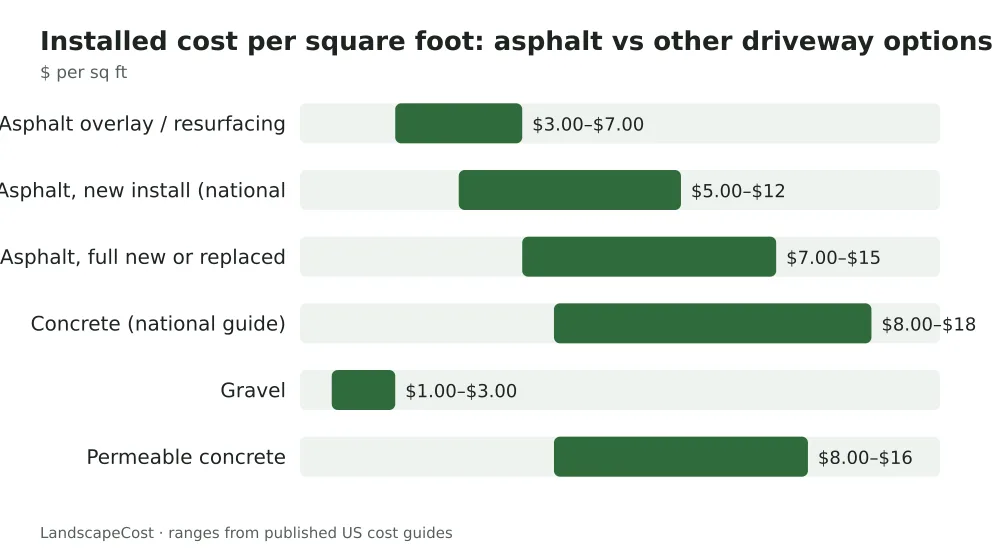
An asphalt driveway costs about $5 to $12 per square foot installed, so a 20 x 20 ft two-car driveway of 400 sq ft runs roughly $2,000 to $4,800 before excavation, new base or tear-out, while an overlay on a sound existing base costs $3 to $7 per square foot.
Those two bands are a starting point, not a quote. Driveway size, asphalt thickness, site preparation, regional labor costs and any drainage problems move the final number far more than the hot mix itself. Published prices also disagree because they price different scopes, so the table puts two sources side by side: a national cost guide that prices installation alone, and a New Jersey paving contractor whose 2026 rates already fold in tear-out, grading and base work. You can compare similar projects in our Hardscape, Driveway & Paving Calculators collection.
| Driveway | National guide, new install ($5–$12/sq ft) | NJ contractor, full new or replaced | NJ contractor, overlay |
|---|---|---|---|
| Single car, 10 x 20 ft (200 sq ft) | not listed | $1,400–$3,000 | $600–$1,400 |
| Two-car, 20 x 20 ft (400 sq ft) | $2,000–$4,800 | $2,800–$6,000 | $1,200–$2,800 |
| 600 sq ft | $3,000–$7,200 | not listed | not listed |
| Large, 20 x 40 ft (800 sq ft) | not listed | $5,600–$12,000 | $2,400–$5,600 |
| Circular driveway, 30 x 50 ft (1,500 sq ft) | $7,500–$18,000 | $10,500–$22,500 | $4,500–$10,500 |
| 2,000 sq ft | $10,000–$24,000 | not listed | not listed |
Neither column is wrong. Use the national figures when the old surface is already gone and the ground is ready for stone. Lean on the New Jersey replacement column when a crew must dig out, haul away and rebuild, or when you live in a high-wage metro area where labor alone pushes rates up. For related projects, see the concrete slab cost calculator section.
How to use the Asphalt Driveway Cost Calculator
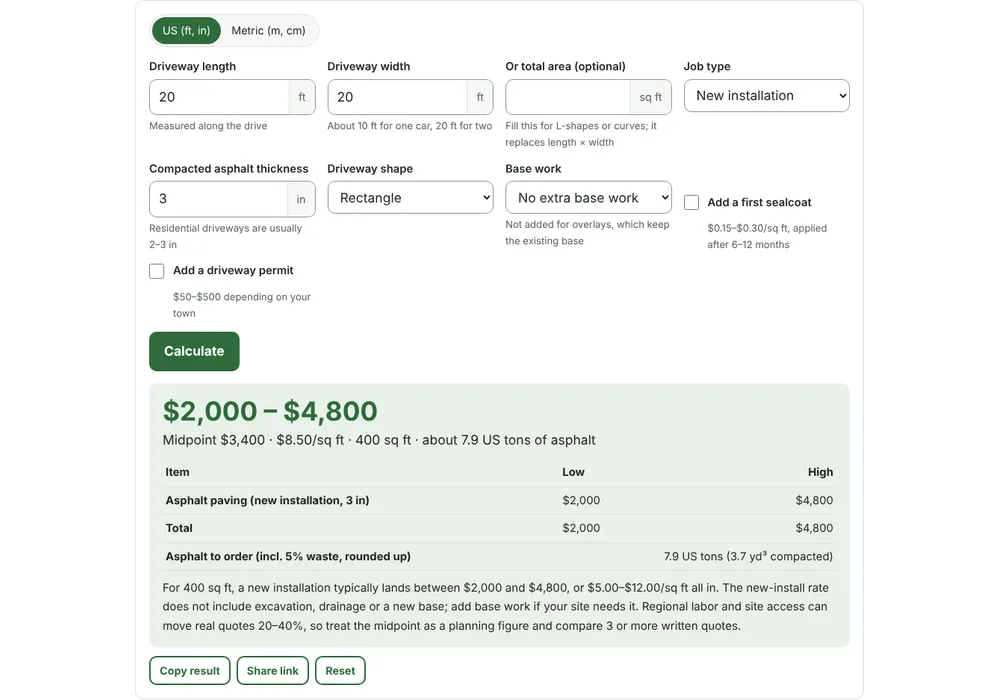
The Asphalt Driveway Cost Calculator needs only the driveway's length and width, the job type and the asphalt thickness, and it returns a low-to-high price range, a midpoint, the cost per square foot and the tons of asphalt to order.
- Measure the drive. Enter length and width, and the calculator will multiply length by width to get square footage. For an L-shape or curved drive, add up the rectangles yourself and type the total into the area box.
- Pick the job type. Choose new installation, replacement (which adds removal of the existing driveway), or overlay on a stable base.
- Set thickness and shape. Keep 3 in for a typical home drive and choose rectangle or the curved option.
- Add extras. Tick new base work, a first sealcoat, or a permit box that adds typical permit costs of $50–$500 for towns that require permits.
- Read the result. The range, midpoint, price per square foot and tonnage appear under the form with an itemized table.
Worked example: a standard 2-car driveway of 20x20 ft (400 square feet), new installation, 3 in thick, rectangle, no extras. Result: $2,000 to $4,800, midpoint $3,400, $5.00 to $12.00 per sq ft ($8.50 at the midpoint), and about 7.9 US tons of asphalt including waste.
The figures are national paving ranges, not a price from your supplier, so a quote for an installed drive can land outside them when site complexity is high, such as a steep approach or a long haul from the plant.
How the Asphalt Driveway Cost Calculator calculates your result
The Asphalt Driveway Cost Calculator multiplies your area by a sourced low and high price per square foot for the job type, adds any optional line items, and averages the two ends to give the midpoint.
Total = A × (R + E × X) × S + removal + base + seal + permit
- A is the area in square feet from your dimensions; metric entries are converted first.
- R is $5–$12 for new installation (a national guide's installed price range) or $3 to $7 for an overlay, which lays a new asphalt layer over a sound structural base and, per a Midwest paver, is generally 30–40% cheaper than full replacement.
- E is the inches above 3, because both rates assume a standard 2–3" asphalt surface; X is the $0.75–$1.25 a New Jersey contractor charges for each extra inch.
- S is 1.00 for a rectangle and 1.10–1.20 for curves, matching the 10–20% shape premium.
- Removal (replacement only) is asphalt removal at $3–$7 per sq ft plus $300–$800 for hauling and disposal; base is $2–$4 per sq ft installed, plus $1–$3 for soil stabilization; seal is $0.15–$0.30 per sq ft of sealcoating; permit is $50–$500.
Replacement mode stacks tear-out ($3–$7 per sq ft plus $300–$800) on top of the $5–$12 install rate, so 400 sq ft shows $3,500–$8,400. That is higher than the New Jersey contractor's $2,800–$6,000 all-in replacement figure, because that contractor quotes one rate that already includes removal and base work, while the tool adds each item from separate sources.
Tonnage uses volume = area × compacted thickness, then weight = volume × a density of 2.4 t/m³ (inside the 2.3–2.5 t/m³ typical range a quantity tool gives) × 1.05 for a 5% waste allowance, converted from tonnes to US tons. That tool's own example, 200 sq ft at 2 in, gives 0.94 m³ and 2.38 t, and this calculator reproduces both. Treat every result as a planning range rather than a binding quote; the math adjusts for size, job, thickness and extras, but not for region or waste beyond 5%.
How does driveway size change the total asphalt cost?
Driveway size raises the total cost almost in step with area, but the price per square foot usually drops as the job gets bigger, because crews spread setup and hauling over more pavement.
Take the 1,000-square-foot layout, common for a long single lane or a wide two-car apron. At the national guide's rate, 1,000 square feet works out to $5,000 to $12,000, and that figure still leaves out excavation, drainage work and existing surface removal.
The New Jersey contractor's size scale shows the volume effect on larger projects. Jobs under 500 sq ft run $7–$15 per sq ft, 500–2,000 sq ft drops to $6–$13, 2,000–5,000 sq ft falls to $5–$10, and anything over 5,000 sq ft lands at $4–$8. Equipment efficiency explains most of that slide, since a paver and rollers cost about the same to bring out for a small pad as for a big one.
Size also shapes scheduling. One driveway guide suggests owners phase large projects to spread spending, and the contractor notes that pairing up with neighbors shares mobilization costs, with savings passed on for multiple driveways done in one visit.
What goes into the asphalt price per square foot?
The asphalt price per square foot bundles three things: the hot mix, the labor and machines that place and compact it, and the preparation a site needs before any paving begins.
The mix is the smallest slice. Raw hot mix runs $40–$80 per ton, roughly $0.75–$2.00 per sq ft at a 3–5 inch depth, according to third-party data cited by a New Jersey contractor. Mix prices move with the market too: the federal producer price index for asphalt paving mixtures set a record of 326.1 in February 2025 and eased to about 267.6 by April 2026 (December 2004 = 100).
Preparation and compaction labor make up the rest, which is why quoted rates jump. The same NJ contractor prices full new or replaced work at $7–$15 per sq ft, but overlay work at $3–$7 when the base is stable. Most of that gap is digging, hauling and base building.
No universal rate exists. A quantity tool asks for your local price for exactly that reason, and your own site conditions decide where inside any range a quote lands.
What factors raise or lower asphalt driveway cost?
Area is the biggest cost driver for an asphalt driveway, followed by site preparation, regional labor, thickness, drainage and finish choices.
Shape surprises many owners first. Custom shapes and curves cost 10–20% more than a plain rectangle because edges take hand work. Finish choices come next: premium finishes and decorative touches push a job toward the top of any range, and so do sealcoating options bundled into the installation price.
Site preparation is the swing factor. One driveway guide says prep alone can add 20–40% to a quote, while a New Jersey contractor puts its effect at 20–50% of base costs. Drainage systems stack on top, and extra drainage features run $500–$2,000 on that contractor's price list.
Labor rates and local material costs complete the picture. Labor in the Northeast and on the West Coast usually costs 20–40% more than in the Midwest or South, and New Jersey construction wages sit 18–22% above the national average, citing Bureau of Labor Statistics data.
How do labor and location change asphalt paving prices?
Location changes asphalt paving prices through three channels: what local labor costs, how far hot mix must travel, and how long the paving season lasts.
Distance from the asphalt plant matters because hot mix has to arrive hot, so long hauling distance, transport time and oil costs all feed into the material price. Access works the same way: easy access cuts costs 10–15%, while tight spaces force a contractor to bring smaller equipment, and the size of the crew a site demands shows up in the labor line.
A Midwest paver working in MN and WI says local factors such as hauling and soil prep shape its estimates more than any national figure, which is why it builds prices from regional labor and material data.
Season is the third channel. Asphalt is temperature-sensitive and needs a ground temperature of 50°F and rising, which limits that paver's paving window to May through October; the New Jersey contractor works April–October. Early booking can beat mid-summer demand. Off-season discounts exist, and one guide reports fall or winter booking saves 10–20% versus summer, yet emergency winter repairs cost 30–50% more.
How much does asphalt thickness add to the cost?
Asphalt thickness adds about $0.75 to $1.25 per square foot for each inch beyond the standard 2–3 inches, so going from 3 to 5 inches on a 400 sq ft drive adds roughly $600 to $1,000.
Standard residential rates assume a surface of Hot Mix Asphalt, the industry standard for driveways. Extra thickness makes sense for heavy vehicles such as a loaded work truck parked every night. Commercial parking lots get thicker applications for traffic load, which is one reason their rates follow a different scale.
Thickness also drives quantity. Compacted thickness, mix density and a waste allowance decide how many tons of hot asphalt a plant loads, and each added ton carries transport cost to your site.
Base quality, climate and weather decide whether a thin layer survives, which is why a local authority or a pavement design may set a required structural thickness. A cost tool only quantifies the thickness you input; it cannot prescribe how thick your mat must be.
What base layer does an asphalt driveway need?
An asphalt driveway needs a compacted gravel sub-base sized to its soil, and digging room for that base typically costs $1,000 to $2,500 in excavation for a two-car driveway. Before any digging or grading starts, call the local utility-locate service (811 in the US) so buried lines are marked.
Standard residential work removes 8–12 inches of soil, the usual excavation depth for a standard gravel base, and grading adds $500–$1,500 on top. Crews also strip vegetation and roots before the first load of stone goes down.
Soil decides how much more you pay. Poor soil or unstable soil may need deep excavation and soil stabilization, which one driveway guide prices at $1–$3 per sq ft when ground conditions are weak. That line item is easy to skip on paper and hard to fix later.
A weak sub-base combined with poor drainage is a leading route to driveway failure. Foundation issues show up as deep cracks that no overlay can hide, while a well-built base buys long-term durability for the asphalt above it.
What do excavation and grading add to a driveway quote?
Excavation and grading add the most to a driveway quote when the soil is weak, the lot is sloped or an old surface must come out first.
Soil type sets the dig. Clay soils need a deeper 10–12 inches of base plus geotextile fabric, sandy soils need a stabilization grid to stop shifting, and rocky soil may take less base but more digging. Wet areas call for extra drainage stone and sometimes French drains, all priced against native conditions.
Slope and grade add a line of their own. A sloped lot needs correct grading so water runs off instead of causing erosion, and base compaction on a slope takes extra passes. Grading is the moment to fix slope issues, while the base is still open and before any stone is placed.
Heavy excavation often follows tearing out an old surface. Demolition of old asphalt brings disposal costs, and the condition underneath decides how much base preparation remains, so excavation and drainage improvements stay provisional until a crew sees real site conditions.
How much does removing an old driveway cost?
Removing an old asphalt driveway costs about $3 to $7 per square foot plus $300 to $800 for hauling and disposal, according to one driveway cost guide.
Removal is mostly labor and trucking. Excavating old asphalt from a damaged drive often turns up extra work, such as tree roots or obstacle removal, and a New Jersey contractor lists existing pavement removal among the prep items that raise base costs.
Disposal rules vary by state. A paver serving Minnesota and Wisconsin says Minnesota jobs carry a 10–15% premium, partly from stricter recycling mandates for millings and higher disposal fees, and partly from hauling hot mix through Twin Cities traffic.
Old asphalt rarely goes to waste: the National Asphalt Pavement Association reports about 100 million tons of hot-mix asphalt used each year in the U.S. and a 99% recycling rate. Before repairing or tearing out, check reviews and references, and confirm the crew is insured, since removal crews work right against your curb and lawn.
How do drainage problems affect asphalt driveway cost?
Drainage problems raise asphalt driveway cost twice: once for the fix during paving, and again later if trapped water breaks up the base.
Grading is the cheapest drainage tool. The standard slope is a 1–2% grade, enough to keep water flowing away from the house and the pavement edge. Without it, pooling water softens the stone layer that spreads out weight, and the surface starts sinking where tires roll.
Cold climates add frost heave. Water held in clay freezes, lifts the pavement and cracks it, which is why the Midwest paver specifies a deeper gravel layer in heavy clay. Careful base preparation limits how much water can collect beneath the asphalt in the first place.
When grading alone can't carry the runoff, the quote grows. Drainage system installation and tie-ins to existing pipes are usually priced as extras, not as part of the base rate, so ask each bidder how they plan to handle drainage before you compare totals.
How do asphalt and concrete driveway costs compare?
Asphalt is generally more affordable than concrete upfront: a national guide prices asphalt at $5–$12 per sq ft against $8–$18 for concrete.
Asphalt is usually less expensive for the initial installation, while concrete takes longer to cure and costs more to tear out, with concrete removal at $3–$8 per sq ft. Over decades, maintenance and repairs narrow the upfront gap. At highway scale, an FHWA lifecycle study over 35 years found asphalt 10–33% cheaper per lane-mile than concrete.
| Material | Installed cost per sq ft | Typical lifespan | Note |
|---|---|---|---|
| Asphalt | $5–$12 | 15–20 years maintained | 100% impervious |
| Concrete | $8–$18 (national guide); $8–$20 (driveway guide) | 25–30 years | wins on durability |
| Gravel | $1–$3 | 5–10 years | high infiltration |
| Permeable concrete | $8–$16; full systems up to $30 | 20–30 years | can earn stormwater credits |
| Porous asphalt | 15–25% above standard asphalt | not listed | drains through |
| Pavers (NJ contractor) | $10–$20 | 25–50 years | 3–5 days to install |
| Permeable pavers, natural stone / brick or clay pavers (driveway guide) | $20–$40 / $15–$30 | 50+ years | stone drains; clay is mostly impervious |
| Decomposed granite (driveway guide) | $1–$4 | 3–5 years, replenished | low-traffic, dry climates |
Permeable choices can win back their premium. Porous asphalt, permeable concrete and interlocking pavers are the usual permeable choices. Local rebates and other permeable incentives can cover 20–50% of permeable costs, and some cities trim the stormwater fee for owners who qualify. Those rebates vary by utility, so check before choosing. If cash is tight, the driveway guide suggests starting with gravel and upgrading later; its savings tips quote $1–$5 per sq ft for that, against $1–$3 in its own comparison table.
What do asphalt driveway repairs and maintenance cost?
Asphalt driveway maintenance costs pennies per square foot compared with paving, and sealing plus timely crack repairs is what keeps a properly maintained drive going for its full lifespan.
Sealcoating is the vital maintenance step. In NJ it runs $0.15–$0.25 per sq ft, or $200–$500 for a two-car driveway, a fraction of paving cost, and the contractor credits a coat applied every 2 to 3 years with a 50–100% longer life, saying it extends asphalt life that much. Another guide budgets $200–$400 per sealing on a longer 3–5 year cycle.
Small fixes come next. Crack filling for small cracks, patching and filling potholes are low-cost repair jobs, and Cold Mix Asphalt serves as the cheaper temporary patch. Damage left alone spreads into the base.
Upkeep math favors repair until it doesn't. One guide compares extensive repairs costing $2,500 today and another $1,500 after five years, $4,000 in all, with a $6,000 replacement carrying a 20-year lifespan, and says to replace once repairs hit 40–50% of replacement cost. It puts asphalt's 20-year total at $6,500–$11,000. Taking on safe DIY jobs once the paving crew has left can save $500–$1,500, part of the 15–40% that smart planning can trim.
With sealcoating every 2–3 years, a drive typically lasts far longer than one left bare, and longevity is where upkeep pays.
Should you resurface or replace an asphalt driveway?
Resurface an asphalt driveway when the base layer is still sound and the damage is limited to the surface; choose replacement when the base is failing or damage covers a large share of the drive.
Overlay or resurfacing puts a new layer over the old driveway and keeps the existing base, which saves $2–$5 per sq ft and roughly 30–40% compared with a tear-out. New or replaced driveways include base work and cost more because the sub-base gets rebuilt into a stable foundation.
Thresholds help. Repair is cheapest while less than 25–30% of the surface shows damage; once it exceeds 30%, or once you see base failure, replacement wins, and one guide draws the line at 25% of the surface area. Major structural damage, large structural cracks, multiple potholes and standing water all point the same way: resurfacing is generally a poor bet there, and full replacement becomes necessary, because the base layer is no longer intact.
Surface-only wear is a different story. Surface raveling costs $2–$4 per sq ft for an overlay, edge crumbling $10–$20 per linear foot to rebuild, and a pothole $100–$400. With steady repair and maintenance, expect an asphalt driveway to serve 15 to 25 years before repaving.
How can you save money on an asphalt driveway?
The surest way to save money on an asphalt driveway is to compare at least 3 quotes for the same scope, skip optional finishes, and keep a sound existing base whenever you can.
Quotes swing widely, so collect 3–5 quotes to see fair pricing; contractors differ in overhead and in how badly they want the job. Make sure every bid covers the same work. The lowest price is not automatically the best value, so weigh reputation alongside the total.
Trim extras next. Colored asphalt adds $0.50–$1 per sq ft and stamped patterns add $2–$4, which makes decorative finishes an easy cut. Owners who want a decorative look should price stamped asphalt against pavers on the same sheet, and anyone weighing gravel should compare its upkeep, not just its price.
Mix and payment terms matter too. Reclaimed asphalt pavement keeps mix costs down: average 21.9% RAP content saves $9.98 per ton, and recycled mixes cost $6.20–$8.75 per sq ft installed, compared with $7–$13 when every ton is new. One contractor offers a 3–5% cash discount, 0% interest financing for 12–24 months, or progress payments that start with a 30% deposit. Small repairs done promptly are almost always cheaper than a rebuild, and a well-kept base is more cost-effective to overlay.
How do you get accurate asphalt paving quotes?
Accurate asphalt paving quotes come from multiple estimates written to the same scope by licensed, experienced contractors, with base depth, thickness and extras spelled out line by line.
Base depth is the line to check first. A compacted gravel base of 4–8 inches is a common recommendation, and quotes often assume 6–8 inches. The Midwest paver wants a crushed stone base of at least that depth, an 8-inch gravel base in heavy clay, and says a 6-inch base is often enough in sandy soil.
Ask what is included. Edge restraints usually are, while aprons, decorative borders at $3–$5 per linear foot, stamped borders, custom edging and sealing treatments are common hidden expenses.
Permits and access shape the price too. Local regulations often require a permit for widening a drive, changing curb cuts, altering drainage direction or installing permeable systems. City jobs with parking restrictions and tight equipment access cost more, so describe site accessibility when you request written quotes. With no universal rate, only bids built on the same scope and local material prices compare fairly.
What else should you know before paying for an asphalt driveway?
Before paying for an asphalt driveway, know how the crew will install it, how soon you can drive on it, what the warranty covers and which warning signs mean the old surface is past saving.
Installation follows a set order: site prep, a compacted gravel base, hot-mix asphalt spread by a paving machine, then compaction with heavy rollers and curing. A rectangle lets the paver run straight passes, an L-shape needs hand-raking at the corner, and curves need precision rolling so water drains properly. Done well, the job adds curb appeal.
Downtime is short. Cars can usually go on new asphalt within 1–2 days, and the driveway guide says you can use it within 24–48 hours, while concrete needs 5–7 days to cure; other sources say 3–7 days, or 7+ days before parking. Keep cars off the fresh surface until the crew confirms final curing. Permeable systems need annual cleaning, and their initial cost can reach $17,300.
A reputable contractor offers a 1–2 year warranty for workmanship defects such as premature cracking. Warning signs that replacement is near include alligator cracking in a web-like pattern, widespread settling with low spots, and frost heaving, all forms of structural deterioration that standing water turns into rapid deterioration.
Frequently asked questions
What does a standard two-car asphalt driveway cost?
A standard two-car asphalt driveway of 20 x 20 ft (400 sq ft) costs about $2,000 to $4,800 at the national $5–$12 rate, before tear-out or new base work.
Real quotes for a two car drive range far wider: one driveway guide sees homeowners quoted $4,000 to $17,000, because scope, size and region all differ. A roomier 24 x 24 ft layout is 576 sq ft, 44% more area than 20 x 20, so budget for that before you compare bids.
Region alone moves the number too. The same guide says an $8,000 job in Ohio could cost about $11,000 in California with the same scope, which is why the calculator above shows a range rather than one price.
What does an asphalt driveway cost per square foot on average?
On average, an asphalt driveway costs about $5 to $12 per square foot installed, according to a national cost guide.
Other published figures differ because they price different scopes: a Midwest paver says national averages hover between $3 and $5, while a New Jersey contractor charges $7–$15 for full new or replaced work that includes removal and base. The national guide itself warns that its range is a benchmark, not a fixed NYC price.
The Midwest paver builds its tool on local data, because local factors such as soil and hauling refine any average into a real number for your street. Treat any single average as a reference point, then check it against two or three local bids that list the same thickness, base depth and removal work.
Is asphalt cheaper than concrete for a driveway?
Yes, asphalt has the lower upfront cost, saving roughly $1,000–$3,000 on a typical driveway compared with concrete, according to one driveway guide.
The same guide says concrete adds $1,500–$4,000 versus asphalt and puts concrete's initial cost at $4,600–$11,500, while the national guide's concrete range tops out at $18 per sq ft. Asphalt also brings faster installation, easier repairs and better performance in colder climates.
Concrete answers with a longer life and more decorative options, so the cheaper choice on day one is not always the cheaper choice over two decades of ownership. Price both materials for the same footprint and base before deciding, and include the cost of sealing visits for asphalt when you compare totals over 20 years.
How long does an asphalt driveway last?
An asphalt driveway lasts about 15–20 years with regular care, and one national guide puts a well-maintained drive at 15 to 25 years.
Neglect cuts that short: without maintenance the lifespan drops to 7–12 years, while commercial lots reach 20–25 years. Concrete offers the longer lifespan at 25–30 years with minimal upkeep.
Sealing schedules vary by source, every 2–3 years or every 3–5 years; on a new installation, wait 6–12 months so the oils can cure before the first sealcoating. Regular sealing, said to extend life by 50–100%, protects the smooth driving surface and weather resistance that make asphalt appealing. Climate, traffic and base quality decide where in those ranges a given drive ends up.
What does sealing an asphalt driveway cost?
Sealing an asphalt driveway costs about $0.15 to $0.30 per square foot, which works out to roughly $60 to $120 on a 400 sq ft two-car pad.
That is pennies next to paving, though one New Jersey contractor quotes $200–$500 for a two-car drive, so ask whether a bid is priced per square foot or per job. A per-job price for a small drive can sit well above the per-foot math, so compare like with like.
Timing matters more than price. After the final curing of a new drive, give the oils 6–12 months to cure before the first coat, then reseal every 2 to 3 years, as the national guide recommends. Ask the crew how long to keep cars off after each coat.
Can an asphalt driveway be repaired instead of replaced?
Yes, an asphalt driveway can usually be repaired instead of replaced when damage covers less than about 25–30% of the surface and the base is still sound.
Single fixes are modest: hairline cracks cost $1–$3 per linear foot to seal and large cracks $5–$10 a linear foot to fill and seal, and patching $2–$6 per sq ft. A national guide averages crack repair at $100–$500 and pothole repair at $150–$600, while another lists potholes at $100–$400 each.
Past 25% damage, one guide says replacement is the better buy. Until then, schedule crack filling early, while each fix is still priced per linear foot rather than as a patch or a pothole. Listing each crack and pothole with its size lets bidders price the work line by line.
How much cheaper is resurfacing than replacing an asphalt driveway?
Resurfacing an asphalt driveway is generally 30–40% cheaper than full replacement, according to a Midwest paver, because the existing base stays in place; some price lists show a wider gap.
On a 400 sq ft drive, an overlay costs $1,200–$2,800 against $2,800–$6,000 for replacement at $7–$15 per sq ft in New Jersey, roughly 53–57% less, so treat 30–40% as a conservative planning figure. Resurfacing stops making sense when the base has failed, the surface is badly damaged, or you see alligator cracking, deep cracks or foundation issues; then full removal and excavating are the fix.
An overlay works only if the current drive drains well, and most contractors recommend removal on drives over 20 years old. If five years of repairs would add up to 40–50% of the replacement price, replace instead. Ask the contractor to explain which side of that line your drive is on, and why.
How accurate is an online asphalt driveway estimate?
An online asphalt driveway estimate is accurate enough for budgeting, but it stays a planning range until a site visit and a written quote confirm it.
A calculator can't see the local items that move a price: hauling costs, material transport, fuel surcharges on metro deliveries, or the urban congestion and NJ Turnpike tolls that New Jersey crews pass on.
When bids arrive, verify material specifications such as the asphalt type, thickness and compaction method, and get them in writing. Also check whether permit fees and finishing work are inside the total or billed later, since either can shift the final invoice. Ask each bidder to name the thickness after compaction, not the loose depth, so the numbers line up.
How do I calculate driveway paving cost?
To calculate driveway paving cost, find the area in square feet and apply an installed rate for your job type, such as $5–$12 for new work.
A 12 x 50 ft single-lane drive is 600 sq ft, so new paving comes to about $3,000–$7,200 before extras. Add removal, base work or sealing as separate lines rather than folding them into the rate, so each bid can be checked item by item.
To order material from a supplier, take the area times compacted thickness and material density, then add a waste allowance. A quantity tool that runs on entered prices reminds users to confirm minimum loads, transport and taxes with local suppliers, because none of those sit inside a per-square-foot rate.
How thick should an asphalt driveway be?
A residential asphalt driveway should be 2 to 3 inches thick after compaction, with 3–4 inches for light commercial use and 4–6 inches for heavy traffic.
Heavier vehicles or commercial-style usage call for thicker asphalt layers, which cost more but last longer, and the project specification always comes first.
Thickness also interacts with job type: a New Jersey contractor's full new asphalt driveway rate of roughly $7–$15 per sq ft assumes a standard 2–3" surface, while an overlay on a stable existing base runs $3–$7 in NJ. For driveway paving budgets, enter your compacted thickness in the calculator above, and it adds $0.75–$1.25 per sq ft for each inch past 3 on your driveway.