On this page
- How to use the Gravel Calculator
- How the Gravel Calculator calculates your result
- How do you turn area and depth into a gravel volume?
- Which gravel types are there, and how do they differ?
- What makes one cubic yard of gravel heavier than another?
- How far does a cubic yard of gravel spread at different depths?
- How much extra gravel should you add for waste and compaction?
- What depth does each gravel project call for?
- How much gravel do common backyard projects take?
- Should you buy bagged gravel or a bulk delivery?
- How much does gravel cost per ton, per yard and per load?
- Where does gravel come from, and what else is it used for?
- Frequently asked questions
How Much Gravel Does Your Project Need, in Yards, Tons and Bags?
To size a gravel order, multiply the square footage by the depth converted to feet, divide by 27 to get cubic yards, and multiply that by the stone's weight per yard for tons: a 10 x 12 ft shed pad 4 inches deep holds 40 cubic feet, or 1.48 cubic yards, which is about 2.1 tons of 3/4-inch gravel at 105 lb per cubic foot before a 10% allowance.
A bed's footprint is only the start: stone is sold by volume or weight, so every order must convert a flat measurement into three dimensions and then into the seller's unit. You can compare similar projects in our Hardscape, Driveway & Paving Calculators collection.
Gravel is a commercial product for roads and large-scale construction, and almost half of US output becomes aggregate for concrete. Home projects use it for looks and for drainage benefits. It lines drainage areas and serves in water filtration, holding back precipitates (suspended solids), though a gravel filter does not decontaminate water. For related projects, see the paver calculator section.
How to use the Gravel Calculator
The Gravel Calculator turns a shape, a depth and a stone choice into cubic feet, cubic yards, tons, bags and cost, and it updates the result as you type. Work through the form from top to bottom: Planning more than one job? The asphalt driveway cost calculator works the same way.
- Measurement system: choose US (ft, in) or Metric (m, cm). Values already typed convert when you switch.
- Shape: rectangle (length and width), circle (diameter), triangle (base and height) or a known area in square feet.
- Depth: enter inches, or tap one of the four quick buttons (garden path, shed pad, fire pit circle, driveway apron) and edit from there.
- Stone: pick one of eight stones. The default is 3/4-inch gravel at 105 lb per cubic foot; Custom accepts any gravel density in lb per cubic foot.
- Allowances, bags and prices: waste % (default 10), compaction % (default 0), a 0.5 or 0.4 cu ft bag, and optional prices per ton, per cubic yard and per bag plus a delivery fee.
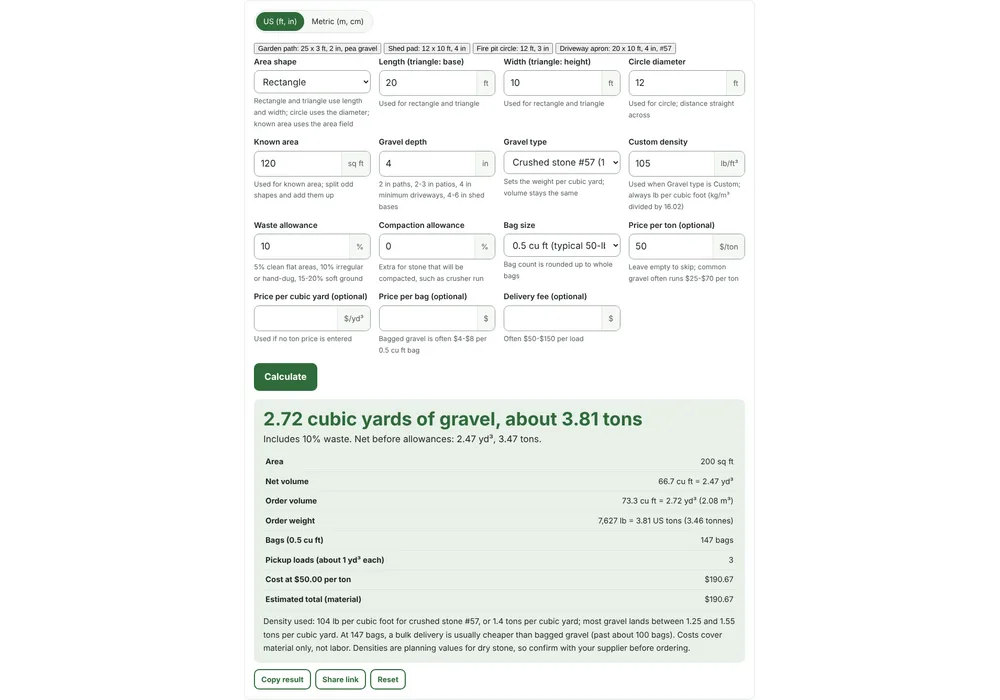
Worked example: a driveway apron 20 ft by 10 ft, 4 inches deep, crushed stone #57 at 104 lb per cubic foot, 10% waste, no compaction, $50 per ton and 0.5 cu ft bags. The tool shows 200 sq ft, a net 66.7 cu ft (2.47 yd³, 3.47 tons) and an order of 73.3 cu ft, 2.72 cubic yards, 7,627 lb or 3.81 tons.
The same run gives a bag count of 147, 3 pickup loads and $190.67 at $50.00 per ton. Published versions of this example quote the net weight as 6,930 pounds and round the order to 3 cubic yards, about 4.2 tons; the calculator itself does not round to whole yards.
Metric input works the same way. A path 5 m long, 1 m wide and 15 cm deep holds 0.75 m³, which the default stone turns into 1.26 tonnes; spread 1 tonne over that same path and it lands about 12 cm deep.
Call it a gravel estimator or an aggregate calculator; either way the tool answers one question for any excavation, which is how much stone fills it. Treat this calculator's order line as the figure to take to the yard, then confirm it with the seller.
How the Gravel Calculator calculates your result
The Gravel Calculator uses the standard volume formula, area times depth, and then turns that volume into cubic yards and weight with a published density for the stone you choose.
Area A comes first, in square feet. A rectangle is length x width. A circle is pi x r squared, where r is half the diameter, so a 12-foot circle, with its 6-foot radius, covers about 113 square feet. A triangle is base x its height / 2, and a known area is used as typed.
Volume V = A x D, where D is the depth in feet (inches / 12). The result is in cubic feet; to reach cubic yards, divide by 27. The order volume is V x (1 + waste / 100) x (1 + compaction / 100).
To get weight, multiply the volume in cubic feet by the density in lb per cubic foot, then divide pounds by 2,000 for US tons or multiply pounds by 0.4536 / 1,000 for tonnes. Bags are order cubic feet / bag size, rounded up to a whole bag.
Cost follows one rule: material cost = quantity x price, using ordered tons x price per ton or ordered cubic yards x price per yard, plus any delivery fee you enter. Labor is not part of the estimate. In metric mode the tool takes meters and centimeters and runs the conversion of units internally. The default density, 1,680 kg per m³, equals 105 lbs per cubic foot. The stones in the tool use these figures:
| Gravel type in the tool | Pounds per cubic foot | Pounds per cubic yard | Tons per cubic yard |
|---|---|---|---|
| 3/4-inch gravel or crushed stone (default) | 105 lb | 2,835 lb | 1.42 |
| Pea gravel | 100 lb | 2,700 lb | 1.35 |
| Crushed stone #57 | 104 lb | 2,808 lb (listed as about 2,800) | 1.40 |
| Limestone | 104 lb | 2,808 lb | 1.40 |
| Crusher run | 110 lb | 2,970 lb | 1.49 |
| Decomposed granite | 110 lb | 2,970 lb | 1.49 (listed as about 1.5) |
| River rock | 95 lb | 2,565 lb | 1.28 |
| Lava rock | 45 lb | 1,215 lb | 0.61 (listed as about 0.6) |
Crusher run at 110 lb per cubic foot comes to 2,970 pounds per cubic yard, and river rock at 95 lb comes to 2,565 pounds. All of these are planning defaults for dry stone, not lab results.
Published answers for one 10 x 10 ft area at 2 inches show why the density has to be named. The volume is always 0.617 cubic yards, often rounded to 0.62 cubic yards.
At 2,831.73 lb per yard the stone weighs about 1,748 lb, a result printed as 0.794 tons that only holds in metric tonnes. A rounded quick answer quotes about 0.85 tons, and the 105 lb default here gives 0.875 US tons. To convert between them, multiply by the density and note which ton is meant.
How do you turn area and depth into a gravel volume?
Gravel volume is the bed's surface times its depth, both in feet, giving cubic feet; that number divided by 27 is cubic yards, since one cubic yard holds 27 cubic feet.
A rectangle needs only length and width, while a circle needs just its diameter, and a bed that is not rectangular can be split into simpler pieces or entered as a measured area. Whatever the shape, measure the excavation area where the stone will sit, so a round bed with sloped sides is measured across its floor.
Depth causes most mistakes: two inches is 0.167 ft and four inches is 0.333 ft, and typing 2 instead of 0.167 into a feet-based formula inflates the order twelve times.
Two quick runs: a 25 x 3 ft path at 2 inches covers 75 sq ft; times 0.167 ft that is 12.5 cu ft, or 0.46 cubic yards. A 10 ft by 12 ft shed pad at 4 inches covers 120 sq ft; times 0.333 ft that is 40 cu ft, or 1.48 cubic yards.
Which gravel types are there, and how do they differ?
Gravel types differ by particle size, by whether the stones are rounded or crushed, and by the rock they are made of, and those three traits decide where each type works.
Rounded pea gravel (1/4 to 3/8 inch) is comfortable underfoot but rolls under load. Angular stone such as #57 locks together and drains fast, the usual fill for a French drain trench or a raised-bed drainage layer; a 4 x 8 ft bed at 3 inches takes 0.30 cubic yards. Cobbles of 2 to 6 inches make decorative ground cover, and a 15 x 2 ft dry creek bed of them at 4 inches takes 0.37.
Geologists name sizes precisely. On the Udden-Wentworth scale, granular gravel spans 0.079 to 0.157 in and pebble gravel runs from there to about 2.5 in. ISO 14688-1:2002 splits gravel into fine (2.0 to 6.3 mm), medium (6.3 to 20 mm) and coarse gravel (20 to 63 mm), so a 44 mm stone is pebble gravel on one scale and coarse on the other. Shape and size, plus moisture, explain why equal volumes can differ in weight.
What makes one cubic yard of gravel heavier than another?
A cubic yard of gravel gets heavier as its density rises, and density depends largely on the stone type, the mix of sizes and the water it holds, which is why published tables put one yard of gravel anywhere from about 2,400 to 3,400 lb (1.2 to 1.7 tons). The tool's 105 lb default works out to 2,835 lb, or 1.42 tons, inside that span.
By context, one source gives 2,500 to 3,100 pounds for gravel, with the rock, its particle sizes and its water content setting the figure.
Named landscape stones such as pea gravel, #57 and crusher run fall between 1.25 and 1.55 tons for each cubic yard, and wet sand sits higher at 1.5 to 1.7 tons a yard.
The spread matters because bulk sellers price big orders by weight. To weigh an order before it arrives, simply multiply cubic yards by the weight per yard. To turn tons of gravel back into yards, multiply by 0.714, the inverse of 1.4 tons per yard; at that rate 2 tons equal about 1.43 cubic yards.
On a larger job the tonnage gap is real money: a 10 x 10 ft area dug 1 ft deep holds 3.7 cu yds, which is 6.3 tons at 1.7 tons per yard, over a ton more than at 1.4.
How far does a cubic yard of gravel spread at different depths?
A cubic yard of gravel spreads over about 324 square feet at a 1-inch depth, and the covered area shrinks in step as the layer thickens, so the same yard covers half as many square feet at 2 inches and a quarter at 4 inches.
Tons tell a slightly different story because weight depends on the stone. Coverage per ton at 2 inches deep is approximately 110 to 120 square feet for gravel weighing 2,700 to 2,900 lb per yard. The round rule of 100 square feet per ton of gravel at 2 inches describes dense crushed material.
A per-ton figure hides a size effect too: one ton fills only 0.59 to 0.71 cubic yards, and smaller-sized gravel stretches farther than coarse stone.
Light stone flips the math. Lava rock at about 0.6 tons per cubic yard spreads to roughly 265 square feet per ton at 2 inches, which is why it works as a long-lasting stand-in for organic mulch around drought-tolerant plants.
How much extra gravel should you add for waste and compaction?
A 5% margin covers clean, flat, measured areas, rougher work calls for 10%, and a separate compaction allowance applies if the stone will be rolled or tamped. The bands look like this:
- 5%: formed edges, level subgrade and measured areas with no guesswork.
- 10%: irregular borders, a first-time DIY job or trenches that are hand-dug; the Gravel Calculator uses 10% by default.
- Compaction: a separate percentage for stone that will be plate-tamped, entered in its own field so the two allowances stay visible.
Yes, the margin earns its keep. Gravel settles after it is dumped and compacts under feet and tires, a little is lost to spillage at the drop point, and uneven ground often sits lower than it looks. Many guides simply say to order about 10% extra, and that default suits most backyard sites.
Ask the material supplier how its stone behaves once laid; a little extra gravel usually costs less than a second trip, and spare tons can be spread thin.
What depth does each gravel project call for?
Gravel depth follows the job: about 2 inches for walkways and a decorative layer, 2-3 inches for patios, 4 inches minimum for driveways, while a load-bearing base takes six to twelve inches.
A range of 2-4 inches is a workable baseline for most light projects, and a drainage bed used as a drainage base or a greenhouse pad moves into the base range of 4 to 6 inches. Doubling depth doubles the order, so the depth figure deserves more care than the length.
The Gravel Calculator's quick preset buttons load four common jobs, and each preset can be edited. A driveway surface at 4 inches rarely stands alone. It rides on a compacted base, and a thick base goes down in lifts rather than in one dump, with each layer compacted before the next one is spread. The finished gravel layer is the sum of those lifts.
How much gravel do common backyard projects take?
Most backyard gravel projects take between a small fraction of a cubic yard and about 2.5 cubic yards, from a planter base that fits in a few bags to a shed foundation that needs a delivery. The table uses the tool's default densities; cubic feet and tons are before waste, bags include a 10% allowance.
| Project | Size and depth | Gravel type | Cubic feet | Tons | 0.5 cu ft bags with 10% |
|---|---|---|---|---|---|
| Landscape gravel path | 40 x 4 ft, 2 in | 3/4-inch gravel | 26.7 | 1.40 | 59 |
| Patio | 12 x 14 ft, 3 in | Pea gravel | 42.0 | 2.10 | 93 |
| Shed foundation (8 x 10 ft shed) | 10 x 12 ft, 6 in | 3/4-inch gravel | 60.0 | 3.15 | 132 |
| Greenhouse base | 10 x 14 ft, 4 in | Crushed stone #57 | 46.7 | 2.43 | 103 |
| Fire pit surround | 16 ft circle, 3 in | River rock | 50.3 | 2.39 | 111 |
| Planter base | 3 x 6 ft, 2 in | 3/4-inch gravel | 3.0 | 0.16 | 7 |
The shed row follows the rule that a pad should run 12 inches larger than the shed on all sides, so an 8 x 10 ft shed sits on a 10 x 12 ft pad. A 4-6 inch bed of compacted stone is the normal range, and the table uses the deep end. Even with the 10% waste allowance added, a garden path of that size stays under two cubic yards.
Landscaping work that is mostly decoration or accent, such as river rock borders, uses less stone than a base, yet round shapes add up: the 16 ft fire pit circle needs more rock than the 12 x 14 ft patio. At the far end, a cuboidal excavation 6 yd by 3 yd (18 yd²) and 2 yd deep holds 36 yd³, about 51 tons of 3/4-inch gravel.
Before digging any bed or pad, call 811 so buried utility lines get marked, check local rules for driveways and shed pads, and move heavy bags with a cart or a helper.
Should you buy bagged gravel or a bulk delivery?
Bags make sense for a small amount of stone, roughly under half a cubic yard, while anything near a full cubic yard or more is better bought loose and delivered.
Hardware stores sell gravel by the bag, and the common bag size is 0.5 cubic feet, which is what a 50-pound bag usually holds. One cubic yard therefore equals 54 bags. To count bags, take the cubic feet after waste, divide them by the bag volume and round to the next whole bag.
The 20 x 10 ft apron from the worked example shows how fast the count climbs. 200 sq ft at 4 inches is 66.7 cubic feet, and with 10% waste it needs 147 bags, every bag lifted, opened and spread by hand.
A 10 x 10 ft patio at 2 inches is a fairer bag job: its 0.62 cubic yards equal 16.7 cubic feet, or 37 bags with the same allowance.
How much does gravel cost per ton, per yard and per load?
Common gravel costs about $35 to $50 per ton in one published range, so a full dump truck load of 13 to 25 tons could run anywhere from $455 to $1,250 before delivery is added.
An average pickup truck carries about 1 cubic yard, which at the tool's default density is about 1.42 tons, so one pickup load of 3/4-inch gravel comes to roughly $71 at $50 per ton. A dump truck only pays off once the order is several yards.
The tool's estimated cost line multiplies ordered tons by the price per ton you enter, or ordered cubic yards by the per-yard price, then adds any delivery fee. Ask each supplier for a written quote with the haul listed separately. On a one-yard order, a delivery charge of $50 to $150 can match or exceed the stone itself, so the cost per ton of a small job is mostly truck time.
Where does gravel come from, and what else is it used for?
Gravel comes from two sources, natural deposits whose stones were rounded by erosion and quarries where rock is crushed by machine, and that origin decides its shape and its uses beyond the yard, from concrete mixes to mining.
Bank gravel, also called bank run or river run, is dug beside rivers and streams and mixes large and small rock fragments with sand and clay. Stone shaped by erosion usually ends up rounder and smoother, so some of those stones are naturally weathered, but a bank run load is a mix of sizes and fines, not uniformly smooth stone. Crushed products are angular and most often start as limestone, dolomite or granite, and quartzite is another angular option.
Some deposits earn a different name. Pay gravel, also called pay dirt, is any gravel that holds rich concentrations of precious metals such as gold, and miners process it instead of spreading it.
Size and color matter for earthworks of every scale. Fragments range from fingernail-sized chips to stones about 4 inches across. Dark stone soaks up heat and dries faster after rain, and Jersey Shore gravel is picked for its yellow, gold-like tint.
Frequently asked questions
How many cubic yards does one ton of gravel fill?
One ton of gravel fills about 0.714 cubic yards at a typical 1.4 tons per yard, so 2 tons equal 1.428 cubic yards.
The exact amount depends on what a cubic yard of the stone weighs. Published figures for ordinary dry gravel put a yard at 2,400 lbs to 2,900 lbs (1,089 kg to 1,315 kg), about 1.2 to 1.45 tons, approaching one and a half tons at the top; the tool's 1.42-ton default sits inside that band. Gravel from 1/4 to 2 inches yields 0.59 to 0.71 cubic yards per ton.
Other materials shift the ratio. Wet sand gives 0.59 to 0.67 cu yd per ton and dry sand 0.67 to 0.77, while 2- to 6-inch rock gives 0.71 to 0.91. For a 3-ton quote of 3/4-inch gravel at the tool's 105 lb default, the order is about 2.12 cubic yards, using the 0.714 figure only as a rough check.
What does a cubic yard of gravel weigh?
Across published tables a cubic yard of gravel weighs about 1.2 to 1.7 tons; mixed 1/4- to 2-inch gravel, often moist, is listed at 1.4 to 1.7 tons (2,800 to 3,400 lbs), and the stone and its moisture decide where a load lands. The tool's 1.42-ton default sits at the low, dry end of that mixed-gravel range.
Other materials bracket that range. Rock 2 to 6 inches weighs 1.1 to 1.4 tons (2,200 to 2,800 lbs), pea gravel reaches 3,000 lbs, and riprap runs 1.7 to 2 tons, up to 4,000 lbs. Dry topsoil is lighter at 1-1.3 tons.
Water adds weight quickly. A loader bucket of wet limestone may run 8% heavier than an identical scoop from a dry pile, so a ton bought after a storm holds slightly less stone.
Flip the ratio and 1 ton fills roughly 0.7 cubic yards, a handy planning figure. The Gravel Calculator skips the rule of thumb and multiplies your volume by the density of the stone you pick.
How much area does 1 ton of gravel cover?
At a 2-inch depth, one ton of gravel covers about 115 sq ft for stone weighing 1.4 tons per cubic yard, and roughly half that area each time the depth doubles.
| Depth | Coverage per ton (at 1.4 tons per cubic yard) | Coverage per cubic yard |
|---|---|---|
| 1 inch | 230 sq ft | 324 sq ft |
| 2 in | 115 sq ft | 162 sq ft |
| 3 inches | 77 sq ft | 108 sq ft |
| 4 in | 58 sq ft | 81 sq ft |
| 6 inches | 38 sq ft | 54 sq ft |
| 8 inches | about 29 sq ft | 40 sq ft |
Heavier stone shrinks the per-ton column. At 2,700 to 2,900 lb per yard, a ton spreads 220 to 240 sq ft at 1 inch and 74 to 80 sq ft at 3 inches, and dense crushed stone comes closer to 100 square feet at 2 inches. Larger-sized gravel and heavy rock cover less ground per ton than fine stone, so the table is a starting point; the tool's coverage comes from your own density.
How many bags of gravel will a job take?
The number of bags equals the cubic feet you need, waste included, split by the size of one bag and then rounded up, so 1 cubic yard of 0.4 cu ft bags is 68 bags (27 / 0.4 = 67.5, then round up).
The same rule scales to any job. A 20 x 10 ft apron at 4 inches with 10% waste needs 73.3 cubic feet, which would take 184 bags of the 0.4 cu ft size, and the Gravel Calculator does that division for either bag size.
Bagged gravel from a garden center costs about $4 to $8 per 0.5 cu ft bag, which works out to $8 to $16 per cubic foot, well above bulk prices. Past about 100 bags, bulk delivery is cheaper even with the haul charge. Bags still win on small jobs and where a truck can't reach the spot, such as a fenced backyard planter.
Should I order extra gravel?
Ordering more than the measured amount is wise, because an overage of about one tenth covers voids, transport losses and stone that disappears into the subgrade.
The classic example: a job figured at 5.2 tons becomes 5.7 tons once the overage is added. Compacting is a separate effect, and tamped stone can lose up to 30% of its loose volume, so the same job may need as much as 7.4 tons once the volume lost to compaction is replaced.
Material and subgrade set the size of the additional gravel. Under compaction, crusher run can settle by as much as 15-20%, and the same 15-20% margin suits work on soft ground. A modest buffer costs little next to a half-finished bed waiting on a second load, and leftover stone keeps well for top-ups.
How thick should a gravel layer be?
A gravel surface should be about 2 inches for walkways, at least 4 inches on residential driveways, and 4 to 6 inches of compacted crushed stone under a shed, with more depth wherever heavy loads travel.
Depth is only half of the answer; how the stone goes down matters too. Thick base layers are spread in 2-3 inch lifts, and each of those lifts is compacted with a plate compactor or a hand tamper before the next goes on.
A driveway base of dense-graded material such as crusher run settles, so the loose layer you spread should start deeper than the finished layer you want. Enter that loose depth in the tool, or add a compaction percentage.
Under paths, landscape fabric blocks weeds and stops the stone sinking into the soil, which keeps a 2-inch path at 2 inches for longer.
How much does a truckload of gravel cost?
A full dump truck carrying 13 to 25 tons of gravel costs several hundred dollars to more than a thousand for the stone, plus a delivery fee of about $50 to $150 per load.
Smaller hauls work differently. A pickup truck takes about one cubic yard, and quarry pickups often carry fuel and environmental surcharges on top of the stone price. Many yards set a minimum order of 5 cubic yards for bulk pricing, so a 2-yard job may not get the bulk rate at all.
Pricing units also differ by seller. Landscape yards usually price by the yard, while stone yards and quarries tend to quote by the ton. Convert both offers to the same unit before comparing trucks, and the Gravel Calculator shows tons and cubic yards side by side for exactly that reason.
Is gravel ordered by the yard or by the ton?
Most bulk gravel is sold by weight in tons, though some sellers price landscaping material per cubic yard, especially on small orders, so convert every offer to one unit before comparing the totals.
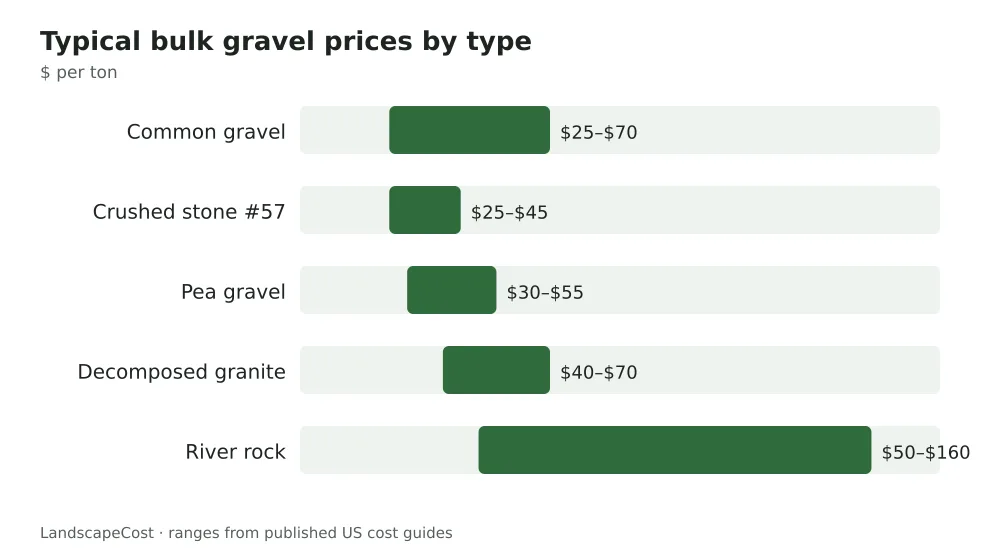
Prices line up once converted. Common gravel runs $25 to $70 per ton, or about $40 to $90 per cubic yard; pea gravel sits at $30 to $55 per ton and river rock at $50 to $160.
Supplier pricing also varies by place: the same #57 stone can differ by 30% between two yards 20 miles apart. To compare a price per ton with a per-yard price, multiply the ton price by the stone's tons per cubic yard. At the tool's 105 lb default, $50 per ton is about $71 per yard.
How do you calculate gravel for a circular area?
For a circular bed, square the radius, multiply by 3.1416, then multiply by the depth in feet and divide by 27 for cubic yards.
A fire pit surround 12 ft across at 3 inches deep holds 1.05 cubic yards, about 1.5 tons at 1.4 tons per yard, or just under 1.5 tons at the tool's 105 lb default.
In the Gravel Calculator, set the area shape to circle and enter the diameter; the tool finds the radius itself. A bed that is half rectangle and half circle can be split into two runs, or its total can be entered as a custom area with the Known area option. Each ton ordered for a round bed goes exactly as far as it would on a square bed of equal area, since only the area formula changes.
Does the gravel type change the calculation?
Yes, but for weight only: the volume stays the same whatever stone you choose, while the material density changes the tonnage.
One cubic yard of river rock weighs about 2,565 pounds, while crusher run reaches 2,970 pounds, so the same yard is about 0.2 tons heavier as crusher run.
Pick the gravel type from the dropdown list and the tool applies the selected material density; if a supplier gives an exact density, choose the custom option, the last entry in the list, and type it in. Sources disagree slightly, and pea gravel is listed at 96 lb to 100 lb per cubic foot depending on its gradation.
The calculation uses planning values for dry, loose aggregate, so a wet or compacted material of the same type weighs more. For a large order, ask the yard for its own density figure; supplier measurement sheets, where a yard publishes them, beat any planning default.