On this page
- How to use the Invisible Fence Cost Calculator
- How the Invisible Fence Cost Calculator calculates your result
- Which invisible fence system costs the least: underground, wireless or GPS?
- How does yard size change invisible fence cost per acre?
- What pushes an invisible dog fence quote up or down?
- Should you install an invisible fence yourself or hire a crew?
- What does invisible fence training cost?
- How do you keep an electric dog fence running in a power outage?
- What are the pros and cons of an invisible dog fence?
- Is an invisible fence cheaper than a physical fence?
- What does an invisible fence cost to own over three years?
- Is an invisible fence safe for dogs and cats?
- What should you check before paying for an invisible fence?
- Frequently asked questions
How much does an invisible fence cost?
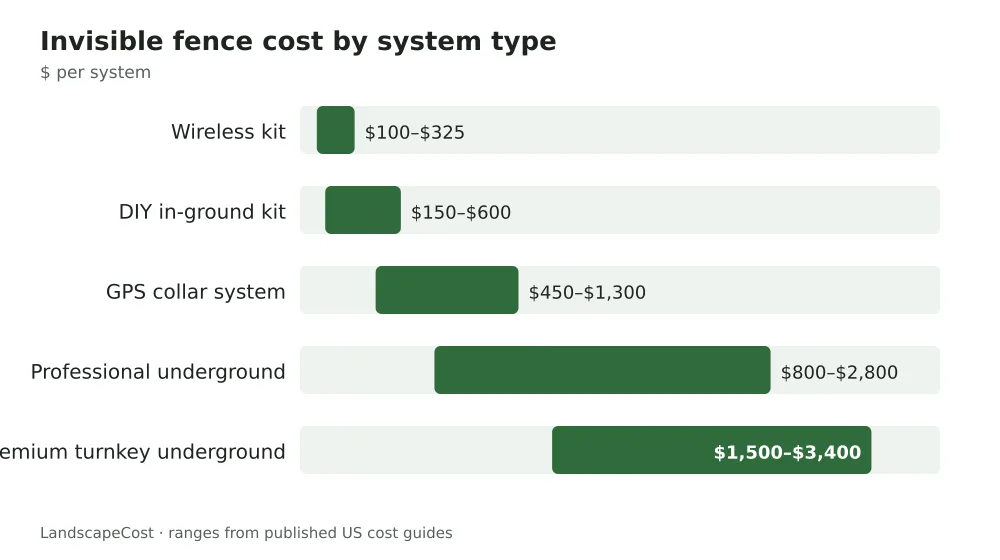
An invisible fence costs $800 to $2,800 for a professionally installed underground system, while a wireless kit runs $100 to $325 and a GPS collar system $450 to $1,300.
The inground model uses buried wires to define perimeters at $2 to $4 per foot. A plug-in wireless system broadcasts a circular boundary for yards of less than an acre; GPS units use satellite data, not an underground cable. Both are less reliable. You can compare similar projects in our Fence Calculators & Cost Guides collection.
One guide lists installation $100–$2,000, hardware cost at $100–$400 and batteries at $60–$90/yr. Another puts a plug-in wireless system at $100 to $600 and a premium turnkey underground job at $1,500 to $3,400; a third reports $200 to $2,500 for an acre of wire, where the average cost is $1,150.
Extra transmitters raise installation cost. A do-it-yourself kit is the lowest-cost pet-training system, teaching a dog to stay within its yard boundaries without building a fence. Planning more than one job? The pool fence cost calculator works the same way.
How to use the Invisible Fence Cost Calculator
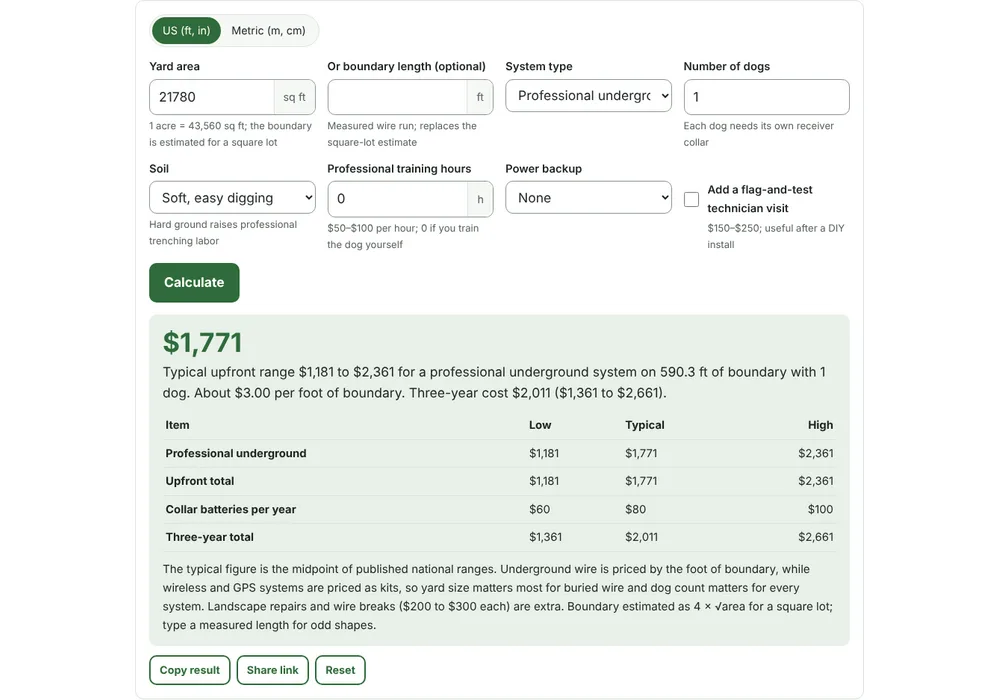
The Invisible Fence Cost Calculator turns yard size, system, dogs and add-ons into an upfront range, cost per foot and three-year total.
- Enter the yard area in square feet (1 acre is 43,560 square feet), or a measured boundary length.
- Pick the system: professional underground, DIY in-ground kit, wireless or GPS.
- Set the dogs (each additional collar is priced), soil and training hours.
- Tick the extras: a flag-and-test visit and a power backup such as a portable generator.
Worked example: a 21,780 sq ft yard (a 1/2 acre square lot), professional underground, one dog, soft soil, no training, flag visit or backup gives 590.3 ft of boundary, about $1,771 upfront (range $1,181 to $2,361), $3.00 per foot and about $2,011 over three years.
That fits a single dog on a suburban lot; an energetic dog deserves the high figure, and dog size matters less than the number of pets.
How the Invisible Fence Cost Calculator calculates your result
The Invisible Fence Cost Calculator multiplies boundary length by a per-foot rate for an underground system and adds kit, collar, soil, training, testing and backup costs.
For square lots, the perimeter formula is P = 4 × √A: the square root of 43,560 is about 209 feet, so 1 acre needs 835 feet of wire.
| Lot size | Boundary | Professional at $2 to $4 per foot |
|---|---|---|
| 1/4 acre | 417 ft | $835 to $1,670 |
| 1/2 acre | 590 ft | $1,180 to $2,360 |
| 2 acres | 1,181 feet | $2,360 to $4,725 |
| 5 acres | 1,867 ft | $3,735 to $7,470 |
Upfront = system + (dogs − 1) × extra collar + soil + flag visit + training hours × rate + backup. Defaults: $2 | $3 | $4 per foot for professional wire; $150 | $375 | $600 plus $30 | $40 | $50 per 500-ft spool for DIY; $100 | $212.50 | $325 wireless; $450 | $875 | $1,300 per dog GPS; $50 | $100 | $150 per extra collar. Three-year = upfront + 3 × collars × $60 | $80 | $100 batteries. Typical is the midpoint.
Which invisible fence system costs the least: underground, wireless or GPS?
A wireless fence is the cheapest invisible fence system at $100 to $325, a GPS collar costs $450 to $1,300, and a professionally installed underground system costs the most at $800 to $2,800.
| System | Typical cost | Who installs | Boundary |
|---|---|---|---|
| Wireless transmitter | $100 to $325 | Owner; it plugs in | Circle around the base |
| DIY in-ground kit | $150 to $600 | Owner, 4 to 8 hours | Any shape |
| GPS collar | $450 to $1,300 | Owner, set in an app | Virtual line |
| Standard pro underground | $800 to $2,800 | Installer | Any shape, trenched |
Prices span a wide band. A DIY wireless kit can start at $150, while a professionally trenched job reaches $3,400, over 20 times as much. GPS-based fences fit large, open ground where trenching would be slow.
The cheapest box is not always the cheapest result: a wireless circle can spill onto a neighbor's lot and miss a corner, and a DIY kit needs the owner to bury the wire along a planned path.
How does yard size change invisible fence cost per acre?
An invisible fence costs about $1,600 to $2,000 per acre for a buried system, because one acre takes roughly 850 to 900 linear feet of wire on a rectangular yard, and cost per acre falls as land grows.
One acreage chart lists 2 acres at 1,200–1,300 ft for $2,200–$2,800, 5 acres at 1,900–2,000 ft for $3,300–$4,200 and 10 acres at 2,650–2,800 ft for $4,600–$6,000, so the calculator runs high past 2 acres.
Larger yards need extra boundary wire at $30 to $50 per 500 feet, and longer distances call for more expensive transmitters that push the radio signal farther; a second transmitter for multiple zones runs $100 to $500. On extra-large yards, GPS can undercut trenching.
Shape matters as well, since a narrow lot has more edge than a square lot of the same size.
What pushes an invisible dog fence quote up or down?
Soil type, boundary length, the number of dogs and the install method push an invisible dog fence quote up or down.
A boxed kit for $150 to $600 bundles a spool of wire, boundary flags, a transmitter and one receiver collar. A crew with a powered trencher lays wire 3 to 6 inches deep uniformly, and a turnkey install bundles hardware, setup and training sessions into one price.
Installation companies that include training sessions charge about $500 on average, and remedial training runs $200 to $500 priced per dog, not per household. Owners who prefer additional DIY dog training pay only in time.
A DIYer can book a flag-and-test technician visit at $150 to $250 to tune the boundary, since technician fees are separate, and installers report calls from owners who later paid to fix their initial efforts. Measuring yard edges before calling installers makes quotes comparable, and terrain and layout set the labor.
Should you install an invisible fence yourself or hire a crew?
Installing an invisible fence yourself costs $150 to $600 for a kit, while hiring a crew costs $800 to $2,800 for a standard job, so DIY saves most of the bill if your ground is easy to trench.
Soil and terrain decide the difficulty. Cable slides into soft soil, but clay soil and rocky ground often bill twice as much for labor, and a steep grade, tree roots, concrete or asphalt crossings and mature landscaping all slow the trench.
Labor alone runs $800 to $1,200. An owner spends 4 to 8 hours on a typical lot, while a crew spends 1 to 3 days on site, typical for a residential job.
Hire well: ask for licenses, insurance and 5+ years in business, compare 3 to 5 in-person estimates and skip the cheapest bid, which often brings low-quality work. Many companies offer financing, payment plans or discounts, including one for a rescue dog.
What does invisible fence training cost?
Invisible fence training costs nothing if you do it yourself and $30 to $80 per class with professional dog training, while bundled installer training averages about $500.
Training decides whether the money spent works. A dog can run through the line when the battery is dead, when the collar is not fitted correctly, when the equipment is faulty or when it is not properly trained, and a dog chasing a squirrel or frightened by thunder may cross even a well-run system.
A warning sound comes first, and the correction after it startles rather than hurts; if set properly, guides compare the mild sensation to the static discharge from touching a doorknob after walking on carpet. Puppies and cats can wear the system too, with settings adjusted to their size.
Hourly coaching fills gaps. Professional training sessions bill at $50 to $100 per hour, so a two-hour block costs $100 to $200, less than a wire break repair.
How do you keep an electric dog fence running in a power outage?
An electric dog fence keeps running in a power outage only when the transmitter has a battery backup or an outside power source, because the transmitter of a wired system is a box plugged in at the house.
Losing grid power switches the boundary off for every dog in the yard while the collar keeps working. Some transmitters include a battery backup, which is worth checking before you buy, and a portable source covers a longer power cut.
Winter brings a related problem. Wire buried near the surface can lose signal if the ground freezes around it, and an extra-tall pile of snow can obstruct the signal, though most systems typically work through winter.
Wireless bases need wall power as well, while GPS collars run on their own batteries. The cheapest backup plan is a household rule: keep dogs indoors while the power is out, and test the collar when it returns.
What are the pros and cons of an invisible dog fence?
Buried or wireless, an invisible dog fence costs far less than a fence and keeps views open, but it does not keep other animals out and only contains a trained dog wearing a charged collar.
On a 1-acre lot with 835 ft of boundary, chain link at $15 to $30 per foot costs $12,525 to $25,050, and a wood privacy fence at $25 to $60 costs $20,875 to $50,100.
| Fence type | Installed cost per linear foot |
|---|---|
| Chain-link fence | $10 to $40 |
| Wood fence | $20 to $50 |
| Vinyl fence | $30 to $60 |
| Aluminum fence | $25 to $75 |
| Metal fence | $20 to $85 |
| Wrought iron fence | $50 to $85 |
Chain link starts at $10 to $40 per linear foot in another national guide. One installer lists installed aluminum at $20 to $45 a foot and a 150-foot aluminum fence at $3,750 to $6,000.
The tradeoffs are real: regular battery maintenance, battery replacements and some anxious dogs.
Is an invisible fence cheaper than a physical fence?
An invisible fence is cheaper than a physical fence in almost every case, because buried wire costs $2 to $4 per foot installed, while traditional fences cost $15 to $60 per linear foot installed.
On a small 150 foot yard, a fence still costs $2,000 to $4,500 more. Affordability is why homeowners pick wire, and the system is quicker to install, highly customizable, pet-safe with adjustable settings and leaves full views. A dog is unable to dig underneath it, and the wire follows hills, trees and ponds.
The savings buy less protection. A physical fence can keep others out, but the collar only works on your dog, so a coyote, a loose dog or a child can walk in. Escape stays possible, some dogs show pet anxiety, and the system is power-dependent.
Dog training is the hidden cost: a dog learns by walking a line of small flags, and invisible fences are cheaper than physical fences only after that.
What does an invisible fence cost to own over three years?
An invisible fence costs about $1,130 to $3,350 to own over three years for a wired standard professional underground system, mostly upfront, with $60 to $100 batteries per year for each collar after that.
The same comparison puts a DIY underground kit at $330 to $1,050 and a wireless system at $280 to $900.
Batteries are the steady expense: proprietary cells cost $15 to $25 and last 3 to 4 months, and one Georgia installer prices a collar receiver between $150 and $180 with replacement batteries at $15 to $20. A replacement collar costs $100 to $300.
A receiver upgrade to smart receivers costs $200 to $400 per collar, about $100 more than a standard model, and each additional collar adds $50 to $150. Most home insurance excludes the system because it is not part of the home's physical structure. Neither wired nor wireless systems carry a monthly fee, while some GPS products do.
Is an invisible fence safe for dogs and cats?
An invisible fence is typically safe for dogs, puppies and cats when the collar is fitted and adjusted correctly, and a calm, gradual training plan keeps it that way.
Temporary white flags mark the line while the dog learns. Owners run short sessions several times a day, and after about a week they start pulling flags. Traditional training and positive reinforcement each take 1-2 weeks, and self-exploration usually needs 2-3 weeks.
The training method matters more than the hardware. Positive reinforcement rewards the dog for turning back, while self-exploration lets the dog meet the warning on its own, which takes longer. A dog that chases or bolts may need a physical barrier instead.
Collar fit is the other half of safety. Check that the contact points touch skin and retest the correction level after any change in the dog's weight or coat.
What should you check before paying for an invisible fence?
Before paying for an invisible fence, check that local rules allow electric containment, that your dog suits it, and what the full upfront and running costs will be.
- Local rules: local laws and local ordinances can prohibit electric containment in some towns, so call the building or animal control office first.
- Your dog: some dogs develop behavioral issues around an electric boundary, so ask your vet before buying.
- Running costs: collar batteries need replacing every 3 to 4 months, and smart collars cost $200 to $400 each.
- Repairs: the loop wire lasts 20 to 30 years when nobody digs through it, but every wire break means a service call.
Ask installers to split hardware, labor and training into separate lines, since bundled training at around $500 can hide inside a turnkey price, and confirm which collar model, how many collars and what wire depth the price covers. Some GPS models charge a subscription, which changes the three-year cost.
Frequently asked questions
What does an invisible fence cost on average?
A complete invisible fence setup averages $800 to $3,000, including installation and training.
National prices stretch from a $150 DIY wireless kit to a $3,400 professionally trenched job, and GPS-based fences fall in between.
Typical bands are underground $800–$2,800, wireless $100–$325 and GPS $450–$1,300, or $2 to $7 per linear foot for wire in the widest national range.
Local cost figures from one St. Louis installer, updated July 2026, show about $1,600 installed and most jobs at $950 to $2,500. One local price list starts a kit at around $200, with each extra collar at $50 to $150. Another guide reports $200 to $2,500 for an acre of wire. The best-known brand posts no prices online and sends buyers to a local dealer for a quote.
How does an invisible fence work?
An invisible fence works as a containment system in which a collar receiver reacts to a boundary signal and teaches a dog where the yard ends.
The transmitter sends a signal through electrically charged wires buried around the outer edges of the yard, or broadcasts a radius for wireless models. When the dog nears the boundary, the receiver gives a warning tone and then a mild correction. With practice, the animal learns to stop short of the line.
Is an invisible fence worth the money?
Paying for an invisible fence makes sense for most dogs on most properties, as long as you budget past the install and then train the boundary. It is worth it most for a subdivision that bans fences, a big open property or a calm dog.
Ownership plans change the answer. Trenched wire becomes a permanent improvement tied to one specific property, so anyone who plans to rent or move within a few years pays for infrastructure left behind. HOA rules, historic districts and setback ordinances often block a physical fence but rarely block buried wire. For a dog that chases or bolts, a fence is worth the extra cost.
Must an invisible fence wire form a complete loop?
An invisible fence wire must form a closed circuit from the transmitter and back, or the boundary signal fails.
A run that only covers the back of a yard still returns to the transmitter, either around the house or along a doubled section of wire. A break in the loop gives an unreliable boundary and breaks consistent signal transmission. Plan the layout so the circuit closes, the signal reaches every edge and no gap lets the dog walk through.
Do invisible fences keep working in winter?
Cold weather rarely stops an invisible fence, and the systems keep running in most yards, unless the soil around the wire freezes or very tall snow blocks the signal.
A plow ridge or a drift along the line can weaken the field the collar reads, so clear heavy snow near the wire and test the collar after storms.
How deep is an invisible fence buried?
An invisible fence wire is buried a few inches down, with guides quoting 1 to 3 inches, 3 to 4 inches, 3 to 6 inches or anywhere from 3 to 24 inches depending on the installer and the ground.
Burial avoids tripping and lawnmower cuts, but shallow wire is more exposed to aeration and edging, while a deeper trench costs more labor in hard soil. Whatever the depth, mark the planned path on a sketch so future digging stays clear of it.
Will an invisible fence work during a power cut?
An invisible fence stops working when the electricity goes off unless a backup source keeps the transmitter on, because the system will go down with the grid.
A dog left outside during a power outage is a safety hazard. A solar charger or solar charging station costs $200 to $400, and most fences use less than 100 watts; solar panels run $2.53 to $3.15 per watt once installed. A backup generator or portable unit costs $500 to $2,500, and a surge protector adds $35 to $60.
Do invisible fences come with a monthly fee?
An invisible fence of the wired or wireless type carries no recurring charge, because you own the hardware outright.
GPS models are the exception to check. A few GPS collars need a paid plan for tracking or containment features, while others need no subscription; one major brand lists GPS DIY starting at $300. Some receivers link to mobile applications, and one such receiver averages $300 with batteries that last up to two years.
How long does professional installation take?
Professional invisible fence installation usually takes one to three days, depending on the size of the lot and the ground, because a professional crew can finish a residential job quickly.
A crew trenches, lays and connects the wire, flags the boundary and tests each collar. A suburban perimeter on soft ground sits at the short end, while rock, driveways and large lots stretch residential jobs. Training starts after the crew leaves.
What happens if the boundary wire breaks?
A broken boundary wire means the loop stops working until someone repairs it, and a repair costs $200 to $300 per incident.
A wire break repair usually follows digging, aeration or edging. A technician finds the gap, splices the boundary wire and retests the loop until each collar gives its warning and correctional signal at the line again. Trenching for a new run can also mean landscape repairs, with sod installation at $1 to $2 per square foot and tree removal at $400 to $1,200 per tree.
Records keep repairs cheap. A sketch of the loop helps any technician find a break, whether the yard has a professional run or a DIY underground kit, and a dated note of battery changes on each standard collar rules out a dead battery before anyone digs.