On this page
- How to use the Pool Fence Cost Calculator
- How the Pool Fence Cost Calculator calculates your result
- What does a pool fence cost per foot?
- How much fence does a pool need, and how tall must it be?
- What makes one pool fence installation cost more than another?
- What do pool fence gates, alarms and add-ons cost?
- Should you choose a removable or a permanent pool fence?
- What do pool fence codes and safety standards require?
- How can you save money on a pool fence?
- Does a pool fence affect insurance and liability?
- Frequently asked questions
How much does a pool fence cost?
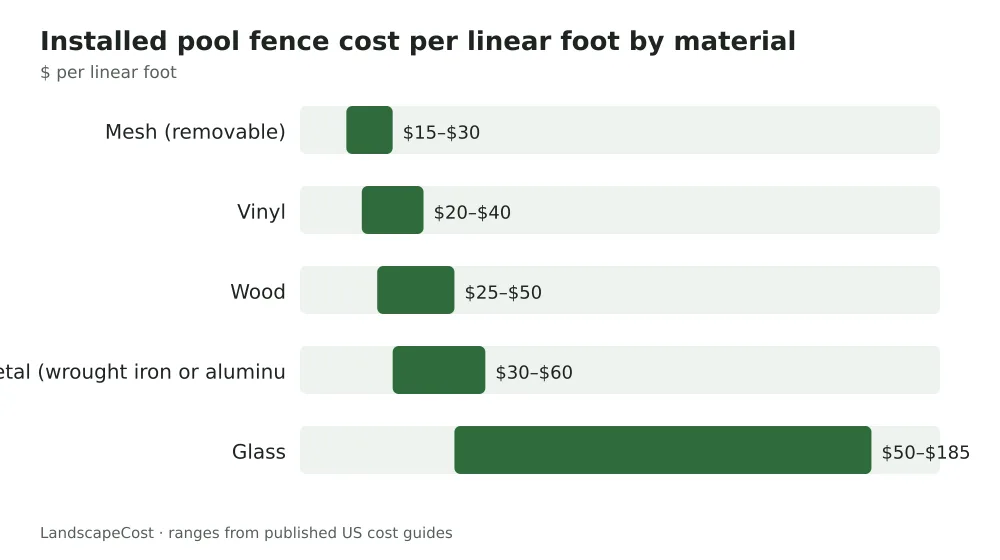
A pool fence costs about $15 to $65 per linear foot installed for mesh, vinyl, wood and metal, which puts a typical backyard pool at roughly $1,500 to $5,100, while tempered glass can reach $185 a foot.
One installer's guide puts a typical pool fence at $18–$38 per linear foot. A mesh pool fence starts near $15 a foot, a vinyl pool fence or a wood pool fence lands in the middle, and metal costs more. Plexiglass and tempered glass cost the most. You can compare similar projects in our Fence Calculators & Cost Guides collection.
Length turns the rate into a total. One mesh specialist prices 100 feet of mesh at $1,700–$3,500, and a temporary fence for a short-term need runs $1,000–$5,000. Mesh with installation spans $1,500–$5,000 in another guide.
Extras finish the price. Custom configurations and certain deck types add $1–$15 per linear foot, and a self-closing gate, alarm and permit sit on top. Planning more than one job? The fence calculator works the same way.
How to use the Pool Fence Cost Calculator
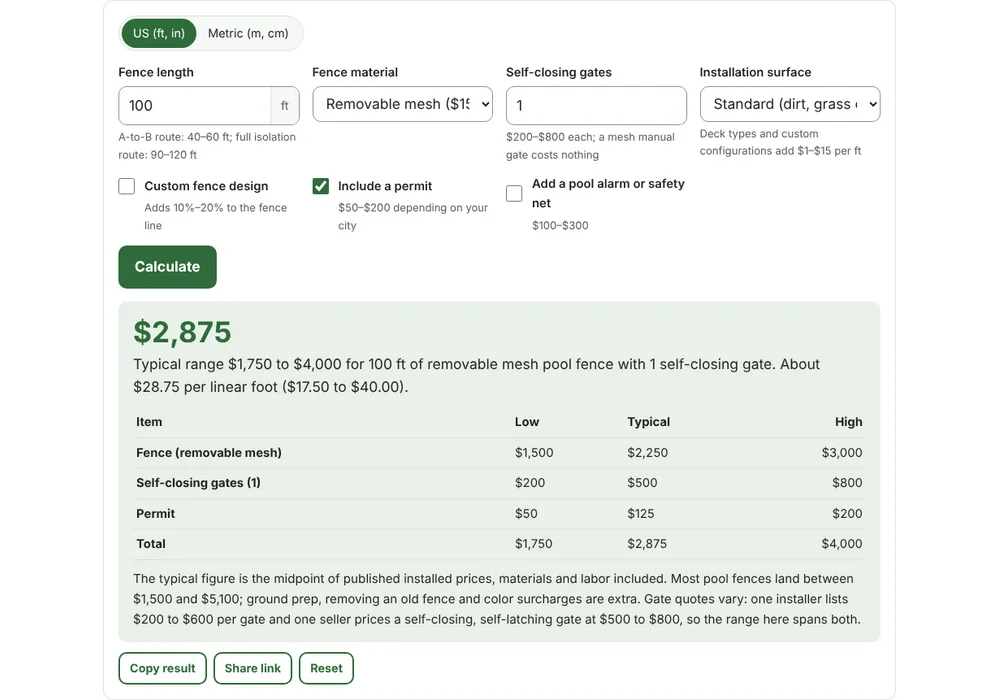
The Pool Fence Cost Calculator turns length, material, gates and add-ons into a low, typical and high price and a cost per foot.
- Measure the linear footage: a wall-tied route is shorter than an isolation pool fence circling the swimming pool.
- Choose the material: mesh, vinyl, wood, metal or glass.
- Enter the self-closing gates; a mesh fence can use a free manual gate.
- Pick the installation surface; tick custom design, permit and pool alarm if needed.
- Read the range and cost per foot.
Worked example: 100 ft of removable mesh, one self-closing gate and a permit on standard ground gives about $2,875 (range $1,750 to $4,000), or $28.75 per linear foot.
That sits inside the $1,500 to $5,100 average and the $2,000 to $5,000 before tax quoted for many mesh jobs; local markets, terrain, material choice and installation details move a real quote.
How the Pool Fence Cost Calculator calculates your result
The Pool Fence Cost Calculator multiplies fence length by a per-foot material rate, then adds surface, design, gate, permit and alarm lines.
| Item (per foot unless noted) | Low | Typical | High |
|---|---|---|---|
| Mesh | $15 | $22.50 | $30 |
| Vinyl | $20 | $30 | $40 |
| Wood | $25 | $37.50 | $50 |
| Metal (wrought iron or aluminum) | $30 | $45 | $60 |
| Glass | $50 | $117.50 | $185 |
| Deck, curves or custom angles | $1 | $8 | $15 |
| Self-closing gate, each | $200 | $500 | $800 |
| Permit, each | $50 | $125 | $200 |
| Pool alarm or safety net | $100 | $200 | $300 |
Total = L × rate + L × surface + design (10% to 20% of the fence line) + gates × price + permit + alarm, with L in feet (meters ÷ 0.3048). Typical is the midpoint; cost per foot = total ÷ L.
One installer lists mesh at $15 to $30 per linear foot and glass at $50 to $65; another guide puts glass between $100 and $185. Gates run $200 to $600 or $500–$800 at a seller, so the tool spans both.
What does a pool fence cost per foot?
A pool fence costs $15 to $30 per foot in mesh, $20 to $40 in vinyl, $25 to $50 in wood, $30 to $60 in metal and $50 to $185 in glass.
| Material | Cost per linear foot | Best fit |
|---|---|---|
| Mesh (removable) | $15–$30 | Seasonal use, renters |
| Vinyl | $20–$40 | Lowest-cost permanent fence |
| Wood | $25–$50 | Owners ready for intense upkeep |
| Metal | $30–$60 | Long-term safety |
| Glass | $50–$185 | Open views, highest upkeep |
Mesh stays the most affordable choice because the panels are lightweight and the posts sleeve into the deck. Permanent material options run $25–$65 a foot as a group, so mesh to permanent is the biggest price step.
Durability pushes the top of the table. Tempered glass and wrought iron are long-lasting and carry a higher pool fence cost per foot, so the most durable options suit owners who plan to stay. Style and local labor costs move the rate too.
How much fence does a pool need, and how tall must it be?
A typical pool needs 40–60 feet of fence for an A-to-B route that ties into existing structures, or 90–120 feet for an isolation route enclosing the pool, and the fence must stand at least 48 inches tall.
The A-to-B route uses the house or another wall as one side, which shortens the run and the bill. Either layout still needs a self-latching gate.
Height rules come from code. The ISPSC baseline calls for a minimum 48 inches, measured from the side faced away from the pool, and the gap under the fence should stay below 2 inches over grass or gravel and no more than 4 inches over solid concrete.
Uneven ground is where clearance gets hard. Slopes and steps can open a gap under a straight panel, so installers step the panels or add posts to keep the bottom edge within the limit.
What makes one pool fence installation cost more than another?
Material, site conditions, gates and the installer's own pricing make one pool fence installation cost more than another, even when the length is the same.
Material comes first. A wrought iron or tempered glass fence costs more than mesh or vinyl; avoid custom designs where a standard layout works, because custom work adds 10% to 20%.
Layout comes next. Route layout, fence height and number of gates are the cost factors one mesh installer names first, and each changes the final price. A pool deck also needs a core drill, which a lawn does not.
The installer sets the rest. A specialized pool fence company with trained and authorized staff often quotes differently from general fence contractors, and some list clear up-front pricing with flexible fence lengths. Booking in the off-season can lower labor costs, and using a wall as one side trims the run. Compare at least 3 quotes before signing.
What do pool fence gates, alarms and add-ons cost?
Pool fence gates and add-ons cost $200 to $800 per self-closing gate across sources, $100 to $300 for a pool alarm or safety net and $50 to $200 for a permit.
The gate range merges two lists: one installer prices gate add-ons at $200 to $600 and a seller prices a self-closing, self-latching gate at $500 to $800, so ask each installer to quote gates as their own line.
Code shapes the hardware. Gates must open outward, away from the water, and the release mechanism must sit at least 54 inches above the ground so small children cannot reach it. A key-lockable gate adds a second layer.
Added costs beyond the fence usually include ground prep, permit fees and alarms, which together add several hundred dollars to the total price.
Should you choose a removable or a permanent pool fence?
A removable pool fence costs less, at about $15 to $30 per foot for mesh, while a permanent fence in vinyl, wood, metal or glass costs more and needs less handling over the years.
Removable mesh suits seasonal use and renters. A manual pool gate is free: you unlatch a section, lift a pole, leave the mesh folded back and drop the pole in a spare layback hole. That gate relies on adults, so many owners choose self-closing pool gates instead.
Permanent fences suit long-term safety. A metal or glass enclosure never depends on someone putting it back, and maintenance runs from low for mesh to frequent cleaning for glass.
Climbability is the deciding safety point. Non-climbable designs and limited spacing between posts are standard on pool fences, while a picket fence with rails a child can easily climb defeats the barrier. Some mesh systems are approved as permanent fences by building codes.
What do pool fence codes and safety standards require?
Pool fence codes require a barrier at least 48 inches tall with small ground gaps and self-closing, self-latching gates, and local rules can add to that baseline.
Code usually wants fences 4 feet high, some municipalities require 5 feet, and safety guides suggest 4–6 feet. Mesh makers sell three different heights, 42, 48 and 60 inches, with 48 most popular, plus custom heights for pets.
The American Academy of Pediatrics, the National Drowning Prevention Alliance and the Consumer Product Safety Commission recommend self-closing, self-latching pool gates, which use hinges with tension to swing shut and a magnetic lock to catch. Pool safety regulations pair that with a non-climbable barrier.
Local government has the final word, so confirm local building codes before starting and keep proof of compliance. Insurance companies weigh safety standards when setting coverage, and a poorly installed fence can leave a responsible homeowner liable for accidents and injuries.
How can you save money on a pool fence?
You can save money on a pool fence by choosing mesh or vinyl, keeping the layout simple, booking in the off-season and using an existing wall or deck as one side.
Shorter runs save the most, because every foot dropped removes material and labor. Plain black mesh avoids the color surcharge some dealers add.
Many installers measure the linear footage on site and give an estimate at no cost, so collect 3 quotes. Each should list the fence, each gate, the surface work and the permit, since the contractor and the location both move the price.
Check quality too. Look for the ASTM standard, UV protection in every plastic part and cuts that are re-bordered after trimming. A cheap fence that fails inspection costs more than a sound one, and some mesh kits suit DIY installation with a hammer drill instead of a core drill.
Does a pool fence affect insurance and liability?
A pool fence affects insurance and liability, because insurers review the barrier when they price a policy and an owner can be held responsible when an unsafe fence lets a child reach the water.
Drowning ranks among the leading causes of unintended death in children ages 1 to 4, so a pool fence is treated as the primary physical barrier around a swimming pool and a safety essential rather than an optional extra.
A fence that blocks the line of sight to the water makes supervision harder, which favors see-through tensioned mesh or glass over solid panels.
Keep the permit, the inspection sign-off and the installer's invoice, since those records show the fence met the code on the day it was built.
Frequently asked questions
What is the cheapest pool fence per linear foot?
Removable mesh is the cheapest type of pool fence, with installed prices starting at about $15 per linear foot.
Removable fences in tensioned mesh are lightweight and offer zero footholds, so kids and pets cannot climb them. One mesh specialist quotes $17–$35 per linear foot and another $16–$30 per linear foot, with total installation of $1,500 to $3,500 for a typical job.
Does a pool fence need a permit?
Most towns require a permit before a pool fence goes in, so check with the building department before any work begins.
Permit fees usually run $50 to $200 depending on the city, and local building codes decide what the inspector checks. The building office checks height, gate hardware and ground clearance, so a plan that already meets the ISPSC baseline moves faster.
What added costs come on top of material and installation?
Pool fence projects often carry extra costs on top of the fence line, mainly gates, alarms, permits and site preparation.
Alarms, locks or self-closing pool gates can add $200–$500, one installer lists gate add-ons at $200 to $600 per gate with a self-locking feature (a seller quotes up to $800), an alarm or safety net costs $100 to $300, and a custom fence design adds 10% to 20%. Ground prep and removal of an existing fence also come before the new one goes in.
Which material makes the longest-lasting pool fence?
Wrought iron and tempered glass give the longest service life of common pool fence materials, though both cost more per foot than mesh or vinyl.
Durability comes with upkeep. Glass needs maintenance and cleaning, glass and metal fences need regular washing, and a wooden fence needs intense maintenance to stay sound. Removable mesh, by contrast, needs little upkeep but is the least permanent choice. Removable fences give flexibility and can be stored away, while permanent ones add stronger security and aesthetics.
Prices differ by guide: galvanized metal costs $2,600 and $3,500 per 100 feet or $23 to $49 a foot, vinyl or picket $15 to $39 a foot and $3,000 to $15,000 overall, and wood $12–$34 a foot and $2,000–$30,000 per job.
Can you install a pool fence yourself to save money?
You can install some pool fences yourself to save money, especially mesh kits, but a professional install is the safer way to meet the code.
A self-installed mesh fence avoids labor, yet the posts must be drilled at the right spacing and the gate set to close and latch every time. Fence contractors know the local rules, so compliance is easier to prove at inspection. If you hire a professional, choose one that is licensed and insured, with good reviews and a reputation in the water safety community.
Why does one pool fence cost more than another?
Height, gates, layout and the ground under the fence make one pool fence cost more than another, alongside the material.
A 4 ft or 5 ft fence differs in material, and each gate adds hundreds of dollars.
Site work adds labor: concrete work for footings on a garden or dirt yard, drilling into concrete pavers instead of soft dirt, and special panels for steps, stairs, pillars and elevation changes, each adding labor hours. Black is standard, while white, tan, brown, green or copper vein powder-coating carries a small surcharge. Slopes, steep yards and retaining walls need reinforcement poles, terminal posts and end posts, and the thickness of pole on premium mesh changes the price too.
How many feet of fencing does a typical pool need?
A typical pool needs 40–60 feet of fencing for an A-to-B route or 90–120 feet for an isolation route enclosing the pool.
The A-to-B route attaches to existing structures such as the house, so it is shorter but leaves the house doors as part of the barrier. The isolation route encircles the entire pool with its own self-closing gate. Measure your own layout before using the calculator, because a typical pool is only a starting point.